The arrival of the new chess king
I feel, at the start of 2013, that I am witnessing an incredible thing: the coming to maturity of the strongest chess player in the history of the game, in twenty two year old Norwegian, Magnus Carlsen.
I first met Magnus at the Turin Olympiad in 2006: in many ways, he was just a typical teenager, but when Norway played England, he defeated England's No 1, Mickey Adams, the first super-grandmaster he had beaten. That was a shocking and terrifying game for us: we knew Magnus was coming, but that was his arrival. Since then, he has become firmly established as World #1, and recently he exceeded Garry Kasparov's highest ever rating.
Still, there is rating inflation and until the last couple of months, I was unsure who I felt was the better of the two: Garry or Magnus; though to be fair, I should at least consider Bobby Fischer. I exclude him because I don't fully appreciate Bobby's games, since he gave up chess just as I was learning. With Garry, I grew up with him, witnessed all his fights with Karpov, and have studied his games throughout my adulthood, whereas my knowledge of Fischer is weaker, having for instance read his Sixty Memorable Games when I was a relative beginner.
But I now think Magnus has surpassed even Garry. And with his own style, the like of which I have not witnessed before. A lot of the time he does nothing, achieves nothing from the opening, but he does nothing so well, and somehow emerges with something, and then overpowers his opponents, time and again.
His game against Sergey Karjakin, who could well, being similar aged, be Magnus' rival for years to come, yesterday was superlatIve. Being a Sunday, I could have Playchess.com on, and dip into my study every so often, and look closely at the game from time to time.

Magnus has just played Qh1: the Queen having shuffled out to c4/b4, before going back to the first rank, and then unusually to the corner, h1. I wasn't sure whether he was trying to gain control of the h1-a8 diagonal, or swap queens off: in fact, it was the latter, an unusual way to exchange queens. As I saw it unfold, I wondered if he could get much advantage out of the two bishops: no not really; roughly equal, I thought. But I also recalled reading somewhere that one advantage of the two bishops is that pawns only come off the board, are never added to, and as pieces and pawns are exchanged, the position has to open up, so time and exchanges favour the bishop pair.
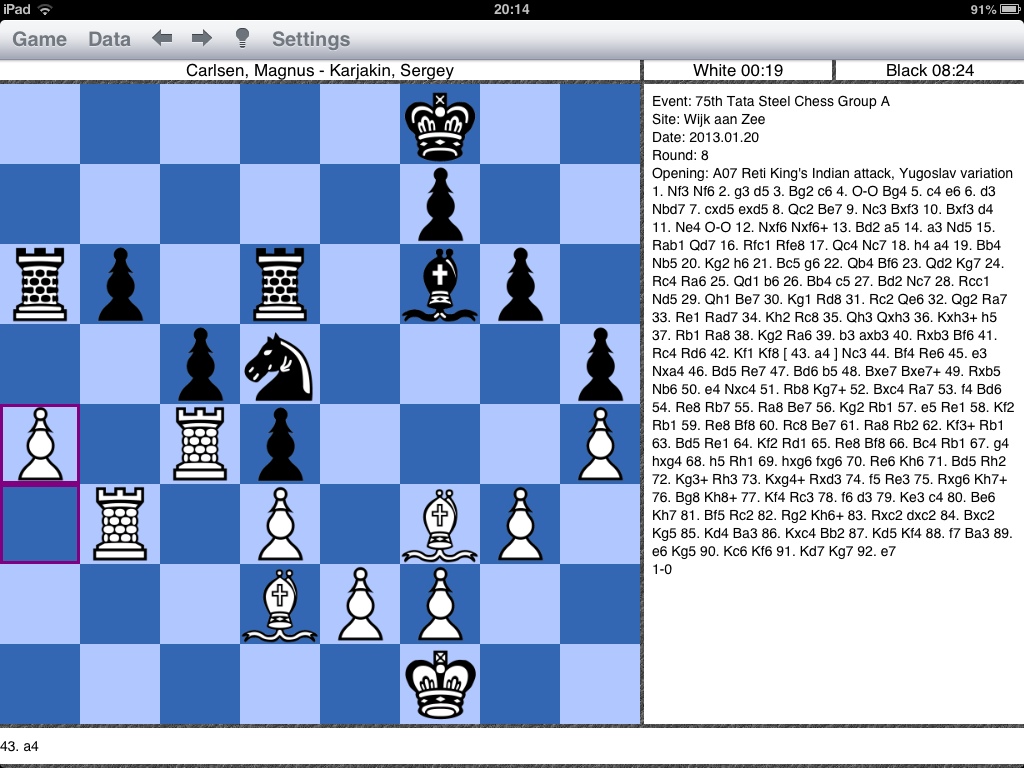
Here, Magnus has just played a4, having previously played b3, opening up the queenside. I, and I believe many GMs, would have been nervous, and instead settled for a draw, but not doing so is one feature of Magnus. Malcolm Pein tweeted yesterday (about this game) that we are witnessing the 21st century endgame virtuoso, and indeed we are. Another feature of his play is the reliance on 'little tactics'. I wouldn't have played a4, fearing Nc3, which Sergey played, but I didn't notice until the position came on the board why a subsequent Ra4 failed: the little tactic Rbc3! wins a piece, for if Ra1+, Rc3c1 is 1-0.
Then, when Sergey took with the N instead, putting it offside, further nuances emerged: the centralising Kf8 might have been a little mistake, although I would have played it, not realising that in some lines Bf4-d6 can pin the R, if the white square bishop has forced it to move to the e file. I think it is the relentlessness of it, with the continual appearance of reasons for not being able to do what you want to do, is part of the psychological pressure that Magnus creates.
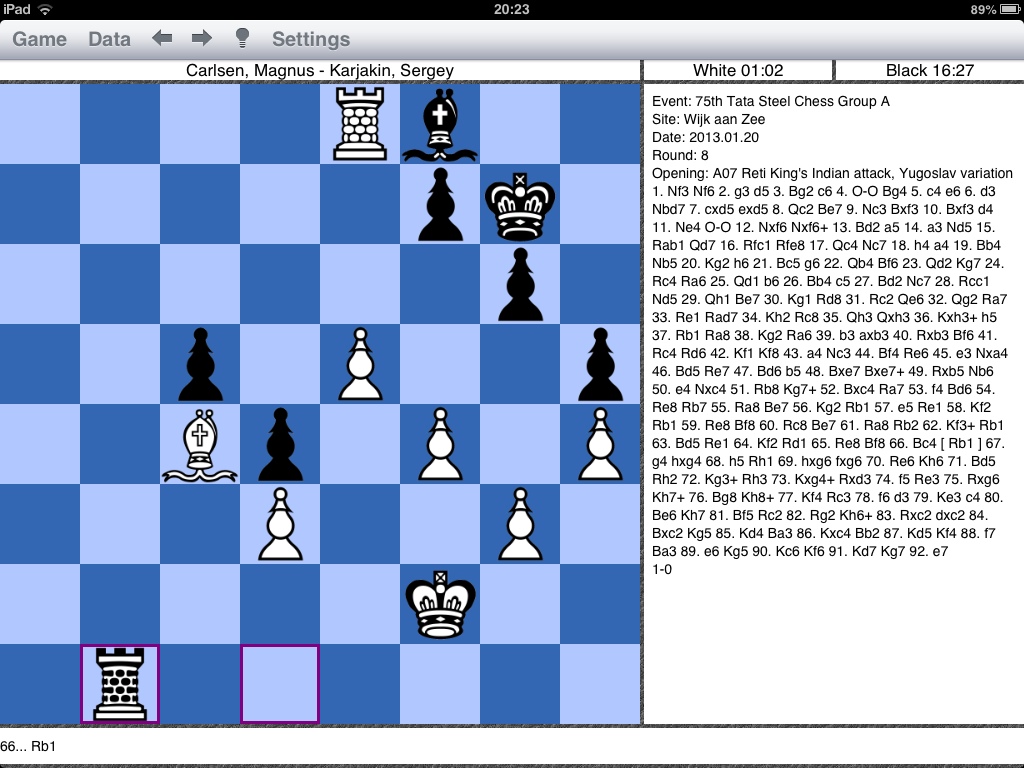
This position is also quiet but remarkable. It would be easy to think not much is happening, or not to spend much time on the position. But I can now see that white is a pawn up! Well maybe not by normal counting, but counting in the way that matters, he is: white's anchored Bc4 and Pd3 contain black's majority on the queenside, whilst white has a 4-3 majority on the king side. I wonder how early on Magnus could see this coming to pass? I wouldn't be too surprised if it was early as my first diagram. White's anchored bishop is of course stronger than black's, focussing on f7 and g8. And white's king is safer than black's, and, being centralised, will soon be employed in slowing down black's pawns.
Magnus was far ahead of Sergey on time by now: I think something like more than 50 min to less than 15 minute, and here he played g4!? hg h5, gambling that the opening up would give him mating threats. Subsequent analysis by commentators has shown that Sergey might still have been able to draw, by taking on h5, with many lines leading to perpetual check, because of the strength of the two passed pawns. But Sergey played cautiously, Rh1, and Magnus was exquisite, precise, perfect, in using a combination of mating threats to advance his pawns, finally simplifying into a bishop ending, two pawns up.
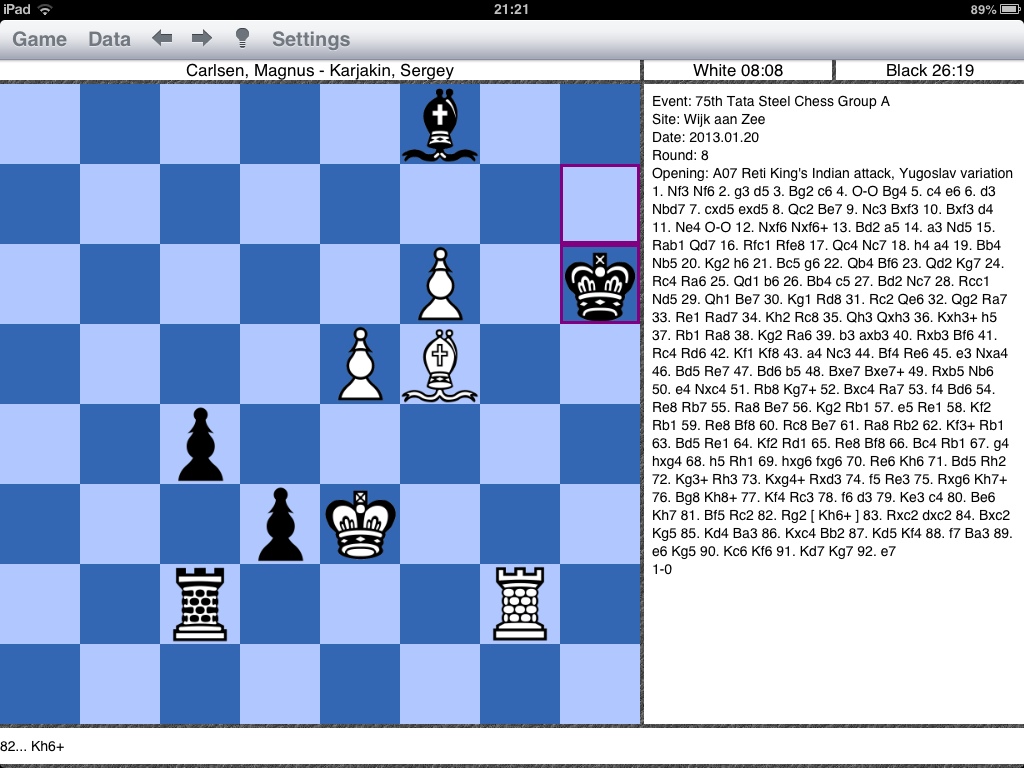
Here, having chosen this route rather than a more complex, but also winning path, Magnus exchange's the rooks, takes black's two pawns, and then wins: he moved at great pace in this last stage, no doubt having seen it all.
Overall, he seems to eschew theory, is happy just to get a playable middlegame, but somehow time and again gains a 'niggle' or a 'nibble'. He seems to know where to put all his pieces, and how to manoeuvre them to employ them to the maximum. And Sergey, here, seemed never to have a chance to try for an advantage.
Incredible.
There are several more rounds to go at Wijk aan Zee: Magnus has got quite a comfortable draw, largely playing the players presently towards the foot of the table, and this coupled with the awesome power he has shown in this and other recent games, makes him odds on to notch up another first. Personally, I expect him to win by a big margin, but we shall see: Vishy Anand, for one, has had a resurgence, and Fabiano Caruana is also playing impressively.
 Posted with Blogsy
 allanbeardsworth