Carlsen-Gelfand, Candidates Tournament
Today, I visited for the first time the Candidates Tournament being held in London. I got the lunchtime train from Stockport, arriving in London mid afternoon, and in the taxi to the venue saw the opening moves of the round, including the rapid draw in Radjabov-Svidler, a Gruenfeld which I suspect is pretty much all theory; and my taxi analysis saw that Grischuk-Kramnik was a very typical Berlin Ruy Lopez, the line of which Kramnik is the master, and Aronian-Ivanchuk was, of all things, as Vassily is a man for all openings, a Budapest defence.
Vladimir won the Berlin ending after a horrible miscalculation by Alexander, who simplified from a drawn bishop v knight into a lost pawn ending: time trouble; and Vassily lost his fourth game of the tournament on time; but to me, the game of the round, was Magnus's victory over Boris Gelfand.
This was the position when I arrived at the venue.
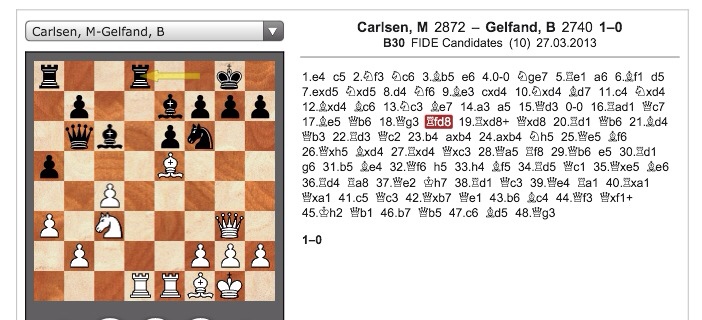
Not for the first time with Magnus's game, I totally mis evaluated this position. At first, I was worried for white, thinking he had no attack on the king side, and that the b pawn was weak, and Boris would have the advantage if all the rooks were to come off. Magnus thought for a good while in this position, and during this time I started to better appreciate the position. The pressure on g7 is real, and there are sometimes Nd5 tictacs to watch out for, so I eventually settled my appraisal as the position being equal, and if I were asked to take one side, I would take black. Wrong.
Whilst I was surprised that Boris took the Rd8 with his Q, thereby keeping a pair of rooks on, I was equally surprised with Magnus's rook lift Rd3, after which I started to appreciate the possibilities in white's position: to make something from 'nothing', and to keep 'something' as the position is simplified, is Magnus's genius.
I am really in awe as to how Magnus plays what I think are bold moves, like 23 b4, which turn out to be obvious once he has played them, and which rely on little tactics, here being the requirement for the Be7 to protect the Nf6: and also Magnus's ability to calculate through the complications after 24…Nh5. Played through rapidly, his games might not impress, might appear simple, but are anything but.
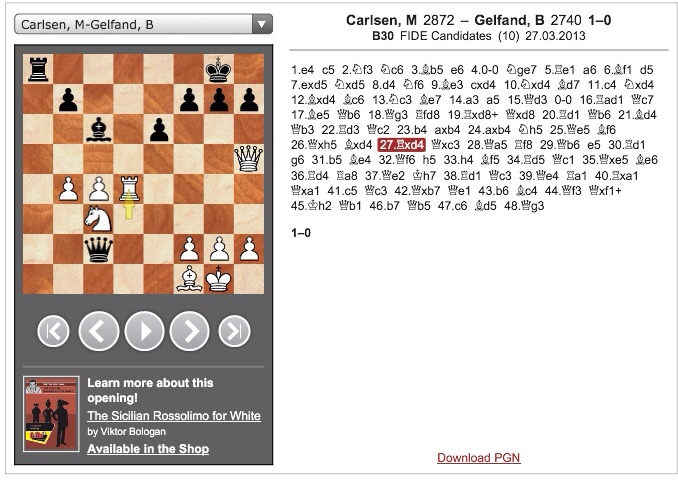
Lawrence Trent, in the commentary room, was impressed and extolled Boris's …e5, with Nigel Short explaining that Boris had chosen it instead of suffering: sacrificing a pawn to free his rook, and put pressure on white's back rank. It was interesting to note that both Nigel and Jon Speelman, who was standing next to me at this juncture, were calmer than Lawrence, with Jon just thinking, true to his style, that 'the game goes on', a phrase I learnt to appreciate from Jon when he was in the England team I captained in 2004: Jon taught me, if teaching was needed, that chess is still a game between two players.
Magnus managed to keep Boris's activity under control and soon we had yet another defeat by Magnus of a world class player. I should add that (I) I didn't look much at the game, since Aronian-Ivanchuk was far more exciting, especially given Vassily's horrendous time trouble (II) I am blogging before any of the sites I follow have any analysis up (I am trying to record my first impressions) (III) Nigel said he didn't like Qf6, thinking the Q was well placed on b6 (iv) Lawrence was saying that 41 Qe7 looked winning…. when I have more time, I intend to look into the last two points further.
Until then, with the first three seeds having each won today, all impressively, there is still all to play for, with four more rounds, with Magnus in front.
If I were to sum up what I feel watching these elite players, I would say: humbling; whilst I can beat a GM I an informal game (see my separate blog posted earlier) the way Magnus, Levon and Vladimir play is on a different planet.
 Posted with Blogsy
 allanbeardsworth