Kramnik-Svidler ending: 25…Kg6!?
Some positions just fascinate me: in (almost) Vera Lynn's words, I don't know how, don't why, but they do.
Take the following, the position being set out on my favourite, treasured, Russian travelling chess set, which is appropriate because the game was played between two Russians.
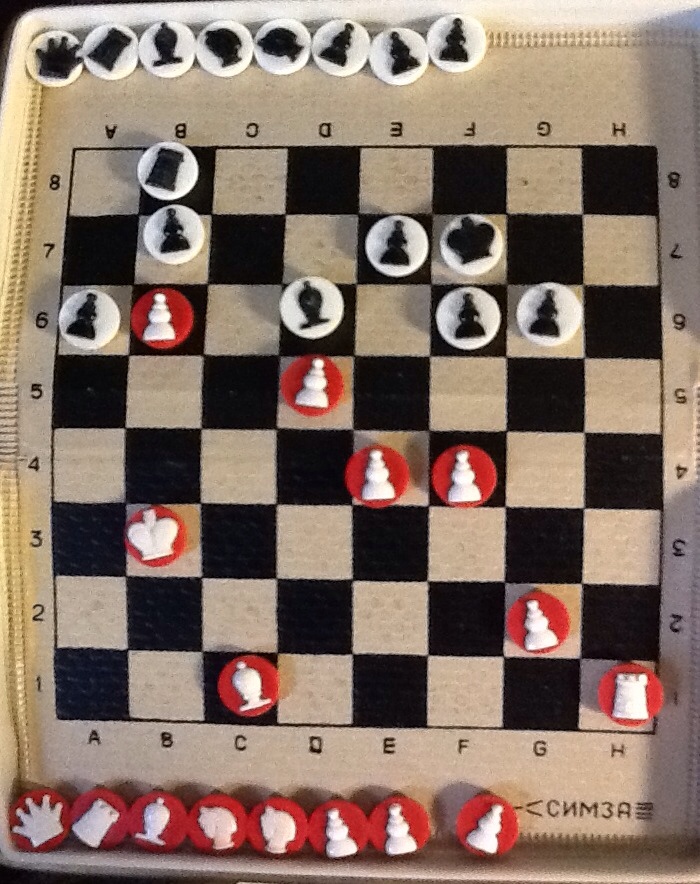
(Credit where it is due: photo cropped and rotated using PS Express, a free iPad app: I don't do any significant photo editing, unlike my professional photographer brother, so don't need the paid Photoshop app, but the Express version is great for what I need).
Why did Peter play 25…Kg6? The above position is after 25…hg instead. I dipped into this game on and off when it was happening, and throughout the ending I knew Vladimir was pushing, but I never felt he had much, and, truth be told, was scared that at any time the b6 pawn would fall, and white's game would soon be in tatters.
The Chessbase.com and Chessvibes.com analyses passed over move 25, as did Malcolm Pein's Telegraph article.
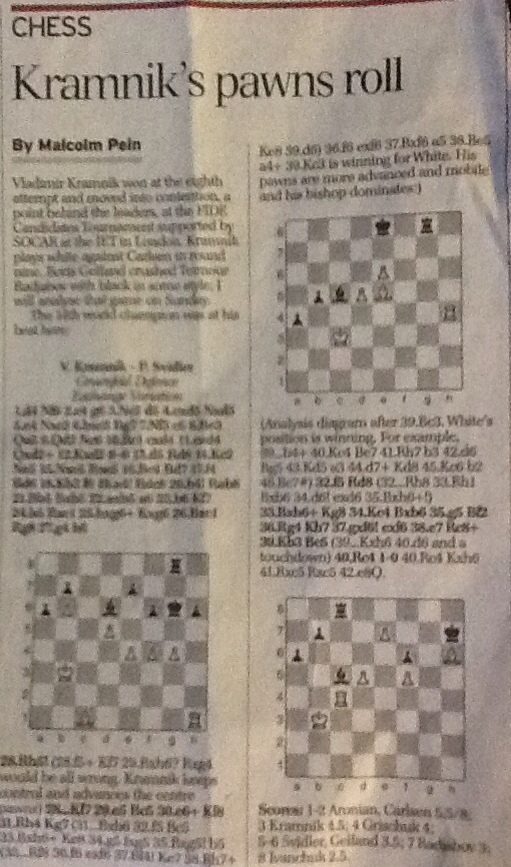
On the train down to London yesterday, I caught up a with a slight backlog of newspapers, and to my delight, saw that Jon Speelman had mentioned the very same move in his Independent article:
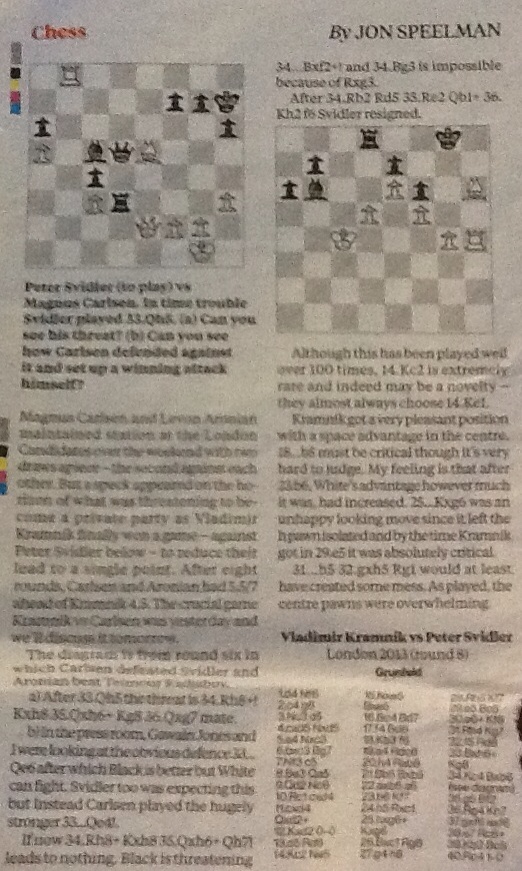
I thought I knew what Jon meant by '25…Kg6 was an unhappy looking move since it left the h pawn isolated' but wasn't sure whether Jon meant 'but it had to be played because …hg lost'. So yesterday I asked Jon, and he told me that Vladimir and Peter had told him, or maybe mentioned at the post game press conference, that hg lost, but Jon himself had wondered about it, and didn't know why: his unhappy word meaning it wasn't the sort of move that you wanted to play. I had assumed, trusting Svidler, that …Kg6 showed my lack of appreciation for king activity, but this trust seems to have been misplaced.
Neither do I, but I intend to try to attempt to find out, though suspect it might be too hard for me. I intend to avoid using silicon assistance, at least until I give up.
My present thought is that 26 Ba3 is the idea, though 26 g3 might transpose. If 26…Bf4 (after 26 Ba3), then Rh7+ and take the e7 pawn, after which I can believe white is winning: the d6 is a monster, and the black king will be out of play on g8, with f8 often being mined because of the threat of discovered check from the Ba3/Re7 pairing. So say 26….Rd8 instead, after which the best I can find at the moment is 27 Ka4 (with the idea of Bd6 and Ka5) 27…Ba3 28 Ka3 Rd8 29 Rb1 followed by Ka4-a5, releasing the rook from defensive duties, but I am not terribly convinced: black might be able to play a timely f5 (so maybe g4 to prevent it) or a timely e6 to get rid of the dangerous d5 pawn and give luft for black's rook.
One fantasy line of mine is 26 Ba3 Rd8 27 Rh7+ Kg8 (27…Kf8?? 28 Rh8+ 1-0) 28 Bd6 (28 Re7 has a similar idea, but in that line, the K is on g8, which is probably a better place than h7) 28…Kh7 29 Be7.
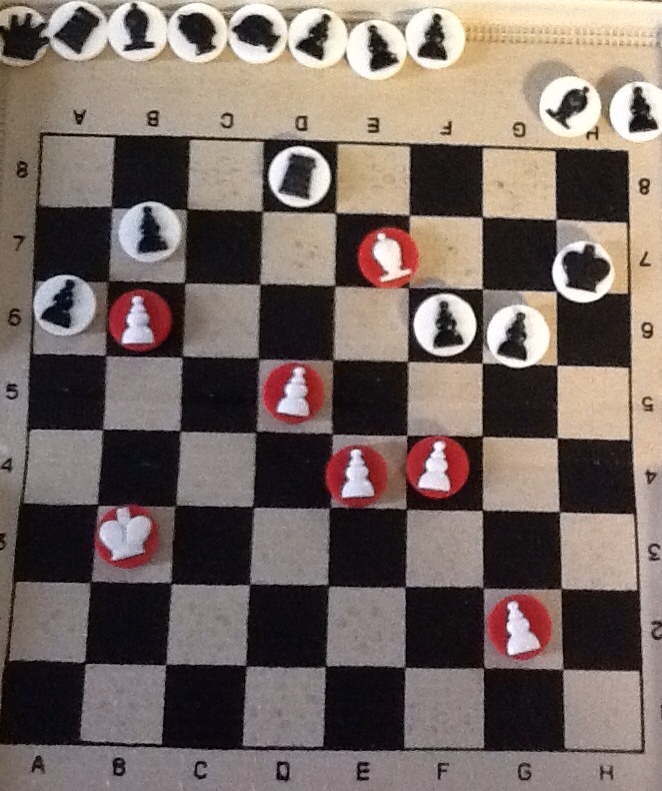
This looks winning, but I doubt I have got anywhere near the true analysis of the position after 25…hg. If this line is robust, then maybe black play's instead 26…Ba3 27 Ka3 Kg7 (27…Rc8 28 Rh7+ Ke8 (28…Kg8 29 Re7 +-; 28…Kf8?? 29 Rh8+ 1-0) when I doubt the pawn ending (after Rh8+ and swapping off rooks) is winning, but I am not sure about 29 Kb4 and say 29…Rc2 30 Rh8+ and 31 Rb8: might be winning, as might 29 Rg7): I don't know.
One more item for my long, for which read very long, improvement-before-I-am-too-old to do list.
 Posted with Blogsy
 allanbeardsworth