Cordingley: a project: number 1
Today, I will start a project, which I hope to finish. I plan to blog each day from now on, each time giving a problem from EGR Cordingley's ' The Next Move is'.
My aim is that the blogging commitment to post each day will give be impetus to spend at least some time problem solving, trying to improve my chess; rather than 3min blitz chess being my daily regimen (think of it as a type of diet, a plan to do good).
EGR's book has a great, unnatural appeal to me: unnatural in the sense that it is an old (1944) book, pre computer era, so some of the problems are bound to be weak: I know this already, from those that I have attempted over the years. But finding the faults is part of the appeal: there is nothing to find say in John Nunn's puzzle books, though doubtless they are a 'better' set of problems.
Another appeal of EGR's book is that every fifth position is given in FEN notation, rather than as a diagram, to limit paper usage: due to war time restrictions on publishers. I find the idea of having to set up the pieces or otherwise create the diagram appealing.
Two further reasons why EGR is one of my favourite books: my copy was bought second hand, I think at a Stockport Rapidplay bookstore some years back, and the inner front sheet has an inscription ' Many Happy Returns, April 11th 1944, with a name which I can't decipher: but the fact that someone's wartime birthday was cheered by this book has sentimental value. Finally, the book is addressed by EGR to the John Lewis Partnership in appreciation of its services to chess and in memory of the late national chess centre: two facts which I plan to investigate.
Puzzle 1
I am not sure whether it is pure chance- I think it is, because the layout of the puzzles in the book seems to be purely random, but the first puzzle is fairly straightforward. Black to play and win:
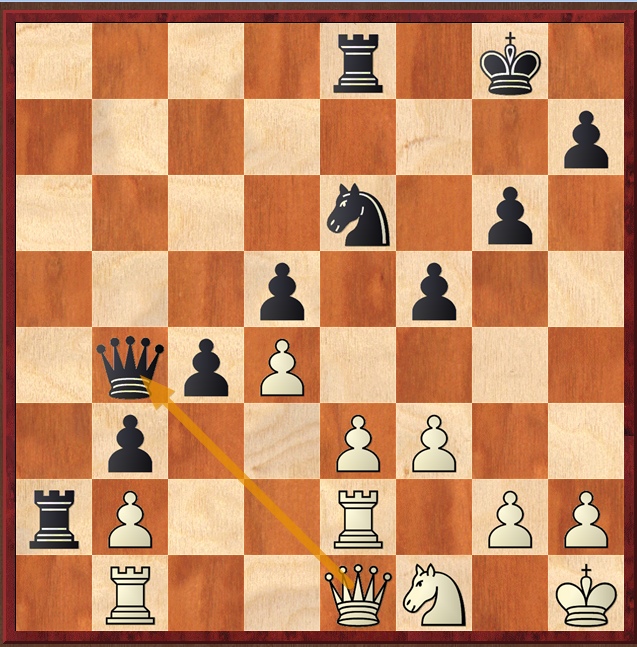
Solution below
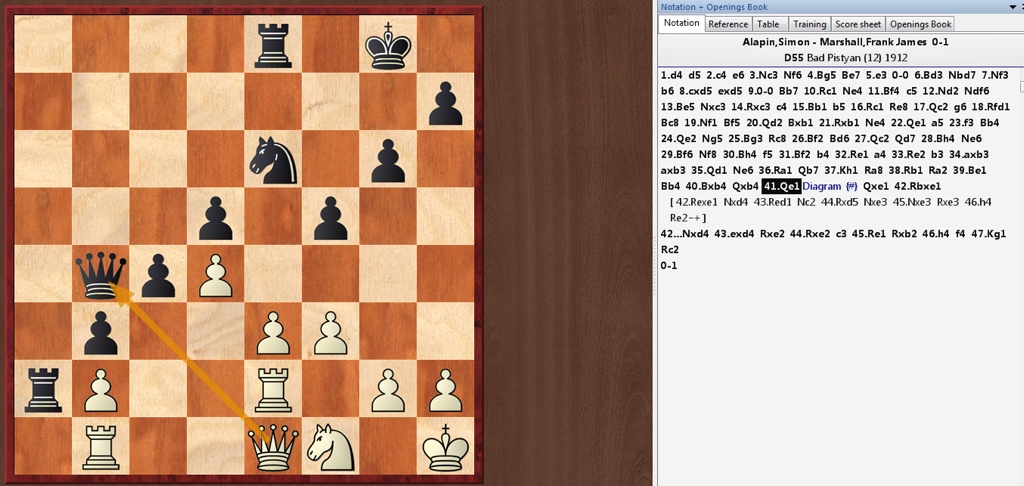
There isn't much to this puzzle. The alternative capture of the queen also loses in straight forward fashion.
 Posted with Blogsy
 allanbeardsworth