60% taxpayers: pensions
As far as tax advisors are concerned, long live the weekend newspapers, particularly the personal finance pages. In my work helping businesses, the entrepreneurs and families behind them, and private clients generally, I have lost count of the number of times I have had a Monday morning call 'did you see the article in the Mail on Sunday about,,,,' (answer, no, but send me a copy). The 2013 translation is a Sunday morning email 'attached is a copy of/link to….'.
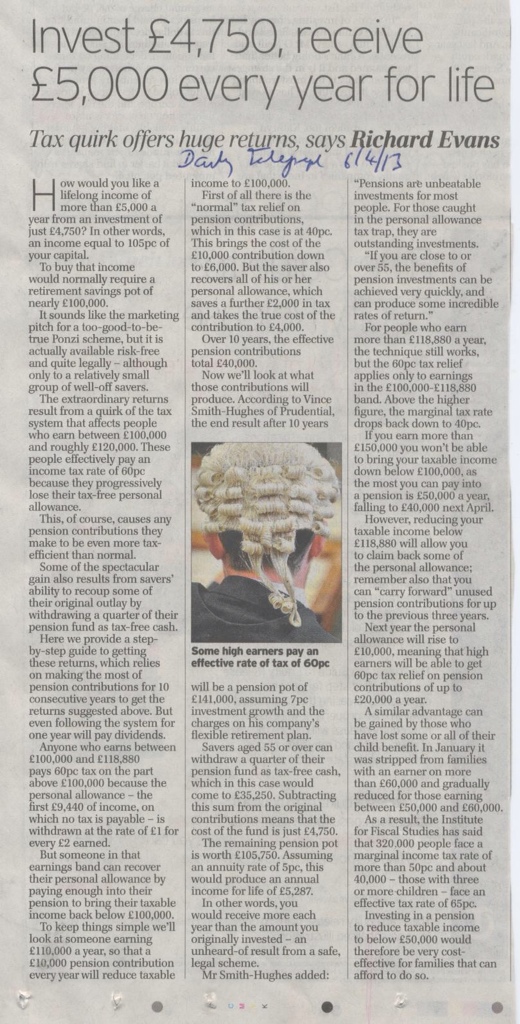
The attached in yesterday's Daily Telegraph was one: though the timing, the start of the new year, could have been improved on: the typical Telegraph reader, Colonel Jones from Surbiton, could have used the article last weekend or even earlier.
There is nothing new in the Telegraph article, except new illustrations: and the article is nicely written, and brings together several points well.
There are two reasons clients send me such articles: (I) is there a catch? (II) I don't understand (no matter how clear the journalists have written, or which smiling readers or celebrities are pictured having done whatever the article is about): and sometimes a third (III) should I do it? The most common answers to the third question are (I) no, it doesn't apply to you [insert sometimes self evident reason why not] (II) yes, but you have already done it. Answer (II) was the case in the instance which caused this blog; I suspect there is an element of just wanting reassurance.
Pensions: the maths
Using 2014/15 rates (when the personal allowance is £10,000), not current rates, when the allowance isn't a round number, but is £9,440, the topic is around:
Do you want to invest in pensions? Do you 'like' having a pension?;
Above the threshold of £100,000, your personal allowance is removed by £1 for every £2 of income. Since your marginal rate of tax would otherwise be 40%, the 50p in the £ removal of allowances makes your effective rate 60%.
So, on income of £110,000, decide to pay a gross contribution of £10,000, restoring the half of personal allowances that are lost at £10,000 above the threshold.
For a gross contribution of £10,000, you physically pay the pension provider £8,000; claim higher rate tax back on your tax return, and in addition your tax liability will be calculated after deducting the full £10,000 allowance: net result, you have a pension pot of £10,000 at a cost to you of only £4,000- 60% relief; but an initial outlay of £8,000, so the initial cash cost is fairly high.
Summary
The article then adds some embellishments, such as the ability to get £2,500 (25% of the fund) out tax free once over 55. But such things are niceties, extras: the key is to think whether you can afford to be £8,000 out of pocket initially, but ultimately (after tax has been reclaimed) £4,000 out of pocket, to get an investment of £10,000. Some with straightened budgets can't afford this, and there are risks, such as the occasionally mooted removal of the 25% tax free rule, which can spoil the maths.
Charity
Another rider I would add is that the same result, in terms of 60% relief, can be obtained by donating to charity.
 Posted with Blogsy
 allanbeardsworth