Cordingley puzzle 9
White to play and win
A nice puzzle, worth spending time on computing all the lines to the end.
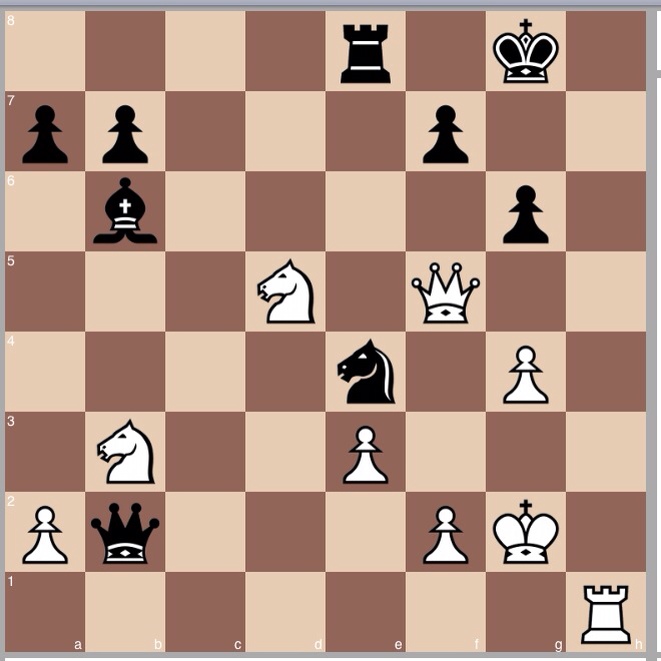
Solution
I think the first move is fairly obvious, or, if it is not, can be found by the routine process of looking at all checks. As a slight discourse, one of my favourite authors is the former World Correspondence Chess Champion, the late CJS Purdy, whose books I whole heartedly recommend: I have learned a great deal from Purdy: in his thinking method, he extends checks to 'look at all biffs', biff being a daft word, meaning all moves which hit another piece, but one which teaches a sensible lesson. Purdy also recommends looking at all jump biffs, i.e. all captures which could have taken place where it not for example for pawns in the way, as a way of looking out for pinned pieces, or a way of understanding some of the geometry of the chess board. So 1 Ne7 biff is the first move, to which black has three responses.
The move to dispense with first is 1…Re7, biffing the knight, and that loses fairly straightforwardly to 2 Qc7+ Kg7 3 Qh8+, skewering the king and queen, which being LPDO, is biffed. Somewhat harder are the two king moves. Against 1.. Kg7, simply biffing the knight, 2 Qe4 wins, since there is a threat of a discovered check, and the Re8 is biffed. I found it hard, and failed to, properly compute 1…Kf8, but could see that it was strong, and would have played the right moved and taken a fresh look when the difficult position came up. 2 Ng6+ Kg7 and I don't know if in practice I would have found the follow up.
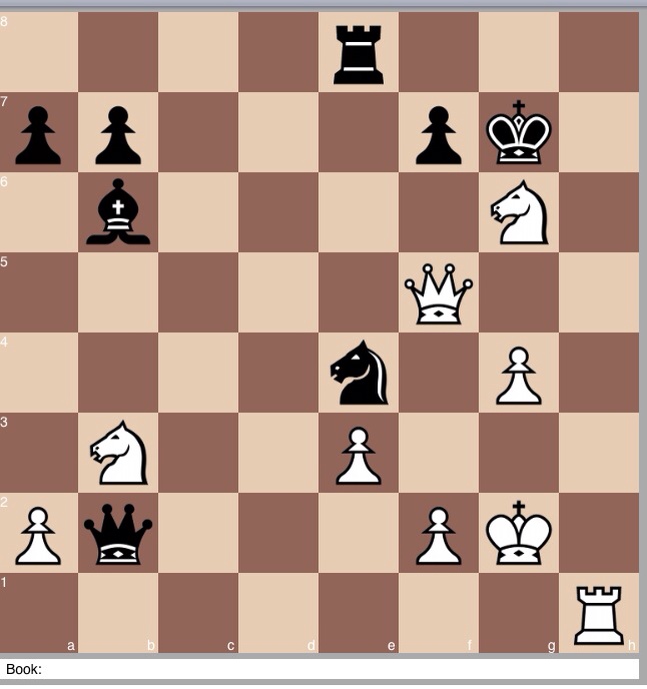
I think if I didn't have much time then my calculating power would have failed me, and I would have chickened out 3 Ne5, hoping that the ending after 3…Qf2+ was tenable. I would have looked at 3 Rh7+, but noted that after captures on h7 and f7, and then taking the rook on e8, black would have mated me after Qf2+: so panic. I think the forced mate after 3 Rh7+ Kh7 is hard to see- but instructive to see how the queen and knight combine well. It is an example of the maxim that queen and knight can combine well, often better than queen and bishop. 4 Ne5+ Kh6 (say, others are similar) 5 Qh5+ Kg7, 6 Qf7+ and mate on g6 next move.
If a line that loses can be nice, and I think it can, then 1…Kf8 2 Rh8+!? Kg7 ( 2…Qh8+ 3 Ng6+ +-) 3 Rh7+? ( would be nice if it were exclamation) 3…Kh7 4 Qf7+, would work except for the backward move 4…Qg7+, when black wins: if 5Qe8 then 5…Nf6 and the Ne7 drops off. The same idea (nice but failing) idea occurs after 1..Kg7+ 2 Rh7+, which also fails in the same way.
 Posted with Blogsy
 allanbeardsworth