Cordingley puzzle 11
(1) White to play and win
(2) plus a bonus mark, and a guaranteed smile, for finding the pretty coup de grâce.
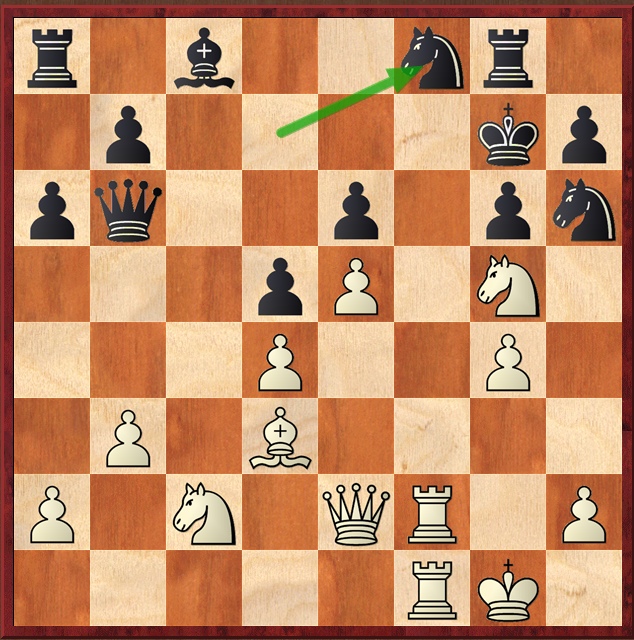
Bernstein-Cohn, 1902
Solution
This one took me time, but I got there in the end; or, at least, I found one of the winning lines; but didn’t find the pretty one.
I had to get the pieces and board out for this one, take me time over it. The first line I thought of proved to be the solution, but at first I couldn’t go deep enough to be satisfied that it was. It was only after I realised that time was on white’s side, that, in Aagaard’s terms, there was time for revolution and then evolution, that I got there: my analysis wasn’t Kotovian, as in the famous book Think Like a Grandmaster, that I read and believed as a child, but now suspect was a Soviet perceived model of supremacy. No, my process was haphazard: noting such things as my Nc2 is probably useless, as are his Ra8 and Bc8; that smashes like Bg6 or Nh7 don’t do anything, nor does the other check Ne6, and nor does the double exchange on f8- white ends up with two few pieces to finish the attack, though the position is a mess and white might just have enough to sustain a win. But on this meander, I saw the importance of the black squares, and the time factor, that white had sufficient time for one or two slow moves (evolution) after the sacrifice (revolution). So 1 Rf7+ Nf7 (not taking just loses trivially, 2 Rf8) 2 Rf7+ Kh8 (2…Kh6 3 Qe3 is lethal) and now the quiet move, 3 Qf2 wins. It is thematic that the win comes on the black squares. 3…Qd8 is forced, to protect f6: the question is, then what?
I played 4 Qh4, and this is sufficient. 4…Rg7 5 Qh6! wins the queen, for if 5…Qg5 6 Qg7 mate, rather than 6 Qg5 Rf7; or if 4…h5 5 gh, and the tactics work for white after 5…Qg5 6 Qg5 gh 7 Rf8 1-0. However, 4 Qf6+!! is far prettier, and decisive, with smothered mate in one of two ways. Lovely.
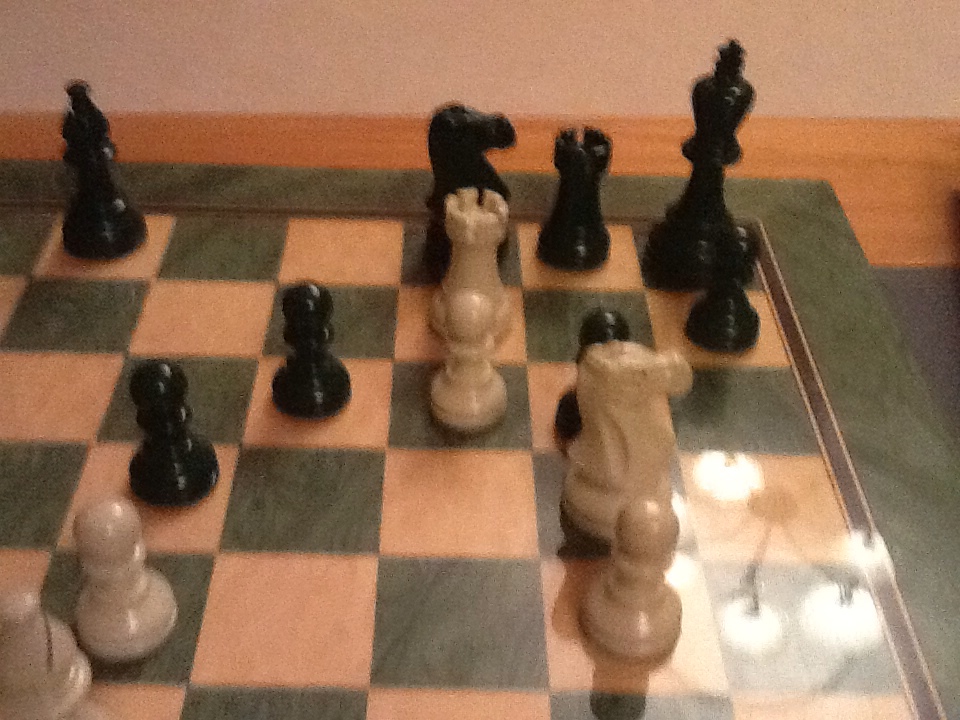
Less lovely is not seeing 4 Qf6+: the thinking or process mistake is to rule moves out without thinking; here, ruling out simplifying, and therefore not testing all checks. Had I been systematic in my approach, programmed to check biffs at each turn, then there is a fair chance the smothered mate would have been found.
When to give up chess: this puzzle has revealed to me the answer to this question: it is time to give up chess when you no longer get happiness from seeing a smothered mate, or no more smiles from surprises.
 Posted with Blogsy
 allanbeardsworth