A nice ending: Svidler-Hammer
I haven't had time to look properly at all the games from yesterday's round one in the Norwegian tournament, but the game which appealed to me most was Peter Svidler's win against Jon Ludvig Hammer. Or, rather, it was the endgame which appealed to me most.
Peter squeezed something from nothing; or Jon made the slightest of slip ups, which turned out not to be slight at all, because of a pretty zugzwang.
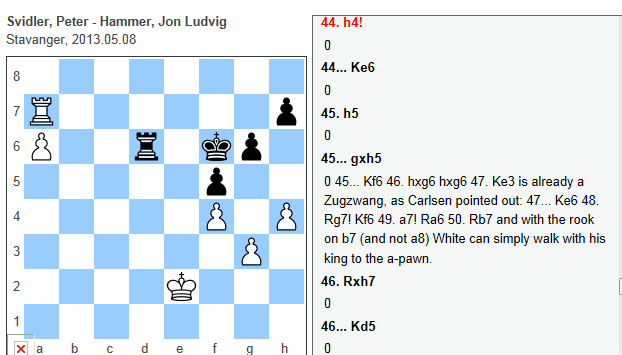
When I first saw this position (the annotations are from Chessvibes.com) I thought that black could draw by 44…h5, but, alas, the same trick works: 45 Ke3 Ke6 46 Rg7 Kf6 47 a7! (the move I had missed) and the rook must leave the d file, and the white king moves up to b8. 45 Ke3 is the endgame favourite, zugzwang.
The draw was earlier:
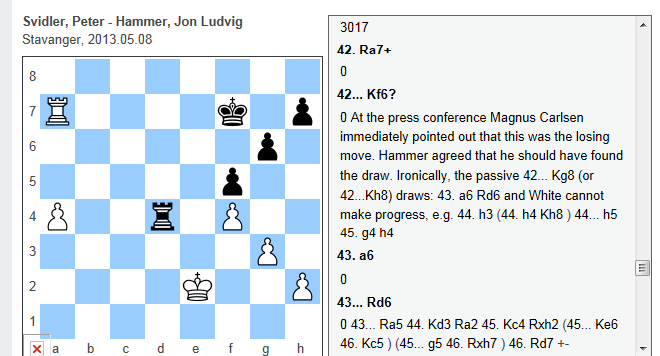
By being less 'active' with his king, white's rook is compelled to passivity: pawn on a7, rook on a8, black's king will oscillate between g7 and h7. Alex Yermolinsky did a fine video series on ICC in January 'endgames by method' on precisely this ending- this meaning pushing the pawn to the seventh, rook on the eighth, and how and when it is possible to win. It seems that Carlsen knows his endings.
Earlier, there was a nice piece of calculation:
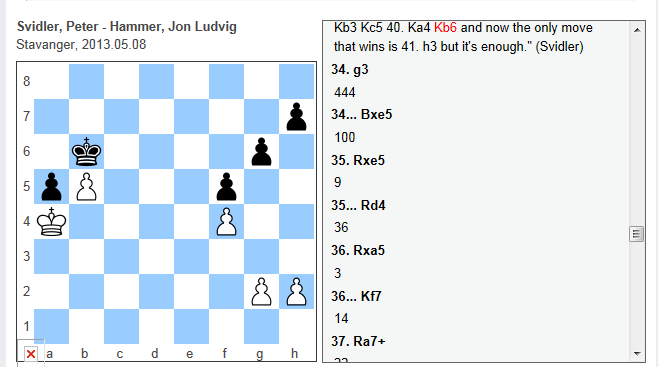
Quite nice to work out how 41 h3 wins, and also how white can scramble a draw if instead he played the 'automatic' 41 g3??. (I think it is a draw, after a series of only moves by both sides: 41 g3?? h6 42 h3 g5 43 fg hg 44 h4 gh 45 gh f4, both pawns queen, and white then has to defend the Q+K v Q+K+P ending (White Qh8, Ka4, Pb5; black Qf1, Kb6, Pa5, black to play and can capture Pb5: I presume this is a tablebase draw an probably a draw in practice too, especially given that black's pawn is an a pawn).
 Posted with Blogsy
 allanbeardsworth