Nepomniachtchi-Inarkiev: a tough puzzle
When in a magazine there is a puzzle I can't solve, I often photocopy it, and keep it for a rainy day: or, in fact, here at our home in Borrowdale, Lake District, a gloriously sunny day.

Out walking, sometimes we keep in a group, some time we became a line, sometimes we stretch out: and on such occasions, sometimes I like to think about things, and for things, read chess.
Today I looked at Nepomniachtchi-Inarkiev, European Individual Championships, 2010, a puzzle I saw in the May 2010 edition of Chess magazine. I had tried to solve it before, the first move being obvious, but not had the tenacity or imagination to solve it. Today, I succeeded.
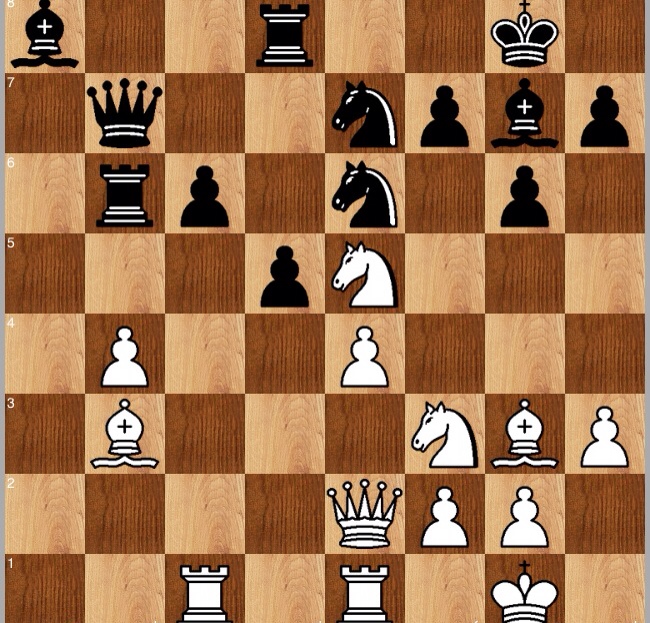
Solution
Using my Cordingley techniques, I looked for follow ups to the obvious 1 Nf7!; if not obvious, a review, Purdy style, for all smites, would have found it. It is easy to see that black must capture the knight, and that after 2 ed Nd5 loses trivially- 3 Qe6+- but what after 2….cd, when the Rb6 defends the Ne6. At first I tried to find an alternative to 2ed, and then a way of interfering with the Rb6's 'jump protection' of Ne6; to no avail. But then I noticed the horizontal alignment of Qb7 and Kf7, and also that 2…cd opened c7 for the rook.
So 3 Rc7 Qa6, and then what? With the Ne6 pinned, the Ne7 triple attacked/ jump attacked, the first move to look at is 4 Ng5+, and when you see that 4… Kf6 5 Qe5 is mate, it is more or less analysis over: just need to check say 4…Ke8, when white can if nothing else exchange queens and take on e6, with an overwhelming advantage.
Very nice.
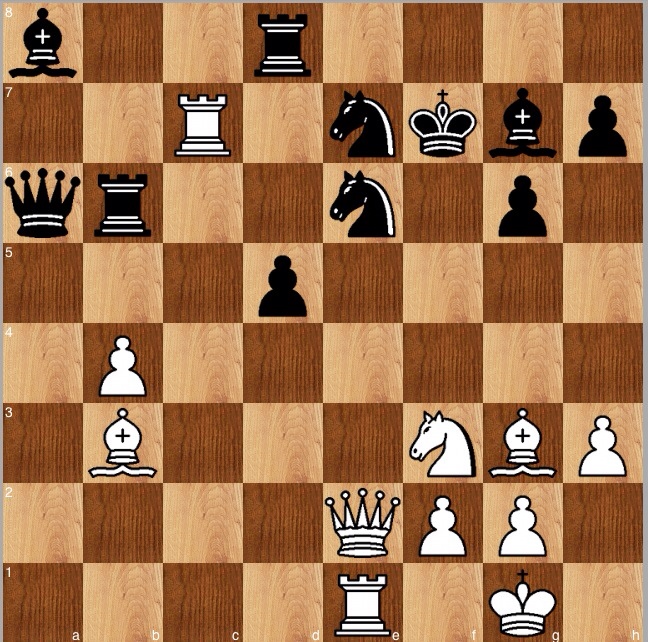
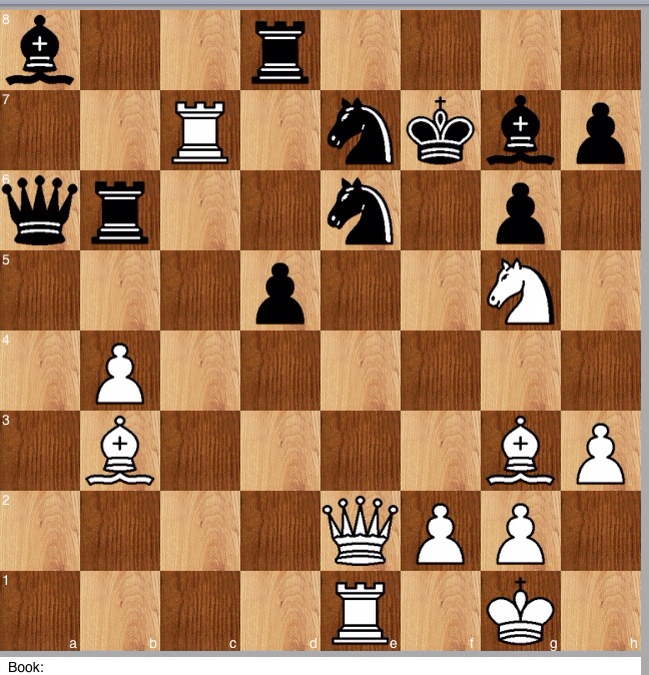
In the game, Ernesto played 3…Rd7, when white is +-.
 Posted with Blogsy
 allanbeardsworth