Chess stinkers: difficult puzzles
For years, no decades, I have torn out or copied and kept difficult problems from magazines and newspapers. By difficult, I mean problems I couldn't solve at the time: I like to have one or more of these with me for spare moments… I hate to be stuck waiting, stuck somewhere, with nothing to do, and sometimes having a go at these stinkers can be the solace (time waster) that I need. I will blog these on an occasional basis.
First, two puzzles by Oleg Romanishin, from ChessToday, 4081.
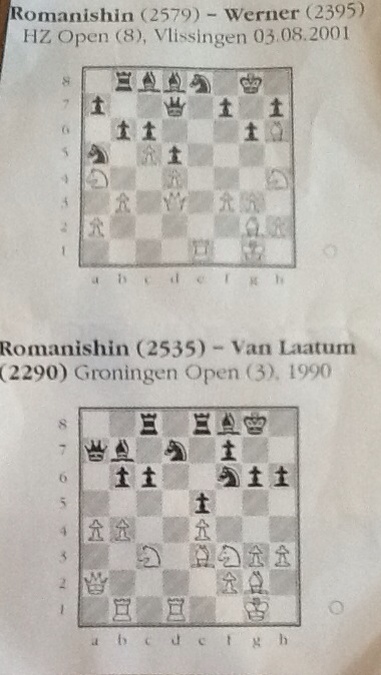
Solutions
Romanishin- Werner
Maybe the first of these isn't too hard. I suspect previously I didn't look far enough into the variation, giving up rather than looking a further half move into the main variation.
Using CJS Purdy language, it is clear that the black king is in a net, and that the black queen is tied to the Ne8. Or, looking through the lens of 'improving your worst placed piece' or 'bringing all pieces to the party', white's Na4 and Bg2 aren't in play. So 1 Bh3! f5 2 Nf5! gf (2…Kh8, for example, 3 Nd6 +-) 3 Bf5 Qf7 is probably where I ended my analysis last time, but 4 Bh7+! ends the game: 4…Qh7 5 Re8+ is the point, forcing 5…Kf7, when the Qh7 drops off. Or it may have been that I couldn't previously see 3..Qf5 4 Re8+ Kf7 5 Rf8+ skewering the king and queen, resulting in a winning material advantage.
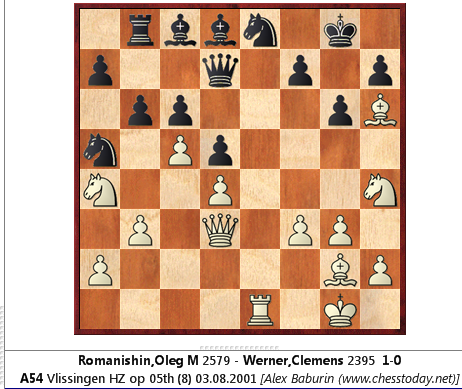
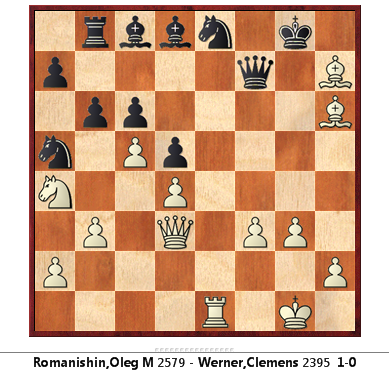
To be fair to myself in 2013, the above one didn't take me too long: 1 Bh3 is obvious, and all I had to do was stick with it.
The second puzzle took me far longer, half a dog walk to be precise.

Romanishin-van Laatum
Why, oh why, did this one take me time?
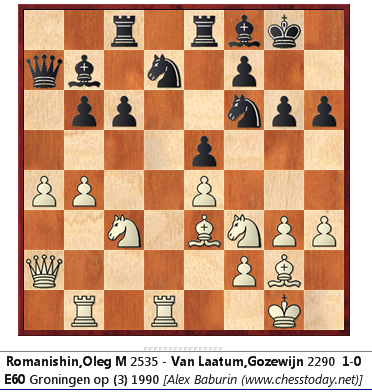
I saw the target on f7 immediately, of course, and wondered about Bf1-c4; but black has Re7, or even a total grovel with Ba8 and Nb8, however bad they might be. And the pinned Pb6 clearly leads to a5 being a possibility; but nothing else. The only captures, and only check, just lose.
Eventually it clicked, and I found 1 Nh4! when after 1…Kh6, 2 Bh6+! is conclusive: 2…Kh6 3 Qf7 is terminal: and this is how the game ended. However, 1…g5 is positionally awful but doesn't lose immediately. Once the N is on f5, and looks at h6 and in particular d6, white's advantage is clear. Then, the ideas mentioned earlier, of a5, Bf1-c4, come with force, often with Nd6 added.
Having found 1 Nh4, it looks obvious: perhaps I should have noticed the fact that the Pf7 is not only a target but is also pinned, so that the Pg6 is a LPDO: and then smiting it, with Nh4, becomes obvious. As Purdy said:
Purdy on nets, pins and ties, Fine Art, vol 2, pg 205
Some things are hooey,
and most others lies;
But forks you mustn't miss,
nor pins, nets, ties.
 Posted with Blogsy
 allanbeardsworth