Cordingley puzzle 91
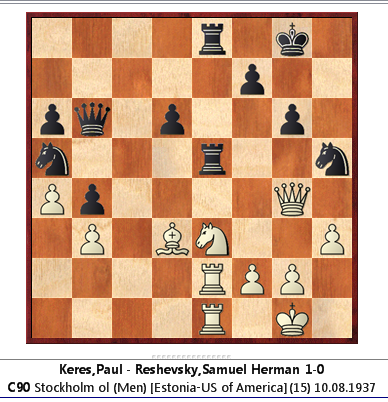
White to play and win
Solution
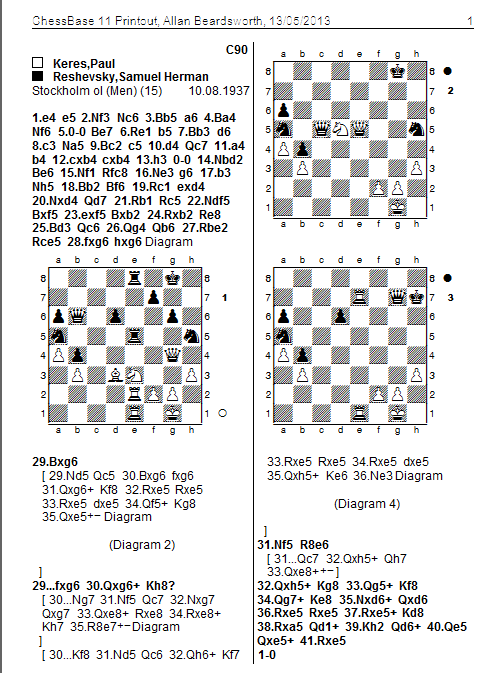
The first move that came to mind was 1 Bg6: an obvious move, the only question being does white have enough after 1…fg 2 Qg6+, since 1…Nf6? does nothing, in view of 2 Qg3 or 2 Qh4. After (1…fg 2 Qg6+) 2…Kf8 the best I could come up with was 3 Nd5 where I thought white probably had enough, with, after the exchange off of all the rooks, and the capture of the Nh5, with Q and N combining against the king: I felt it might be good enough, but couldn't be sure.
So I looked for alternatives, and found 1 Nd5 instead: essentially the same idea, just stops Nf6 and threatens Bg6; on balance I preferred this move order, but not for a strong reason: I perhaps felt that (1 Nd5 Re2 2 Re2 Qd8 3 Bg6+ was a better version of a similar attack.
Having found as much as I could, I looked at the answer, and found that Keres played 1 Bg6, but Reshevsky played 2..Kh8, which I thought was slightly weaker. Confused, I turned on Houdini, to see what was wrong with 1 Nd5, to only find that 1 Nd5 was its preference too, marginally. Its third choice move, which it also appraises as winning, was the surprising 1 Nc4: a different idea- once the knights are exchanged, replaced by a B on c4, the f7 pawn is pinned, so Qg6+ becomes available.
So, a nice enough puzzle. Neither 1 Bg6+ nor 1 Nd5 win absolutely, but have the same principles: 1 Nc4 was an interesting surprise, and shows (not for the first time) the advantages of bishop's changing diagonals.
 Posted with Blogsy
 allanbeardsworth