Cordingley chess 97
White to play and win
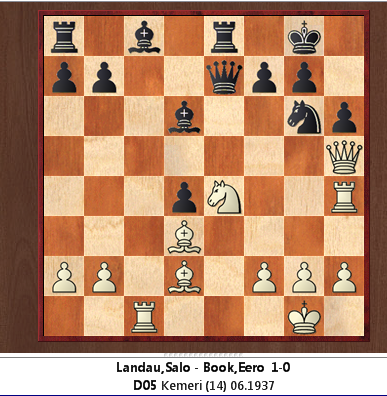
A worthwhile calculation exercise, but not, I think a clear win
Solution
I spent a lot of time on this one, because my initial impression was 'white can't be winning' 'white's position is about to fall apart' 'therefore must be something special'.
I tried all the captures, such as 1 Qg6, 1 Qh6, 1 Rc8, 1 Nd6, none of which are any good; noticed that black's only LPDO was his Ra8 which is safe provided black doesn't play ….b6; saw that white's Rh4 was in jeopardy and that, maybe, white would have his own back rank to protect; checked the only check, 1 Nf6, and then landed on the only other smite, 1 Bg5. This had to be the solution, and was the game continuation.
The bishop can't be taken by the h6 pawn, because 2 Qh7+ mates next move- effectively the h6 pawn is pinned because of the jump-check/ jump-mate, in Purdy language. So the queen has to move (since 1…f6 is ridiculous, though I didn't glance at it).
The most natural move is 1…Qe5, centralising the queen, and pinning the Bg5: not the strongest of pins, but maybe exchanging queens could provide relief. Then, having tried 2 Nf6+, 2 Qg6 etc etc, I realised the only move to continue the attack was 2 f4, to which the natural response is 2…Qd5, though I also considered 2…Qa5. After 2….Qd5, I saw there were tactics based on 3 Nf6+ and 4 Bg6, and decided that they had to be the line, in a sense because, using a poker term, white was 'all in' on the attack, and just had to throw everything in, hope to succeed, else he would fail.
The amount of calculation required was too great for me, at least without setting out the board and pieces. Black has other.defences, such as 1… Qe6, 1…Qf8, 2…Qe6 (this one is poor: 3 f5) but in practice I knew I would have to play 1 Bg5, see what black did, make a move, see what black did etc etc.
Houdini time.
Instantly it flashed up 1 Nd6 with a 0.0 assessment; and gave 1 Bg5 a -1.7 one; and, for around another ten initial moves for white, similar or worse negative scores. Interesting. So, I decided to give Houdini time to think, and, as is my wont, gave it one British Unit of Time (i.e. I made a cuppa), came back, and its assessments were still looking bad and volatile. So another BUT (i.e. made some toast) came back, and started to examine.
There is something of a horizon effect here: the lines are long and further into them the assessment can change. It turns out that 2…Qd5 is far worse than 2…Qa5!, for the non obvious reason that from a5 there it supports a check by the rook on e1.
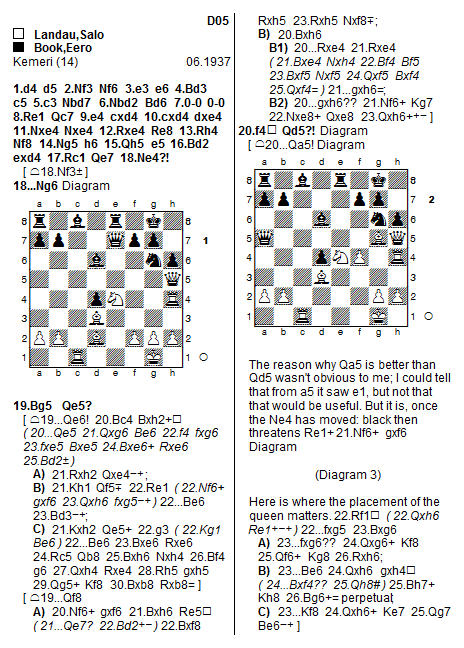
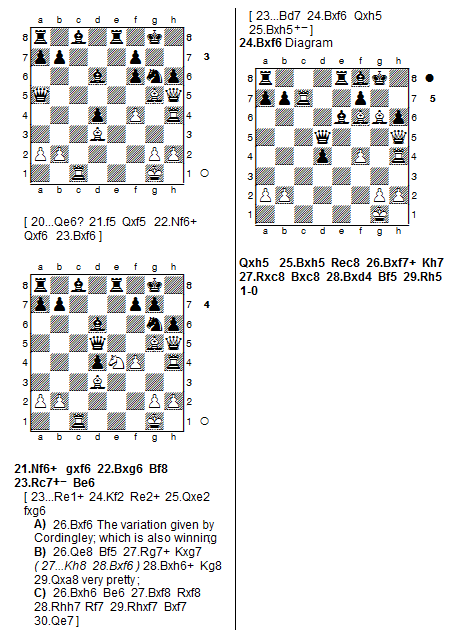
My attached analysis goes some way into the depths of this position, but it is an Aagaardian one: capable of further analysis, more an exercise than a puzzle. My impression is that black is near winning, but is on a tight-rope, and the natural desire to keep the Q centralised with 2..Qd5 is a fall off from that tightrope.
Houdini shows that 1…Qe6 is a strong move, especially with the follow up 2..Bh2+!: both unnatural moves. One advantage of Qe6 over Qe5 is that f4 doesn't smite the queen: so a tempo saved: it also adds some control to g6.
In short, an interesting exercise, one which could repay further study: in some ways cooked as a puzzle.
 Posted with Blogsy
 allanbeardsworth