Did IBM cheat in 1997?
I don't think so: no, they didn't cheat.
The notion that they may have cheated will always be around, will always be something that we will never really know for sure, unless against all odds, Joel Benjamin, the GM who supported the development of Deep Blue from August 1996 through to the match in 1997 admits it, or some other possible player comes forward: there are several names, including Karpov, who are mooted as might have having given support. To me, though, I would say the odds are 1000/1 against there having been support: it was just that Deep Blue represented a step change in playing abilities.
My interest has been sparked by watching The Machine, a play about the match, at the current Manchester International Festival. Several colleagues have gone to it, all thought highly of it…in fact the only criticism I have heard was that the weather being so hot, the atmosphere in the theatre was stifling. Soon enough, Manchester will be raining again.
So, yesterday I spent some time with my chess engines to see what I might find. I looked at three of the positions which have been most commented on, spending most time on the most commented one. The analysis was done on my soon-to-be-replaced fairly ancient PC, on which I set the engines to 1 CPU to prevent hogging of system resources: so not at full strength.
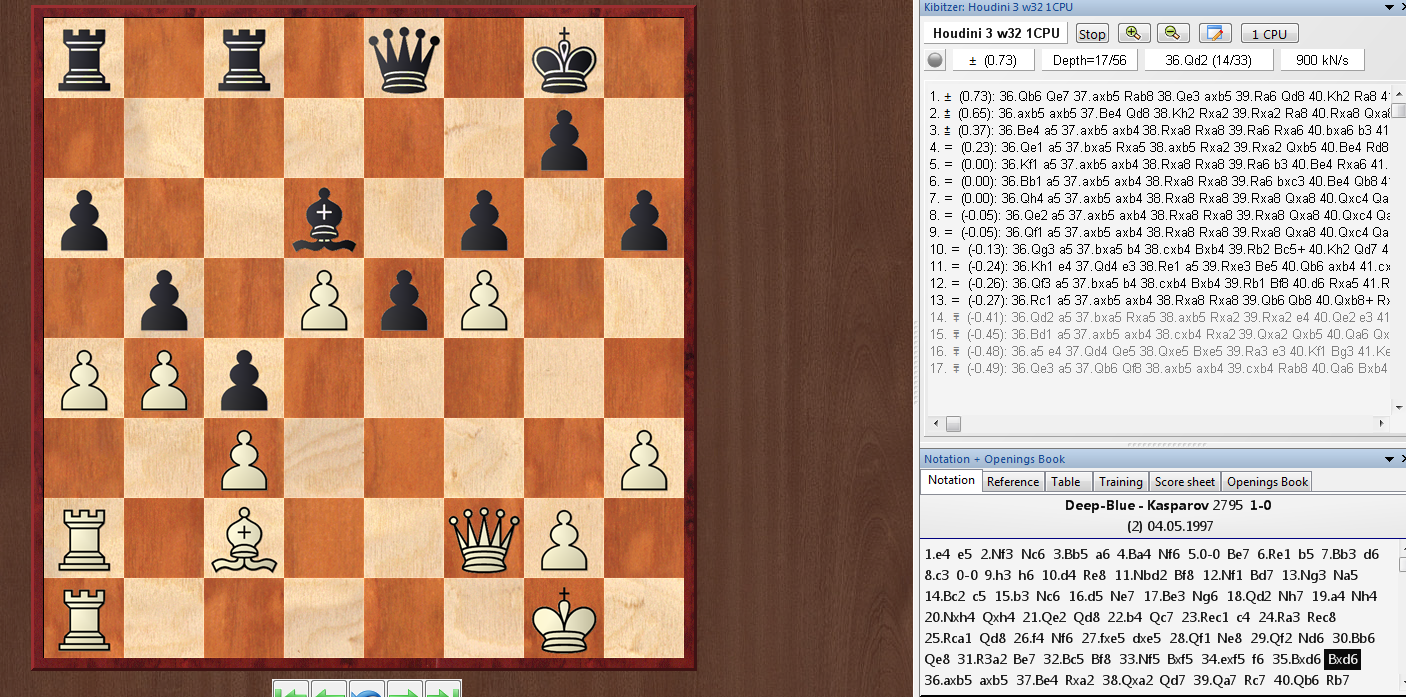
This is the least commented position, but my attention was drawn to it by the second item that I have highlighted in the screenshot below. (Arrows added by snitch, an app I have just downloaded which seems pretty handy)
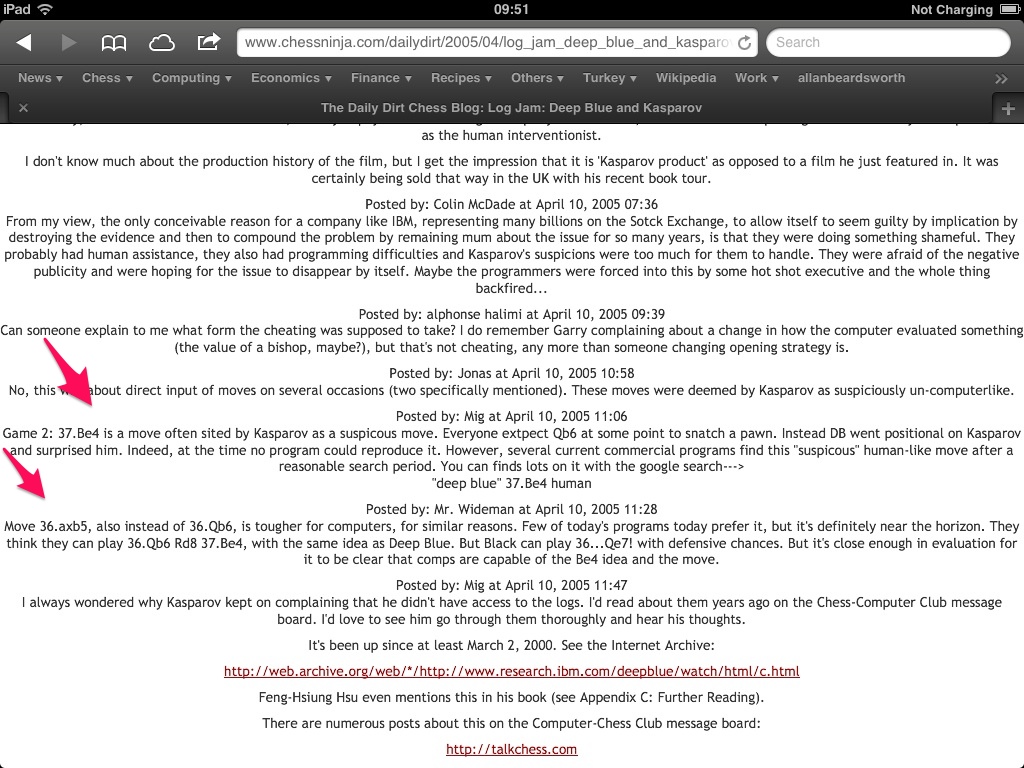
Any fairly strong human player would I think do what Deep Blue did, 36 ab; I also think that IBM wouldn't have needed a Benjamin or Karpov to then suggest 37 Be4, Beardsworth would have said to: it is patently natural to fence black in. What surprised me, and one point for the deepbluegate conspiracy theory, is that Houdini 3.0 doesn't consider 36 ab to be best, preferring the riskier 36 Qb6. Two points, perhaps, because none of the other engines that I tried preferred 36 ab.
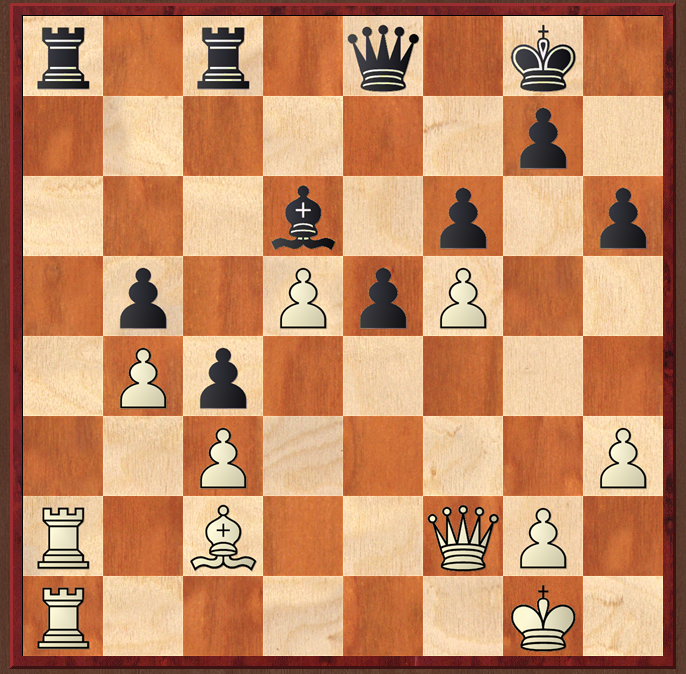
The above is the most commented position. Now that the a pawns are exchanged, black can't mess things up with …a5; and so it is only a question as to whether white can infiltrate with the queen whilst black's major pieces are tied to fighting for the only open line. So a strong white player would naturally look to see if there is an overwhelming advantage after Qb6, and, presuming none could be found, would quickly play the improving/stabilising move 37 Be4.
Initially, Houdini 3.0 preferred 37 Qb6, but after I left it for a standard British Unit of Time (i.e. I went away and made a cup of tea) its evaluation switched to preferring 37 Be4. Rybka 3.1 chose 37 Be4 slightly faster, only momentarility preferring 37 Qb6. The only other strong engine I tried was Crafty, which stuck with 37 Qb6.
The fact that Houdini and Rybka prefer Be4 is, to my mind, sufficient that in my judgment, it is best to conclude that there was no cheating: engines are now, and Deep Blue was then, now able to make judgements- they have better evaluation functions.
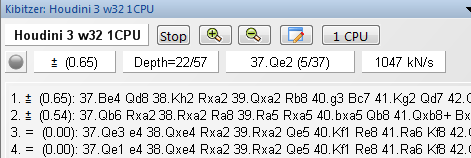
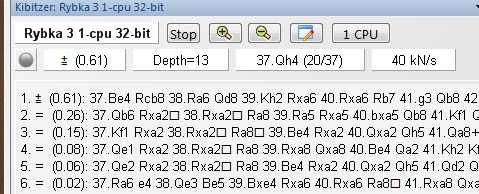
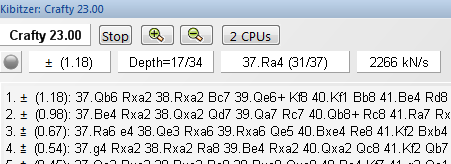
For pure amusement, I also put the position into Turing– something I should blog about one day.
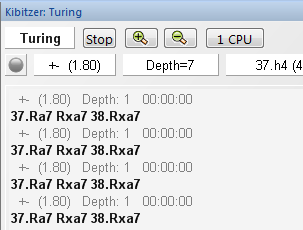
(As I write, there are some moves again to get Alan Turing posthumously pardoned: I hope I live to see that day).
My assessment is that Deep Blue didn't cheat. Whilst Houdini etc are far stronger than Deep Blue was, the hardware Deep Blue was running on would be infinitely faster and stronger than my effectively single CPU machine. (As I write this, I am reminded that when Tom was much younger, and in a video game phase, I once caught him 'buying' tanks as additional 'weapons' to break a siege of some Ancient Greek or Roman battle: Houdini is far stronger, but IBM’s mainframe more powerful)
I also looked at two more lines. Firstly, the game 1 position:
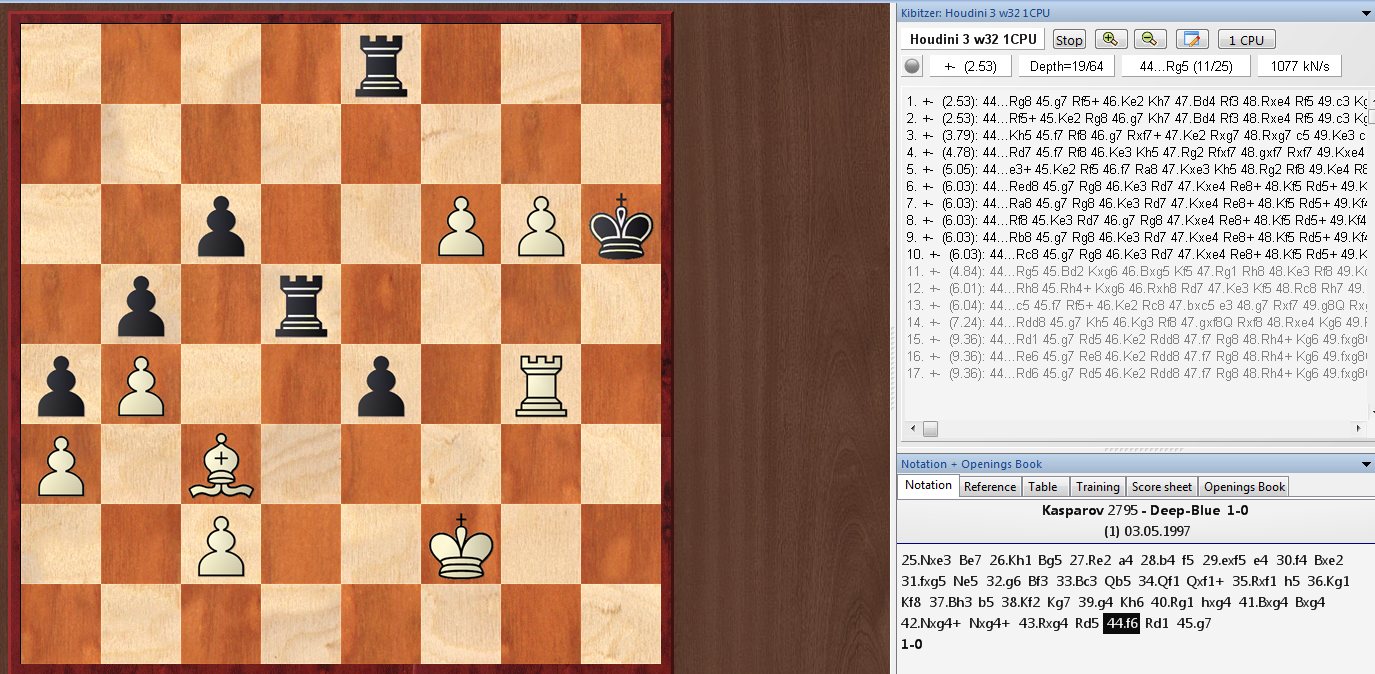
Here, black (Deep Blue) is busted, and played the utterly nonsensical 44…Rd1: I would give a point to the deepbluegate conspiracy theorists here, because there are far better moves, if there were a wish to prolong the game, but I accept the IBM defence that there was a programming blip so that in a hopeless situation, where nothing defends, something random was thrown out. I can though see Kasparov's claim that this single move spooked him badly as being true: this move, not 37 Be4 in the second game, might have been the decisive moment in the match: looking back, both moved show a more judgemental, human like, approach to chess.
Finally, I also looked at the allegation that Kasparov missed a draw in game 2, and that Deep Blue in turn made a slight slip permitting that draw. Neither is true: I am not the first to know this, it seems that by 2005 engines had gone that little deeper. Now, Houdini instantly shows both Kasparov's 'missed' drawing line and the way Deep Blue could still have won. Kasparov would have lost anyway, and his seconds in hindsight didn't do him any favours by telling him that he had missed a draw.
In conclusion, whilst there are legitimate reasons for thinking there was human support (Jane and I are still not entirely sure that man landed on the moon) I think the far, far, more likely position is that there was none: Deep Blue merely reflected a step increase in playing strength. Now, 16 years later, chess engines 'whip our butts': it is quite astonishing what progress has been made in the thirty or so years that machines have played chess.
 Posted with Blogsy
 allanbeardsworth