Cordingley puzzle 120 #chess
White to play and win
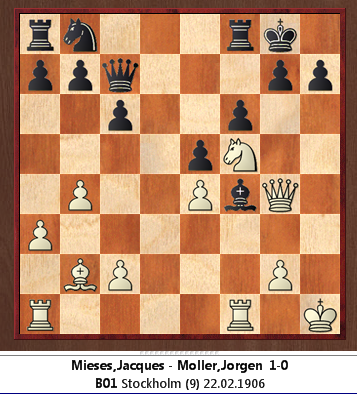
Solution
This puzzle is both easy and hard: it is also very enjoyable. The easy part is to guess the first two moves: take the bishop, 1 Rf4 ef, and bring the last piece to the party, 2 Rd1. I would play these in practice with not much thought, partly for want of anything better, i.e. if they are bad, then white's position is bad.
I should say I spent some time on 1 Rd1, wondering if the Bf4 needed to be taken, and noting that if black can get his pieces out, he won't be worse. However, Rf4 has two benefits: gets rid of the defender of h6, so Nh6+ can sometimes be on, and also enables the thrust e5!, weakening the a1-h8 diagonal.
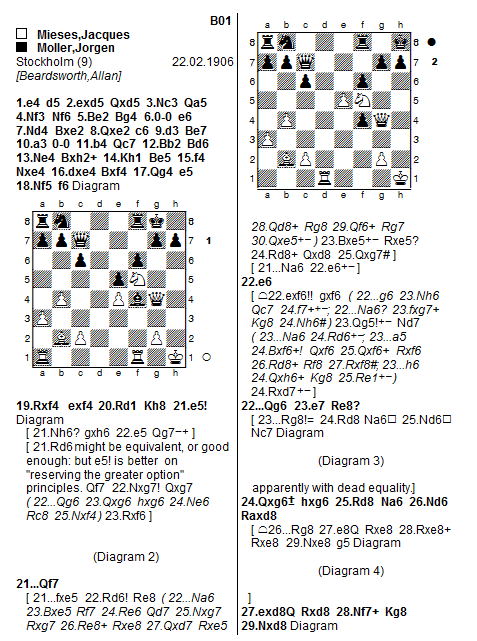
Black has a lot of moves after 2 Rd1, with a key point that 2…Nd7 isn't one of them: 3 Rd7+! Qd7 4 Nh6+ 1-0. So a natural move is 2…Kh8 since black would far rather get his Knight to d7 than a6. After 2…Kh8 I noted that the Rf8 is now LPDO, and so back-tracked, looking at keeping the Rf1, where there is a jump check to the Rf8: but I couldn't bust open the f file, so reverted back to 1 Rf4. My analysis stopped at (2…Kh8) 3 e5, being the horizon of my thoughts: black has too many options that he may play. I also looked at 3 Nh6 which fails (why should it be good to put the knight offside?) and 3 Rd6 (which is good, but not as forcing as 3 e5).
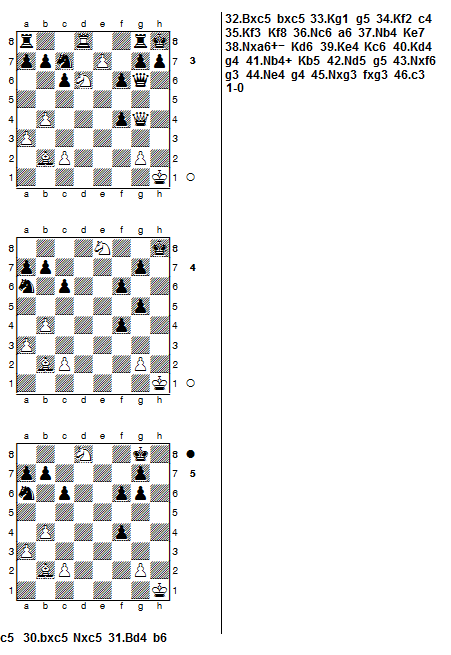
I switched on Houdini and it showed me that the line to 3 e5 was played. Very instructively, it later shows that Mieses threw away his advantage, but that black did not capitalise on it: I wonder if Mieses ever knew that ef!! was far stronger than pushing the pawn forward: of course, I didn't find ef!!, Houdini did, and it took me a while, assisted by the engine, to see its full effects. It is quite telling how much can be made by a less in development: it shows that a sense of urgency is paramount, and also that precision is required.
A very nice and worthwhile puzzle.
 Posted with Blogsy
 allanbeardsworth