Cordingley puzzle 174 #chess
White to play and win
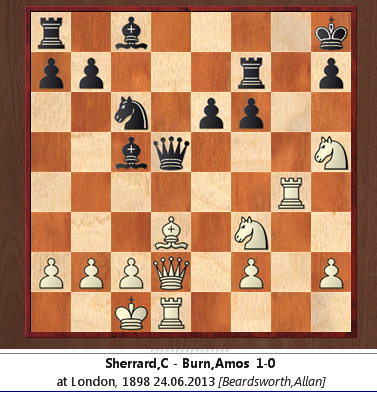
Solution
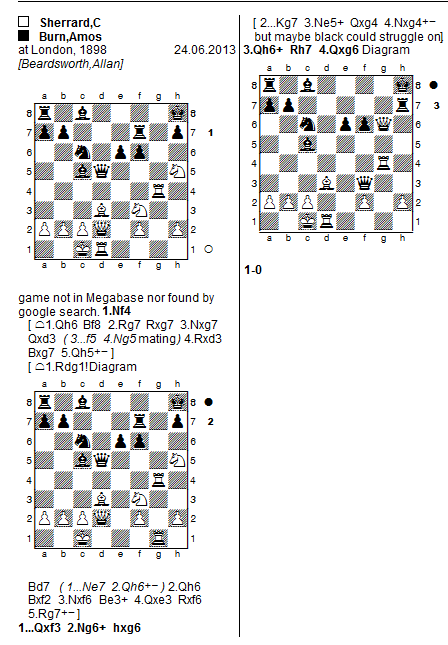
At least three moves win here. I chose the second best one, 1 Qh6, threatening 2 Rg7 mating on h7, so that 2…Bf8 is forced; and then 3 Rg7! Rg7 4 Ng7 f5 when all that needs to be seen (and it took me a while) was that 4…f5 permits 5 Ng5, mating next move. Nice enough.
In fact, 1 Rdg1 was even better; the point being that it forces the less useful move 1…Bd7, when after 2 Qh6 the defence 2…Bf8 is not possible because of 3 Rg8mate : quite instructive, really, and yet another example, if more examples are needed, of 'bringing all the pieces to the party'. Pity I had to load the position into my iPad and that Hiarcs showed me this win.
In the game, white chose a third move, 1 Nf4, which also wins- it is a move I didn't even consider. If black wants to, after 1 Nf4 he can struggle on with loss of material- the position is not obviously winning in one of the lines (see below). This puzzle is actually a good example of principles, because my move, 1 Qh6 also brings a piece to the party, but the best move brings an even better piece: or, develop the worst placed piece, so could have been found by applying two maxims.
As an aside, whilst writing the above paragraph, I struggled to remember who is credited with the develop the worst placed piece maxim. I recalled learning about it not that long ago (within the last ten years- I wish I had learnt chess properly as a child) from a Chessbase DVD by Rustam Kasimdhanov, but I couldn't remember who he credited it to, so I tried google:

Fortunately, after a bit of reflection, I remembered that Kasimdhanov credited Vladimir Makagornov with this maxim. Memory beats google.
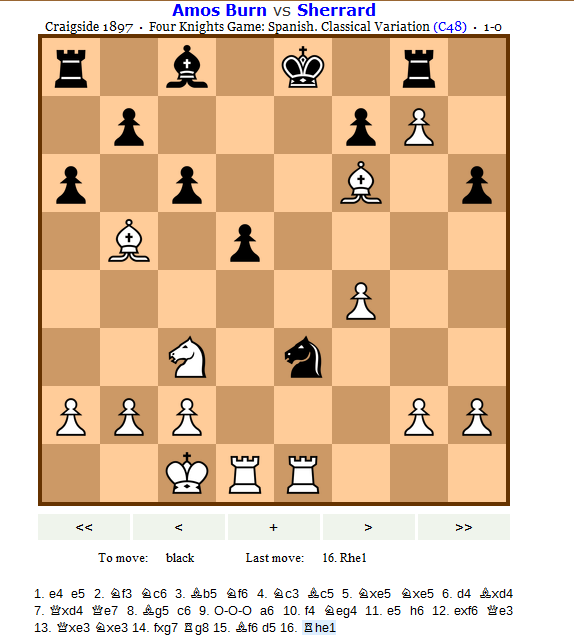
Finally, when searching (unsuccessfully) for this game, I found that Sherrard had two other games against Burn: in 1899 he lost a normal length game, but in 1897 he lost to the great player in only 16 moves.
 Posted with Blogsy
 allanbeardsworth