Cordingley puzzle 196 #chess
White to play and win
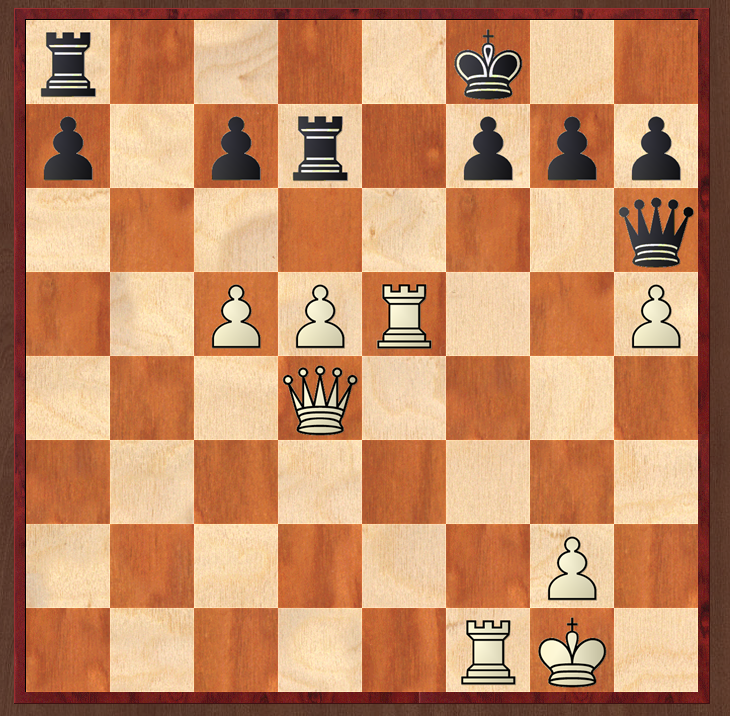
Solution
(I) pre Houdini
I solved this one, but, ahem, in a circuitous route. First, I tried in my head, without success. I noted the LPDOs Ra8 and Rd7, but couldn't land a double attack; saw there were some signs of a back rank mate, and also the black queen was out of play and in a bit of a net, and yet 1 Re6 fails to 1…Qe6. I also saw the jump check-mate Qh8, so made a mental note that if the Q leaves h6, then maybe Ph6 could since, the g7 pawn is pinned. But nothing really. So at first, I settled on just an 'improving' move, 1 Qe4, which turns out to the move that Tartakover played.
So, I set the position up on my board in our lounge, to work on later. Walking past, 1 c6! came to me, and- wait for it- I had misplaced the Rf1, having it on e1, so my idea with c6 had been to threaten 2 Qa7 winning both queen side pawns. I noticed 1…Qc6 with the same pin on my LPDO Queen, noting that 2 Qb4+ Qd6 is a defence, so put it aside to work on later, but did notice the idea (still with the rook misplaced) of 2 Re7! when black's only move is 2…Rd5, since 2…Qd5 loses to 3 Rd7. When I came back to it, in the book, I realised my error in misplacing the Rf1, but thought I should have a look at 1c6 again, on Purdy's 'consider all smites' maxim.
Firstly, I thought 1…Rd6 would be the most solid defence, and, indeed, Cordingley's answer (for 1 c6! Is the move) says it also loses, but that the analysis is lengthy- without giving variations. I suspect 2 Qb4-b7 should win, and yet I wouldn't win the position after 2 Qb4 against Carlsen- by which I mean there is plenty of scope for error. Similarly, 1…Re7 has the same answer in Cordingley, and has some merit, since white's Re5 is the better piece.
However, 1..Qc6 has to be analysed: in a flash, by comparison to my erroneous variation, I saw 2 Re7!, the idea being to find a way for white to move his queen by giving check, so that he can then take the black queen. So 2…f6 3 Rg7! Rd6 4 Rg8+! came to me pretty quickly, since the desperado rook can't be taken, and, very nicely, the end of the combination is that the LPDO Ra8 falls off.
I find it really interesting that most of the factors initialy identified- the back rank mate, the two LPDO rooks-come to feature in the solution (the Rd7 LPDO in the line explaining why 2…Qd5 fails). It is perhaps indicative of the fact that in many positions the solution hangs by a thread: a small nuance here or there can often make all the difference between a line working and it not. Very instructive.
(2) after help from my friend Houdini
Houdini supports the above: 1 c6 does win, assessed as 2.85, and no corrections to my lines, but 1 Qe4! is said to be even stronger, 4,43. The lines are incredible. After 1 Qe4 f6 2 d6! hits the LPDO Ra8, and after 2…Rad8 3 Re7 precise, computer, moves mate or lead to overwhelming material advantage. I should say that the lines with rooks and queens are impossible for me to see, but the white squared and back rank weaknesses lead to a forced win.
 Posted with Blogsy
 allanbeardsworth