Cordingley puzzle 229 #chess
White to play and win
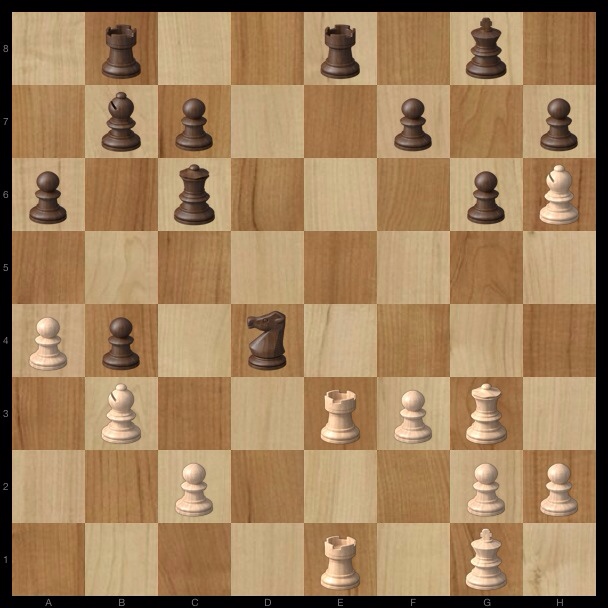
Solution
Clearly, the main task is to exploit the threat of back rank mate; and very quickly I started to look at ways of decoying the Qc6 from its function of defending the Re8.
The move I first thought of was 1 Bd5, which is good enough to give white a sizeable advantage: 1…Re3 2 Bc6 Re1+ 3 Qe1 Bc6 4 Qe5 Ne6[] when objectively white is winning though I guess in a practical game at least at my level, all three results might be possible.
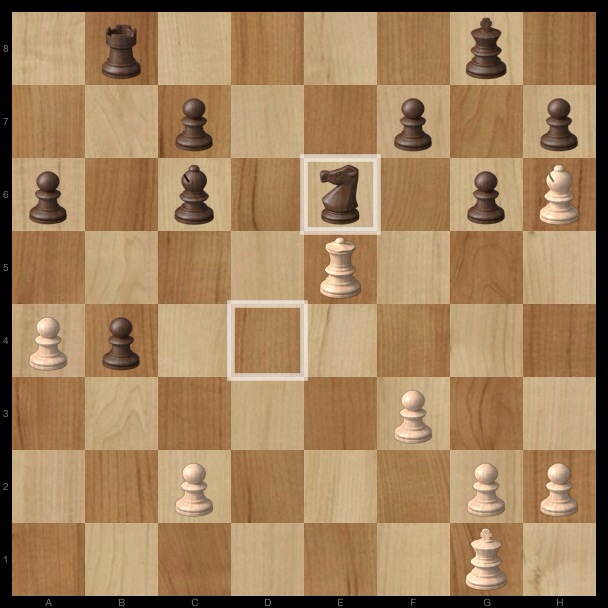
(I guess here 5 Qa5 wins the a-pawn, since 5…Rb6? 6 Be3, and 5…b3 can't give enough counter play since the permanent threat of back rank mate ties the Ne6 down: so +- )
However, 1 Bd5 Qd7! is a tougher nut to crack, since if white exchanges both pairs or rooks, and then takes on b7, he loses to the knight fork Ne2+; and if he doesn't change rooks, and plays 2 Bb7, then 2…Re3 3 Re3 Rb7 4 Qe5 Ne6 defends everything, and 3…Nf5 might be even better. 1…Qd7 stumped me, until I looked again at the initial position, and found 1 Qc7! is a winning decoy: and then I saw (1 Bd5 Qd7 2 Qc7 still wins, but that shows that 1 Bd5 is pointless.
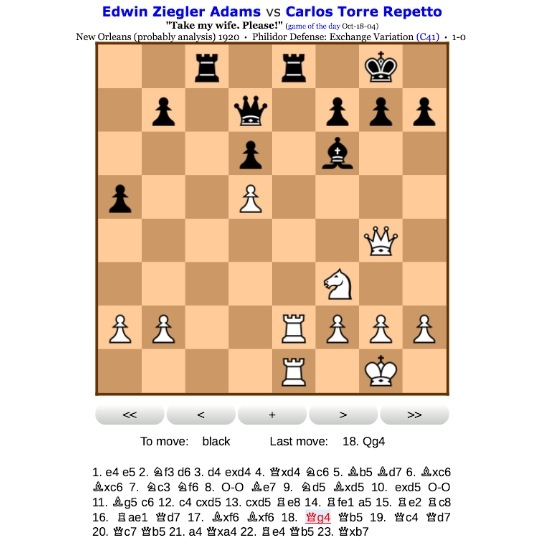
So, 1 Qc7! and if 1…Nb3 2 Qb7! echoing the famous Adams-Torre. If then 2…Qc5, pinning the rook, then 3 Kh1 is a pretty unpin, and is game over.
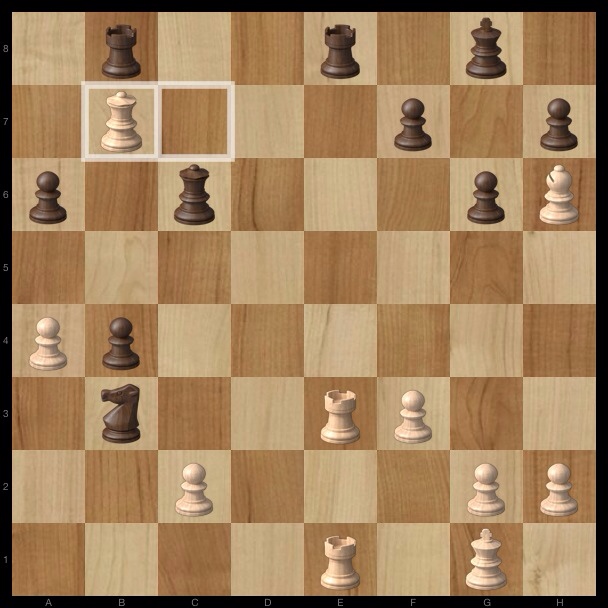
In the actual game, white missed the decoy idea, and the game went on. In fact, he found the idea a few moves later, was winning, blundered into a draw, and then blundered again into a loss.
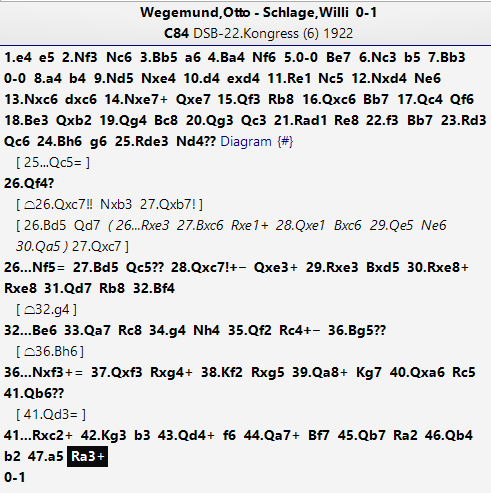
The Adams-Torre game actually occurred two years earlier:
 Posted with Blogsy
 allanbeardsworth