Finders, minders, binders and grinders
A senior colleague I am fond of is having a tough perceived time at work.
Note the word perceived. It is important. What is more important is perceived by whom: not by himself, but by the managing partners. I can't remember whether he came to me for advice: I think not, and instead, when I heard of the bad space he was in, I think I offered to have a chat with him, which soon became two chats, and soon became me thinking a lot about what guidance I could usefully give him.
We discussed many things, some specific to the person, the firm, the personalities. But the issues are also quite general, as I have seen from my own career experiences, from my thinking about my own department has run over the years, from what I see at clients, and from my general reading and learning.
Back to perceived. Been thought of in a poor light knocks confidence, and it takes strength of character to survive it. Is there still self belief? I can't imagine how difficult it must be to come to work really doubting one's own abilities. I have been fortunate, doubly so. I would never have been good enough to be a professional chessplayer despite the lies I told myself about how good I was as a junior; but somehow my career wandered from a false start in engineering (great academically at Cambridge, but if ever there was a square peg in a round hole, that was me for it as career- in fact, a better analogy would be three pin plug in a two hole socket, since despite getting a top first and specialising in electronics, I couldn't even wire a plug [I can now]; from a false start in engineering, through an invaluable learning period in audit, to the happy land of tax advising which is actually a different form of chess or maths or logic puzzles. So the first aspect we discussed was his self confidence and belief in himself.
This led on to my recommending that he should find some uninterrupted distraction free time and invest an evening in watching Randy Pausch's last lecture. Of course, being British, this late Professor's first name causes a giggle or a question about what type of video I am recommending (odds of 750,000 to 1 given that none or the babies born in the UK in 2013 were called Randy), but his lecture is one of the most profound and moving that I have witnessed: if you include all the books I have read, teachers who have taught me, colleagues or clients I have learned from, Randy's last lecture is one of the most influential and instructive in my life. I asked my friend to watch the lecture and try to really understand bricks so that he can identify them now, and work out how he wishes to address them.
A third aspect was telling him how I saw him: and how I knew others saw him. And to do this, I used one of my favourite mental tools, a two by two matrix.
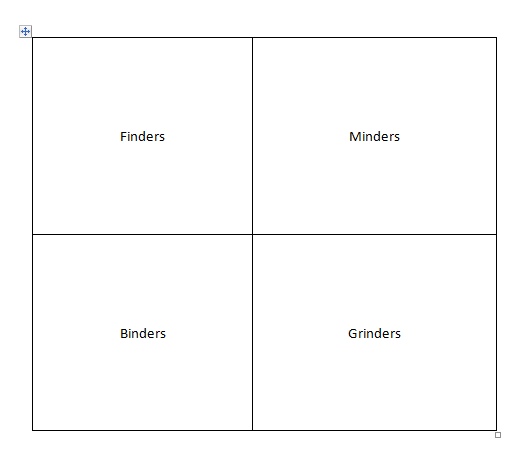
I think in diagrams: whether it be chessboards, corporate group structures, family trees; if I am addressing difficult problems, discussing typical issues which come up daily in my professional work, I will draw things out, even if only in + and – lists: and Donald Rumsfeld will always have my sympathy, for being pilloried about unknown unknowns, but he was right, and knowns and unknowns can be shown in a two by two matrix. But here, there are four kinds of partner, four kinds of partner skills, four kinds of board director skills, four kinds of senior clinician skills.
Finders, minders, binders and grinders was a concept I read about in a recent article by Mark Lee, who writes fairly frequently in my professional press, always in a refreshing and interesting way. My friend and I crudely classified many of our colleagues into their dominant quadrants. We could think of some colleagues who never won a client in their life, but who were excellent at day in, day out, producing high quality work and delivering big projects on time and to cost (as comparison, to show how universal this is: the academic who never won research funding for his department, but produced paper after paper): grinders. Colleagues who kept clients happy, where difficult or key times in projects were never fraught, who got repeat work because they were nice, easy or efficient to deal with: minders. Colleagues who kept colleagues happy and content: who organised social things; who kept the spirit of the department up; who baked cakes, or remembered people's birthdays, or knew the names of their colleagues' spouses, children, where they lived….binders. And colleagues who attracted new, significant projects, won clients from competitors: finders.
My friend is very strong on finding; very strong on minding; very strong on binding; and has a relative weakness on grinding. And all (not to demean it) that had happened was that his grinding weakness had come to the fore in management's eyes. But it was partly perception, and my core advice was for him to self audit, appreciate truly his great skills particularly in finding and binding, recognise the bricks he was facing, and decide whether to go over or round the wall. His grinding weakness needs to be managed, perhaps by ensuring he has staff working with him who are consummate grinders, partly by giving some more personal time to grinding.
The FMBG matrix can be extended into discussion of teams themselves. A team full of A* finders and E- grinders would fail; as would A* grinders, E- finders; as would a hospital department of A* brain surgeons, E- nurses: a composite, an amalgam, a blend of skills is needed in both individuals and teams.
For the last twenty or so years at work, maybe even longer, I have spent more time than others helping people with such discussions. It might be seen as being kindly, but is in fact selfish: since by discussing and thinking about others, I also think and try to help myself. Over the years, I have had colleagues who are pbricks, have met walls, and know that my FMBG matrix has not just weaknesses, like my friend has, but chasms. If the managing partners have good leadership skills, they will realise such things apply to us all, including themselves.
 Posted with Blogsy
 allanbeardsworth