Another puzzle for an easy Reitstein day: and Purdy #chess
White to play and win
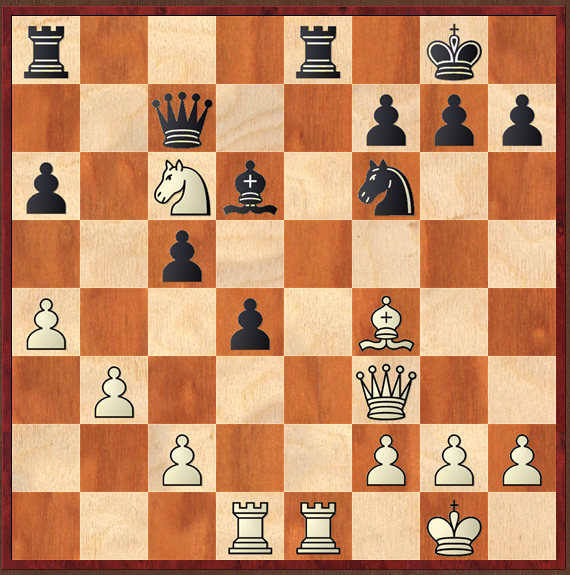
Source: Chess Today
Solution
I just couldn't get this one, and was annoyed at myself when I looked at the solution, having given up. It should have been within my capabilities. In this blog posting I explain why- just by following Purdy's rules.
Alas, and I suspect I am not untypical, my thinking is not structured. Despite the fact that I know it is a problem, that there is a solution, and if I wanted I could spend endless time on any puzzle. But no, I see the back rank mate motif, I see the x-ray attack on the Ra8, I see the surprise 1 Ne7+…get captivated by it! and then go round the houses trying to make it work after either Kf8 or Kh8. When I can't make it work, I try to readjust my thinking, but unsuccessfully. I eventually plumped for 1 Bg5 as being a worthwhile try.
CJS Purdy would be unhappy with me. Maybe I should read one or two of his articles again as a penance- they are so well written, they are always worth re-reading. But, know, I know his mantras off by heart and inside out, I just don't apply them:
Look for checks: Re8+, nothing; Ne7+, something, but on examination nothing;
Look for jump checks: Qf7+, nothing;
Look for biffs: Bd6, Nd4, Na5, Rd4….all nothing; but more on this later;
Look for jump biffs: the Qf3 is hitting the Ra8; something; Qf6 nothing; Bf4 is hitting the Qc7; something;
Look for ties: the Re8 is tied to defending the Ra8;something;
Look for pins: the Bd6 is pinned by the Bf4;
Look for nets: nothing- none of black's pieces look restricted.
Imagine that the opponent's threats can't possibly be executed, what would you want to do?; so, ignore the threat of Bf4: clearly, back rank mating is what should be looked for;
Whilst not Purdy mantras, I would also add:
Look for retreats: nothing (I include it because my Cordingley experience has shown that I often overlook retreads, both when attacking and defending);
Look at geometry: nothing- this test is probably no more than looking of jump checks and biffs, but nice to look for diagonals, ranks and files, to look for alignment, and to ensure the full breadth of each piece's powers are examined. I often fail to look wide enough.
If I could follow this regimen, in the way a professional golfer always goes through the same mental process of preparation, visualisation and thinking before playing each and every shot, maybe I would improve my ability.
Writing this blog has been interesting: the sheer number of biffs, checks and jumps is quite illuminating: it would be a good training exercise to count them all, to try to ensure none are overlooked. Here, in my above notes I omitted one biff, 1 Re7!! which I didn't even consider, but as soon as I saw the move in the solution, I saw its effect- and realised I couldhaveshouldhave seen it.
We know from the Purdy analysis that the Bd6 can't take it; and if the Re8 takes it, the Ra8 is LPDO do a jump biff. So all that is needed is to examine 1…Re7 when 2 Bd6! Qd6 3 Ne7+ wins the exchange.
So is 1 Re7 simple? In a way yes, which makes it all the more galling that I didn't see it. It is a surprising, daresay shocking move, and that is why I didn't see it- and I suspect that is how most chess players think, at least amateurs. But playing by Purdy rules would have enabled it to have been found.
 Posted with Blogsy
 allanbeardsworth