An interesting problem for an easy Reitstein day
White to play and win
A difficult one- took me a long while (*) to solve it, but was pleased when I did. (**)
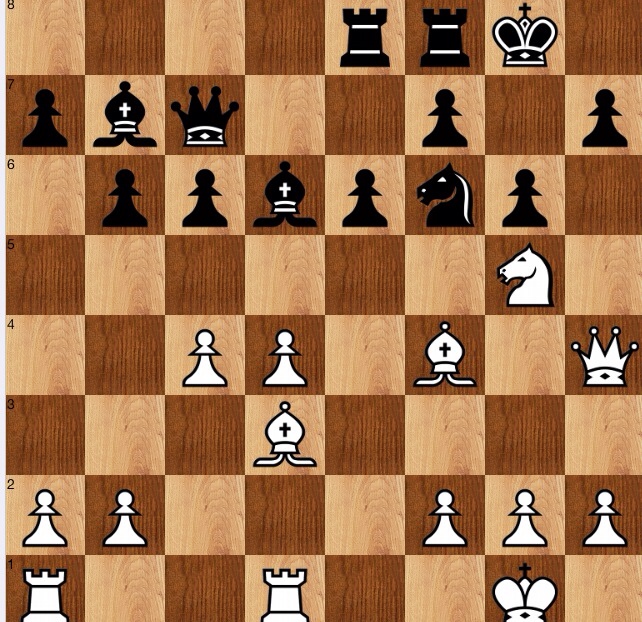
M Foisor v V Bianco, Hastings 2013
Solution
This was for me, a toughie. I saw it in Chess Today (issue 4,801). I would say that three quarters of the Test Yourself! puzzles in Chess Today I solve more or less instantly; half of the rest, after the standard English unit of time (the time it takes to make a cup of tea); some of the remainder I think I have solved, but then the solution proves I have made a total error, or missed a nicer win; and the balance are fiendish. This one took a whole dog walk to solve.
I had to go through step by step, using the Purdy principles, plus some of my other favourite techniques, such as John Nunn's LPDO (loose pieces drop off). These analyses resulted in:
- Nf6 is a LPDO, but alas, no easy way to exploit it;
- All biffs examined, including noting c5 bc dc, with the Bd6 pinned by the Bf4 to the queen;
- Noting that if Bd6 Qd6, the Bb7 is then another LPDO
- The Nf6 is tied to the defence of the h7 square
- Jump checks and jump biffs noted, and in particular the jump check Bh7+, which would be relevant if the g6 pawn were to move
- (Not a Purdy technique, but Aagaard's 'bringing all pieces to the party') Rook lifts didn't seem fast enough, with black ready to push Pe6-e5.
- Biffs and threats to biff: from here, the solution started. 1 Be5! biffs the LPDO Nf6. If 1…Nh5 then 2 Qh5! and as noted above, if 2…gh 3 Bh7 is not just check, but mate. So 1…Be5 is forced, when 2 de Qe5 (2…Nh5 3 g4 is a bit messy, but white must be winning) and the key move is then to biff the Q, 3 Nf3! Once this is seen, you are on the home straight in terms of analysis. The Qe5 is tied to defending the Nf6, but after 3…Qb2 4 Rb1 Qc3 5 Rb3 it must leave the diagonal.
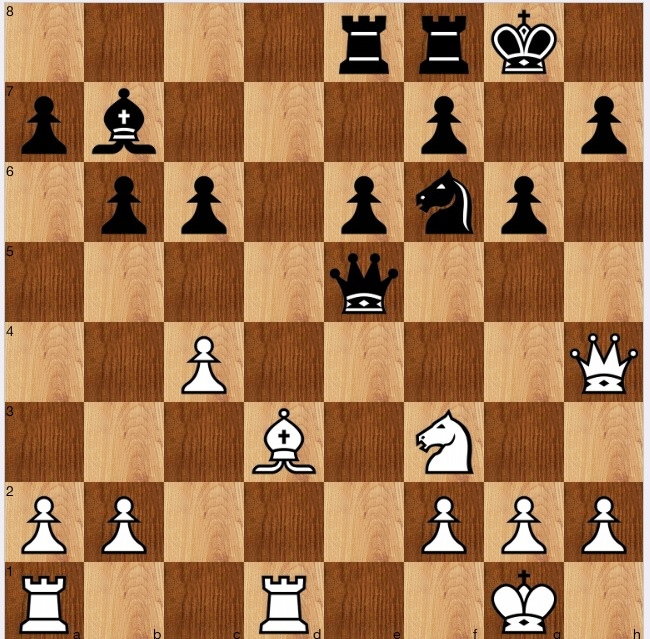
But (**) that is not everything. Instead of 4…Qc3, black can play 4…Qa2 and at least acquires another pawn for his knight.
Is this a win?
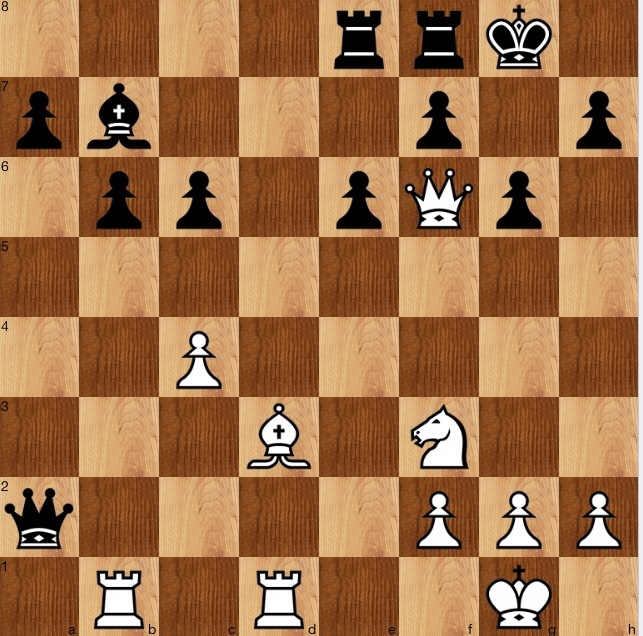
Position after 5 Qf6
This position was actually reached in the game, and white did indeed win: he managed to win the a7 pawn, after which it was a mop up. Yes, white is winning, but it is the type of position that I sometimes let slip away: I wouldn't be confident of Beardsworth 1-0 Carlsen from this position.
Recap
The main problem is very nice: and the methodology worked, for me. Whether it would work in a practical game I am not so sure: I might have played 1 Be3 or 1 Bd2, and the game would go on, for instance with 1…e5.
 Posted with Blogsy
 allanbeardsworth