Test your chess: Reitstein problem 54
Black to play: one king move loses, one draws, one wins: which?
(Alas: cooked: worth looking at for a while, but two moves draw: it is worth looking at, since the draw after the better defence is not obvious)
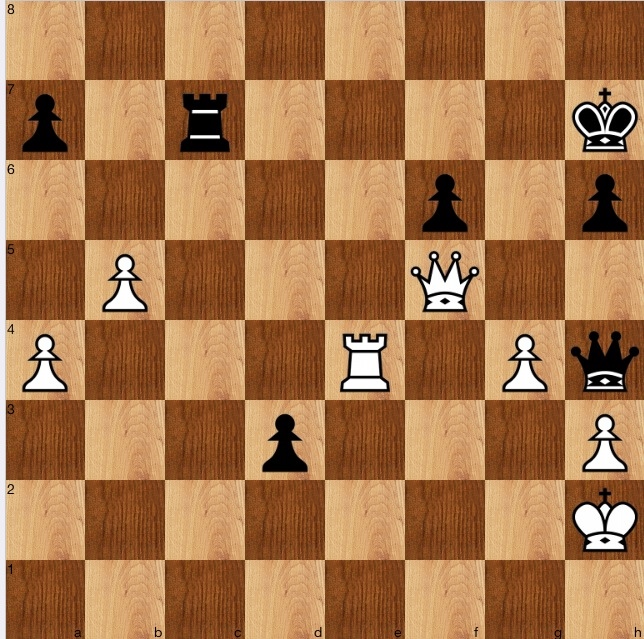
K Hill v WND Gregory 1974
Solution
1…Kg8??
Loses, because of 2 Qg6+ and 3 Re8 mate, whether black plays 2…Kf8/h8 or 2…Rg7.
1…Kh8
This is given by Reitstein as winning, his line being 2 Re8+ Kg7 3 g5 Qg5 'and black's e3 (sic) pawn is too strong. (I have checked the initial position with the pawn instead on e3, but the problem still doesn't 'work').
However, 3 g5? is poor, and instead 3 Re3 holds the balance; and so does 2 g5! To make it worse, the move I thought of, 2 Qf4! also draws: I found this move by examining all biffs, noting also that on f4 the queen also looks at c1.
After 2 Qf4, black has to draw by 2…Rc2+ 3 Kg1[] Rc1+! with perpetual check, since 4 Qc1 Qg3+ is also perpetual, one aspect being the Re4 is LPDO: so if white tries to escape with his king to the queen side, he risks being worse.
1…Kg7
This looks to me to be the better try: the king 'looks' safer on g7, though that it is a weak perception. If 2 Qf4? Rc2+ 3 Kg1 d2! and white only has a spite check: 4 Re7+ Kf8 0-1.
However, white has a lovely defence: 2 g5! and black must take the Rc2-Rc1-Rc2 perpetual check.
Comment
Whilst flawed as posed, I enjoyed this puzzle, taking time over it. After a while I saw that white's defence is possible because black's queen is offside, tucked away, and the queen's checking squares are and can be controlled. I was particularly pleased to find the Qf4 solution against 1…Kh8 by applying the Purdy the technique of examining all biffs.
 Posted with Blogsy
 allanbeardsworth