Another puzzle for an easy Reitstein day
White to play and win
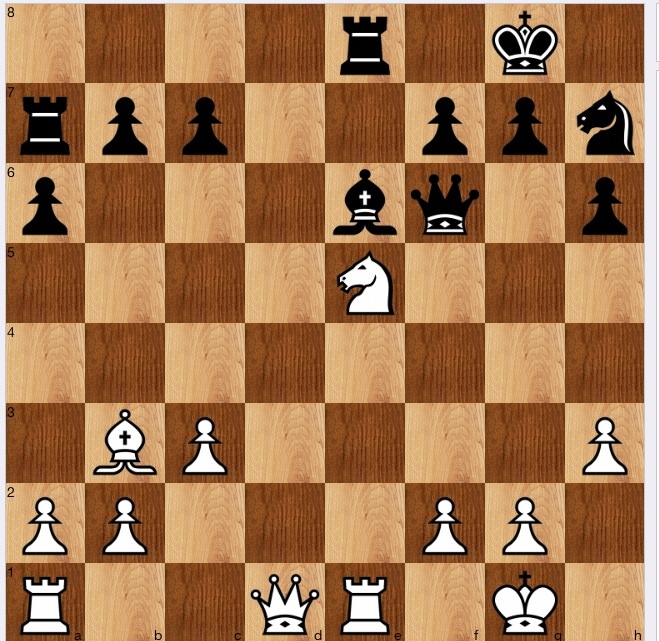
G Sax v B Rogulj, Slovenian team championship, 2003;
Position seen in Malcolm Pein's Daily Telegraph column
Solution
1 Nf7! is an obvious biff, but does it win? I find such tactics hard to compute, given that black has several variations. In Kotovian tree terms (from Think Like a Grandmaster) there are a thicket of variations, not just a single branch.
In my initial assessment of the position, I noted that the Ra7 is a LPDO, but thought it might not be relevant to the solution, though if white were to get Qd4+ or Qc5+ in, so Black king at f6 or f8, then the tactic works. The other Purdy motif to note is that the Re8 is LPDO and vulnerable to a jump check by the Re1.
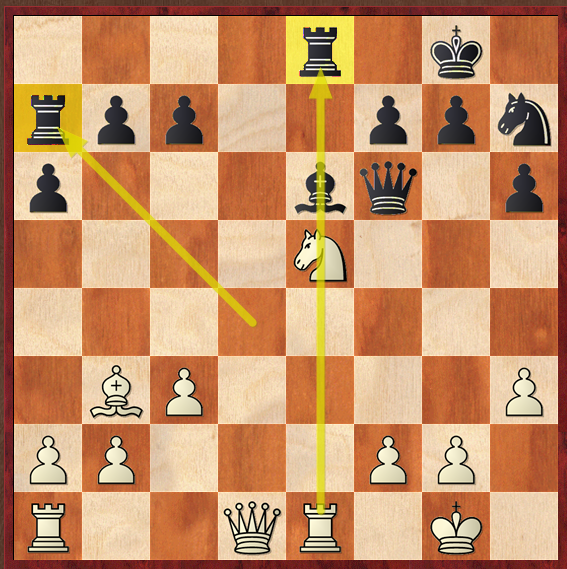
LPDOs and jump check
So, 1….Bf7?? is clearly bad, since the Bb3 then pins the Bf7, so that the Re8 is LPDO- so 2 Re8+ wins trivially.
Black therefore has three defences worth considering: 1…Kf7, 1…Qf7 and 1…Bb3. In practice the number of possibilities, with no immediately obvious solution, might make me fritter away my advantage, playing something poor like 1 Ng4 (with the idea of 2 Qd4) but all this would do is improve black's pieces: and likewise 1 Qd4 just improves black's rook, connecting and removing two LPDO rooks after 1…Ra8.
1…Kf7
The easier one for me to visualise. 2 Re6 Re6[] 3 Qd7+ Qe7 Be6+ Kf6 and now 5 Qd4+! and the LPDO falls off. Nice.
1…Qf7
Harder, but even nicer: 2 Re6 Re6[] 3 Qd8+ Nf8[] 4 Qb8! and the Ra7 is trapped. This was the game continuation, 1-0.
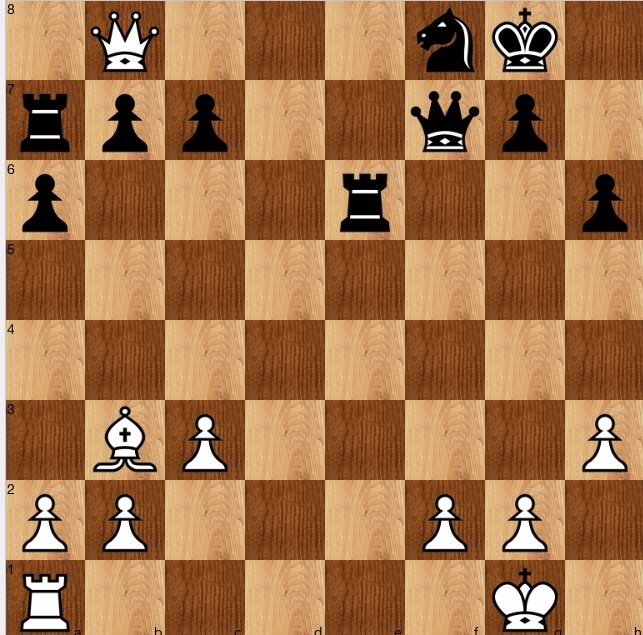
1…Bb3
This was, but perhaps shouldn't have been, the hardest for me to visualise. 2 Re8+ Kf7 (2…Nf8? 3 Qb3+ 1-0) 3 Qd7+ (the move it took me a while to see, blinded by the fact that when the bishop is on e6, this move isn't possible) and 4 ab 1-0.
Who would have thought that the Ra7 was a central factor in this position? If instead there were no rooks on a1 and a7, then the combination would not have worked. However, John Nunn's loose pieces drop off works a treat here,
 Posted with Blogsy
 allanbeardsworth