Test your chess: Reitstein problem 61
Black to play and win
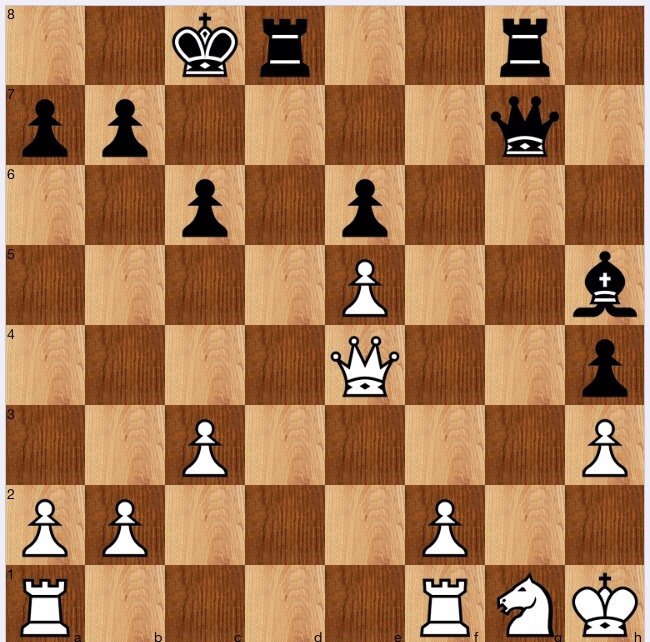
M Rieck v E Bergendorff 1940
Solution
A really tough puzzle, which took me a while to solve. Clearly the aim is to break white's queen's line of sight to g2, but how to do so?
Examining all biffs at first led nowhere: 1…Qg1+??; 1…Rd4??; 1…Qh7?? all need to be looked at, all to no a avail. For a while I focussed on another biff, 1…Bf3+, which forces 2 Qf3, when 2….Rdf8 is met by 3 Qg4, as is 2..Rd3.
Eventually, I saw it: reverse the move order or examine all threats to biff leads to the winning idea 1…Rd3!! which otherwise is really hard to find. Once seen, everything falls into place. The rook clearly can't be taken, the Qe4 being tied to defending g2, and the threat to biff is Bf3+: an examination shows this can't be met.
All the bold items are approaches recommended by CJS Purdy except for reverse the move order, which I learnt somewhere else: trying to understand the merits of Purdy's maxims more, 'reverse' isn't actually needed, since 'examine all threats', if applied properly, reveals the winning move.
Had it been a game, I think it would be highly improbable that I would find 1…Rd3!! Partly this is the result that the approach to a problem, where you know there is a solution, is different from a game, where there are no clues. However, would it really be impossible to adopt a 'professional' approach, a 'methodical' approach, to each and every move, and apply Purdy techniques? For me, it would be impossible, but if I could achieve it at least in the majority of positions, maybe my strength would increase? Had, for instance, there been a piece on d3 (say a white squared bishop) I would certainly have examined the biff Rd3: pity I couldn't quickly have seen the threat to biff Rd3.
More to learn, but a really good problem.
 Posted with Blogsy
 allanbeardsworth