An interesting moment in Karjakin-Topalov #chess
Yesterday I took the day off work, to drive for a total of about seven hours (longer on the way back, due to a series of accidents on the motorway) to pick my elder daughter's things up from Durham University. The astute, eagle eyed reader, will note that I didn't say 'to pick my daughter and her things up…said daughter and her friends departed, a nanosecond after my car was loaded, for the ferry to Amsterdam. Note to readers who are pregnant, or with babies, young or pre-Uni children: this, too, will happen to you).
Not that I minded. The journey over was a pleasure, weather was glorious, and through Instacast I had plenty of things to listen to. I also set my travel times to enable me to get to somewhere near Durham (I was under order from Alice to be flexible about arrival times at college, since she was busy with lectures and packing, and parking on the North Bailey was time restricted) so I found a café with wifi and got an hour or so's work in. No I didn't, I watched the key couple of hours of round 7 of the Candidates tournament in Khanty-Mansitsk.
Note to Chessbase: on a future upgrade of the otherwise excellent Playchess iOS app, please can we have the facility to view say four games at once, or at least two games. Round 7 was particularly good, in what so far has been an excellent tournament of fighting chess. I loved Aronian's smooth win over Karjakin (and loved that he won too) and hadn't the foggiest as to who was winning in Kramnik v Mamedyarov.
This blog, though is about a move from an earlier round which caught my eye: a little move by Topalov (who got crunched yesterday, quickly and badly, by Andreikin).
Comsider all biffs, LPDO and Potassium Cyanide
(Alas, as happens on occasion, and I can't correct it, the formatting has gone awry: sometimes this happens with the app I use, Blogsy: it creates endless false formatting. Fortunately this occurrence is very rare)
I wonder if Topalov has read CJS Purdy? Probably not, and of course he has no need to, such instructional writers are far beneath the elite. But the following, what I thought was a quite dull position, in fact sparkled.
Black to play: what would you play?
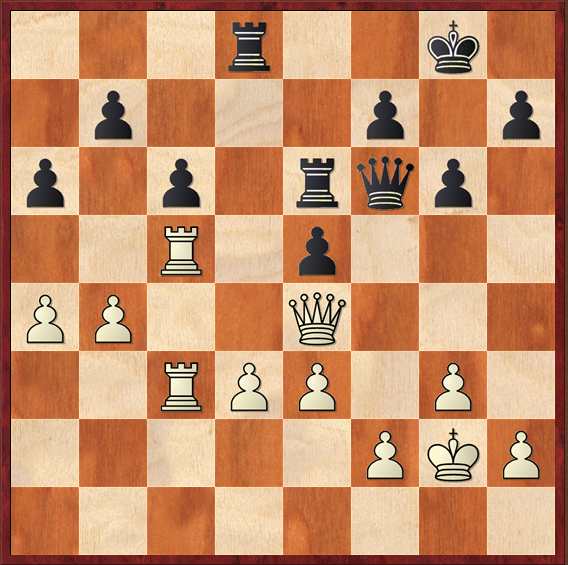
White's last move was a3-a4.
I had watched this game on and off live, though it wasn't the most interesting game of the day (is Karjakin modelling his style on Leko?) and I thought we were in for a standard minority attack, which was either nothing, if Topalov could defend, however painfully, or would result in say a rook plus four vs rook plus three ending: so, dull, or should I say technical.
I never imagined for one instance Topalov's move in the above position. Shame on me, in my quest to be a Purdy player.
Consider all biffs
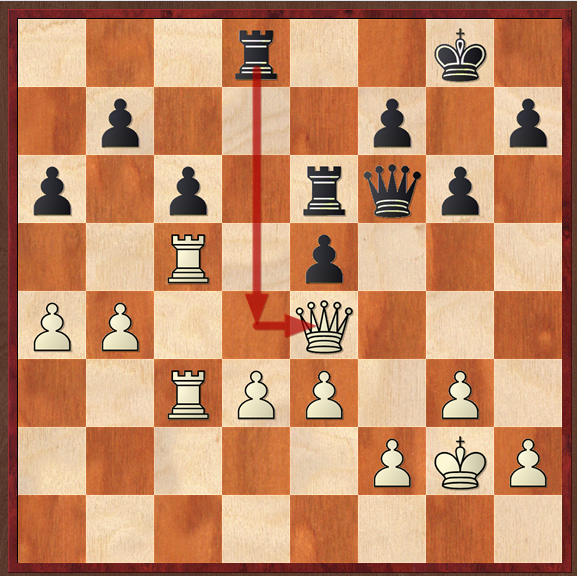
Topalov played 1…Rd4!! (exclams for imagination) and as soon as I saw it, I (a) understood why (b) was annoyed with myself. Karjakin took the rook, so 2 ed ed and then chose to create a minor imbalance, 3 Qe6, rather than simplify into a rook and pawn ending.
Instead, if white had played the much weaker 2 Qf3, two motifs come into play. The major one is again consider all biffs, since 1…Rd4! not only biffs the Qe4, but also biffs the LPDO b4 (note to myself: I would never have noticed that a3-a4 created a LPDO on b4).

Potassium cyanide
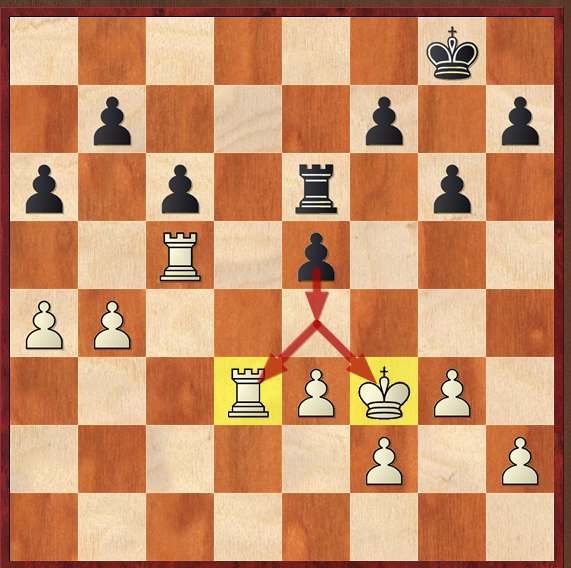
There is also a potassium cyanide motif here in this position. Not that it is a particularly good example, but (after 1..Rd4 2 Qf3? Qf3+ 3 Kf3 Rd3 (Rb4 is better) when after 4 Rd3 e4+ forks the rook and king: here, though, it only leads to equality.
For those interested, the game file is attached. http://www.viewchess.com/cbreader/2014/3/22/Game403454812.html
 Posted with Blogsy
 allanbeardsworth