Test your chess: Reitstein problem 88
White to play and win
Reitstein's hint: white found a pretty move to force the issue in this position. What did he play?
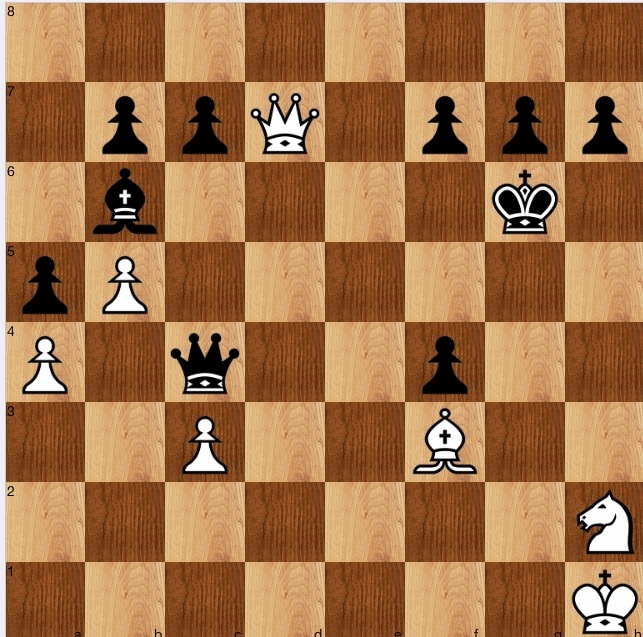
PNJ Smit v J Wolpert 1964
Solution
Alas, if, like me, you followed the hint, you would have been misled, since the problem is cooked.
First, the correction solution is 1 Bd5!, the obvious move which in a game I would play quickly. All I would need to check is that black has no checks (he doesn't, the Nh2 protects f1) and a cursory look at 1…Qc3 2 Qf7, seeing that if black doesn't move Kg5 then his f4 pawn drops off, and, if he does, Nf3+ comes next. And Stockfish says white is then significantly better, as seems fairly clear.
However, influenced by the hint, I saw 1 Bh5+!?, exclam since it is flashy (but Purdy's consider all biffs means it would be found), question mark because it throws away the advantage. I will come to why in a moment, but how it is meant to work is:
1…Kh5? (the move played in the game) 2 Qf5+ Kh6 (2…Kh4 3 Qg4 mate) 3 Ng4 mate: simple enough;
1…Kh6 2 Qh3! (I was pleased to find this move)
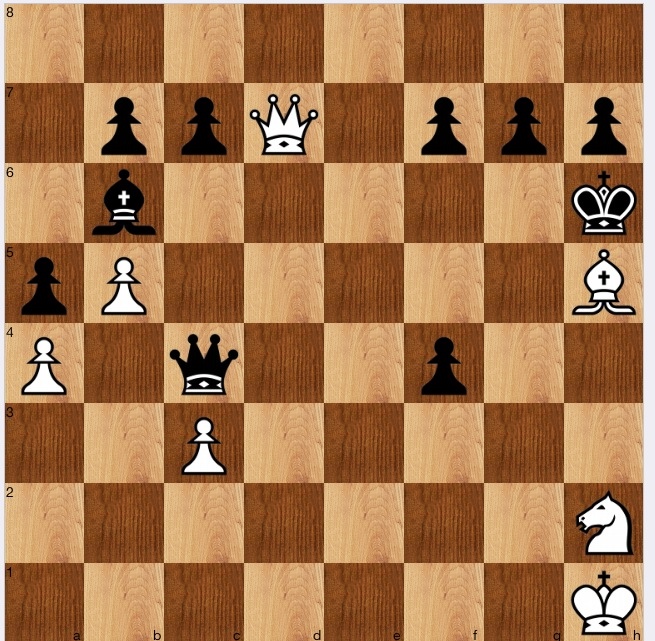
The pin after 2 Qh3 is horrible. 2…Kg5 3 Nf3+ Kf6 4 Qh4+ Ke6
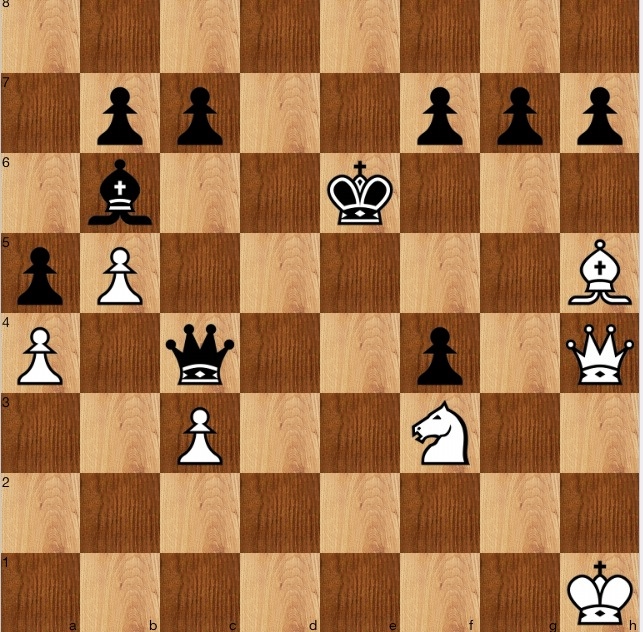
5 Bf7+ and black can only choose to lose his queen by either the bishop skewer or knight fork on e5.
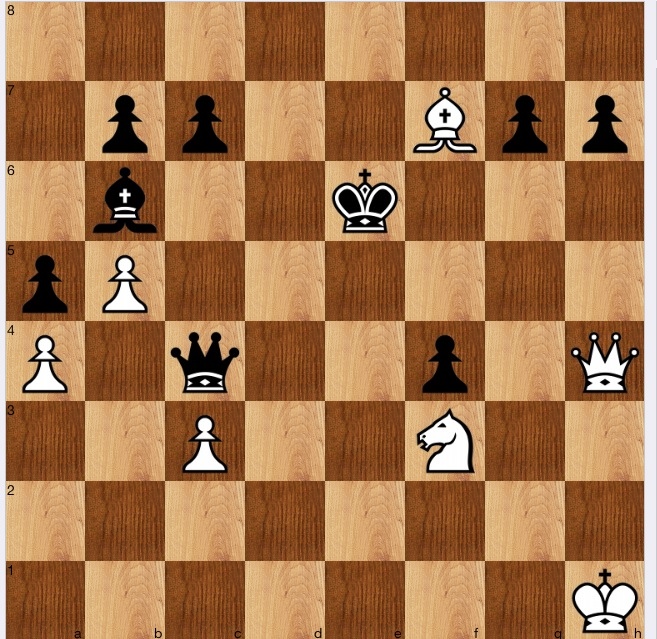
I was pleased to see all this line, though it is not too hard, when you notice in your initial appraisal that the Qc4 is LPDO and that on that square it is in checking distance of the knight when on f3- so g6 and f7 are mined squares for the king, once the N is on f3.
1..Kg5 2 Nf3+ Kf6 (2…Kh6 3 Qh3! transposes) 3 Qd8+ Ke6[] and the same skewer 4 Bf7+! again decides.
But, why encourage the Nh2 onto f3 where it is clearly improved, which is what 1..Kg5? does. So, 1…Kf6! and the game is level, or, rather, any result is possible. Note that the otherwise pretty 2 Bf7 (which plans 2…Qf7 3 Ng4+ Kg6 4 Ne5+ 1-0) loses to 1…Qe4+.
White's best after 1…Kf6! is the tricky 2 Qd8+! when only 2…Kf5![] holds the balance. Both alternatives lose, both in pretty ways, showing the great geometry of the chess board and the importance of LPDOs.
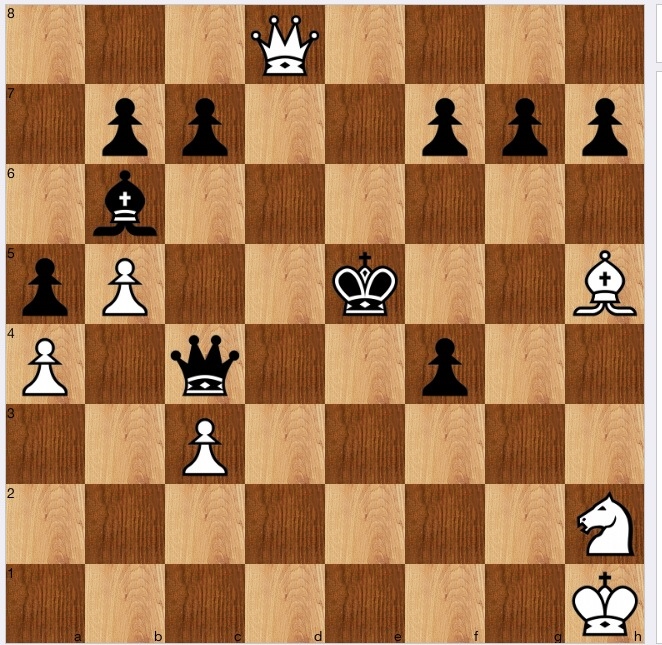
First, 2..Ke5, when 3 Nf3+ Kf5[] 4 Bg4+!! Kg4[] 5 Ne5+ forking the king and queen in a different way.
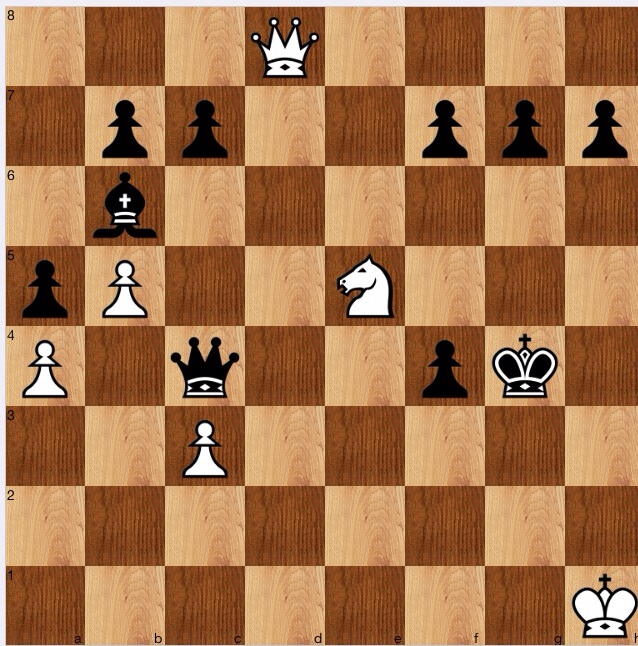
So, 2…Ke6 3 Bg4+ f5[] 4 Qg8+ skewering the king and queen in a different way.
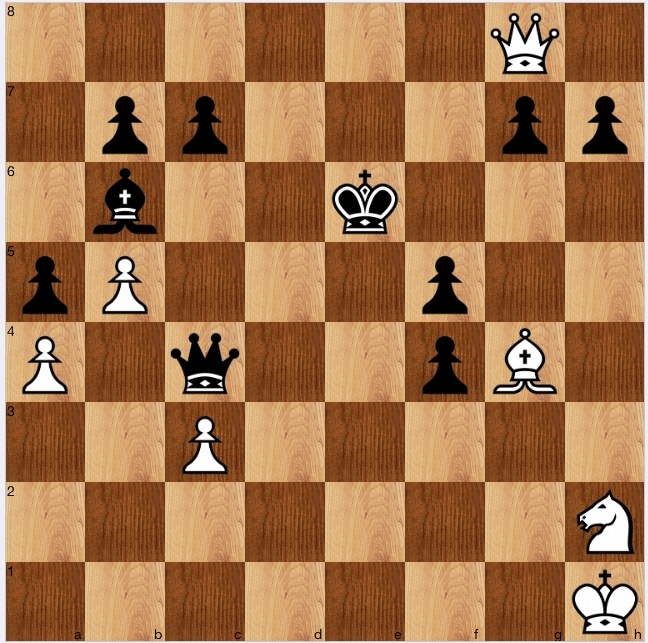
When such things work, chess is certainly a magical game.
Reitstein's solution is too brief. He gives the game continuation and says that if the bishop isn't taken, black loses quickly. By so doing, some very pretty lines are missed, and, an incorrect solution is given. 1 Bh5+ draws with best play, whilst white is better after the simple 1 Bd5.
 Posted with Blogsy
 allanbeardsworth