LPDO #chess
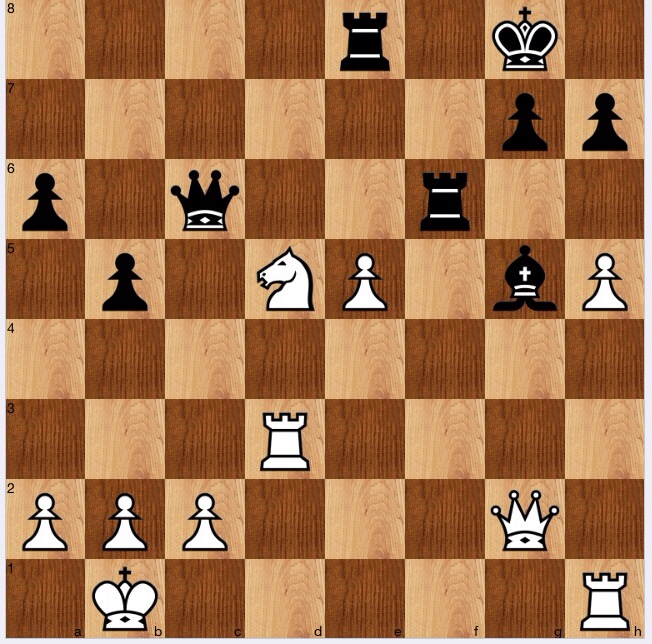
White to play and win
Find the winning move AND overcome the best defence.
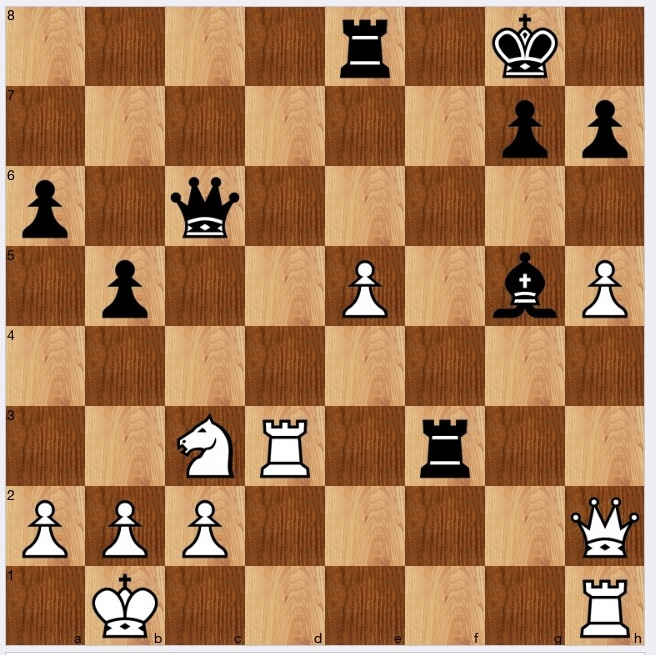
D Kokarev v S Dvoirys Khanty-Mansiysk 2013
Puzzle seen in Chess magazine.
Solution
Yesterday, we walked along the eastern shore of Derwentwater, near our home in Borrowdale.

As is my wont, I took a handful of chess puzzles, photocopies and cut out into singles, to be able to solve during quiet times, for instance when the family has broken into a long line, or when I have nothing else that I want to think about (I do a lot of my best thinking for clients when walking in the Lakes).
The above puzzle was the nicest of the day, and gave me great pleasure to solve and especially to overcome the best defence.
In this highly tactical positon, black's pieces hang by a thread, or, in an acronym, LPDO, to use one of my key chess tools, loose pieces drop off, as coined by John Nunn. Here, black has two LPDOs:
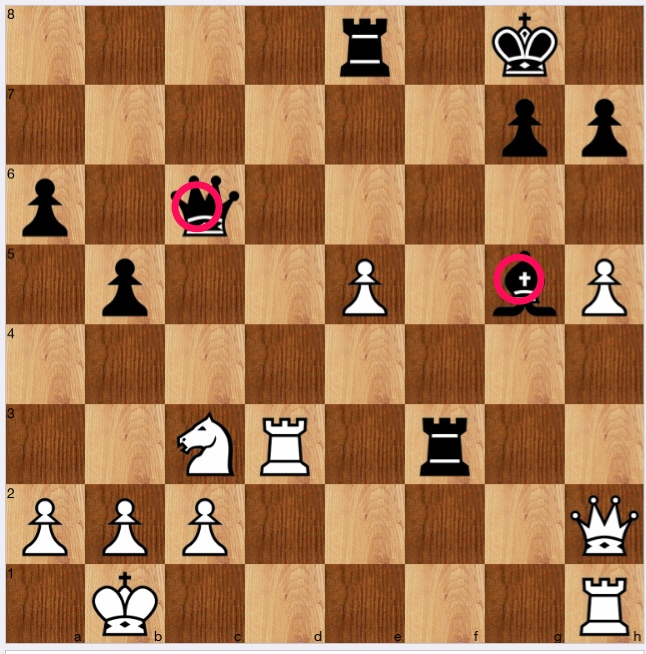
So, 1 Qg2! is a double attack, hitting the LPDO Bg5, and hitting the once-defended Rf3, which is pinned against the LPDO Qc6 (or, Purdy's jump biff notion applies here: from g2, the jump biff Qc6 is 'threatened'. At first, all I needed to check was that 1…Rd3 or 1…Rf1+ didn't cause a back rank nasty, which they didn't…so is that the solution?
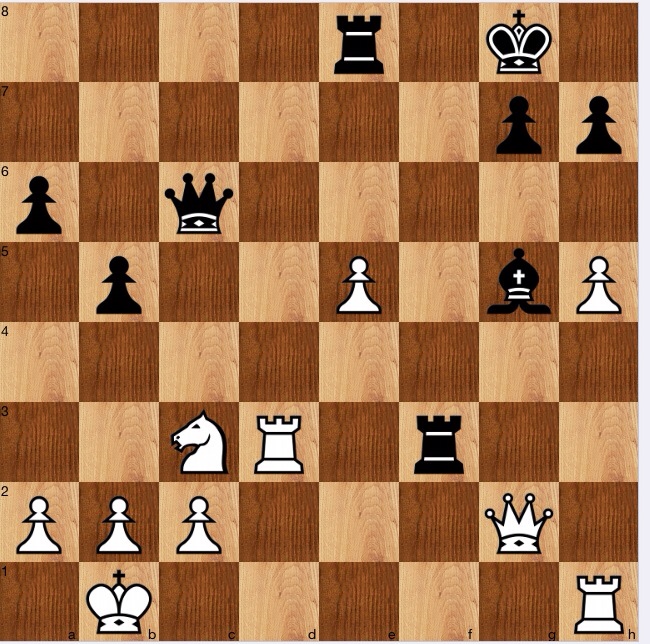
Fortunately, realising that I only cut out the hardest puzzles from Chess magazine (I always solve the 'easy' page more or less by inspection, the 'middle' ones normally fairly routinely, and then get down to the 'tougher' ones, cutting out those with which I struggle), I knew there was more, and then saw 1…Rf6!
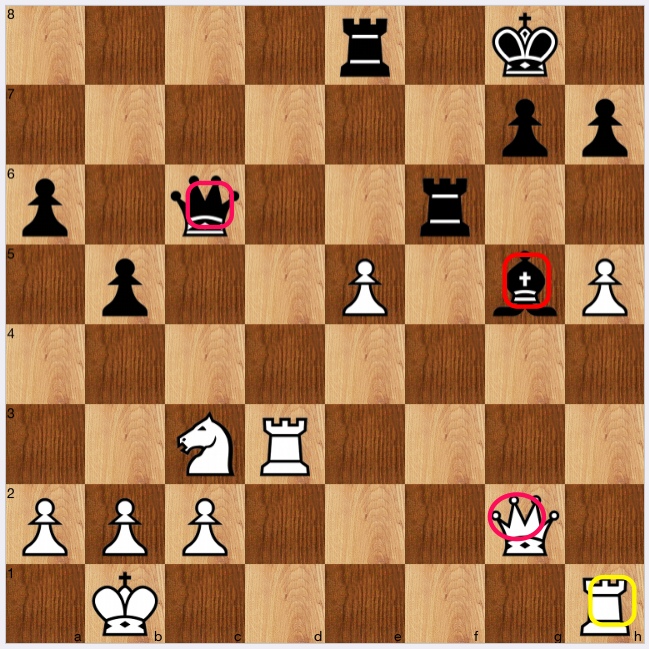
Here, the Bg5 and now the Qg2 are LPDO; and there is a jump check, Qc6-h1, if white plays Qg5 (leaving the h1 as a. LPDO).
So, 2 Qc6? is routine, 2…Rc6 means that nothing is protected, and, to quote Jon Speelman, 'the game goes on'. Black might well be better, since he can attack the e5 pawn which may fall, and, if rooks then come off, black has the better minor piece. I checked 2 Qg5? and 2 ef? (examine all biffs) before seeing 2 Nd5! when it is game over. The threat to biff on f6 blocks the h1-a8 diagonal, reopens the threat to take on g5, so black's best is to struggle on in a lost ending after 2…Re5[] 3 Nf6+ Qf6[] 4 Qa8+ Qf8[] when I would be tempted to play 5 Qf8+ rather than the move Stockfish prefers, 5 Qa6. Taking queens off is likely to safer, whatever that means, and after the forcing line 5…Kf8[] 6 Rd6 a5[] 7 Ra6 a4[] 8 Re1+ Ke8[] 9 Ra8+ Ke7 10 Ra7+, the g7 pawn drops off. The line, whilst long, is calculable, since all black's moves are forced: it is also quite cute, since the aim of Rd1-d6-a6 is not to win the a pawn, but to take on g7.
To possibly extend the LPDO concept too far, in the endgame, the a6 pawn is LPDO, biffed by Rd6; when on a5, it is still LPDO, biffed by Ra6, and then the g7 pawn becomes LPDO, and, indeed, it drops off.
“Love LPDOs is are all around” as someone might sing.
 Posted with Blogsy
 allanbeardsworth