Test your chess: Reitstein problem 173
Problem: see below
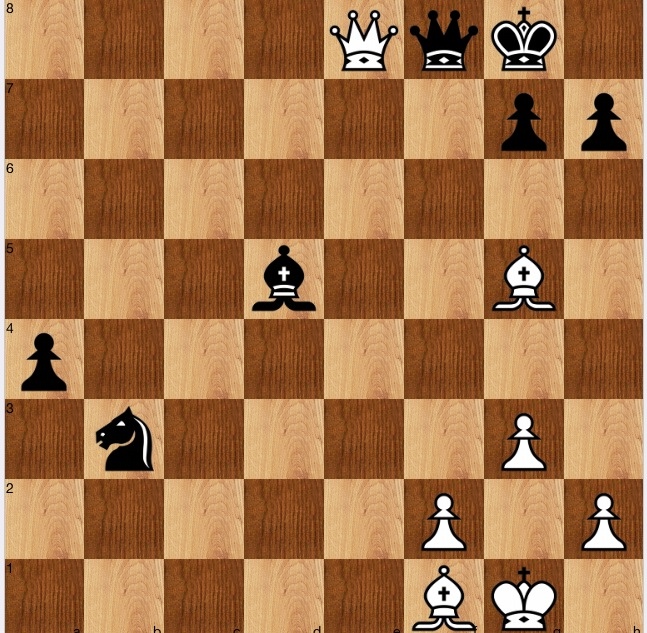
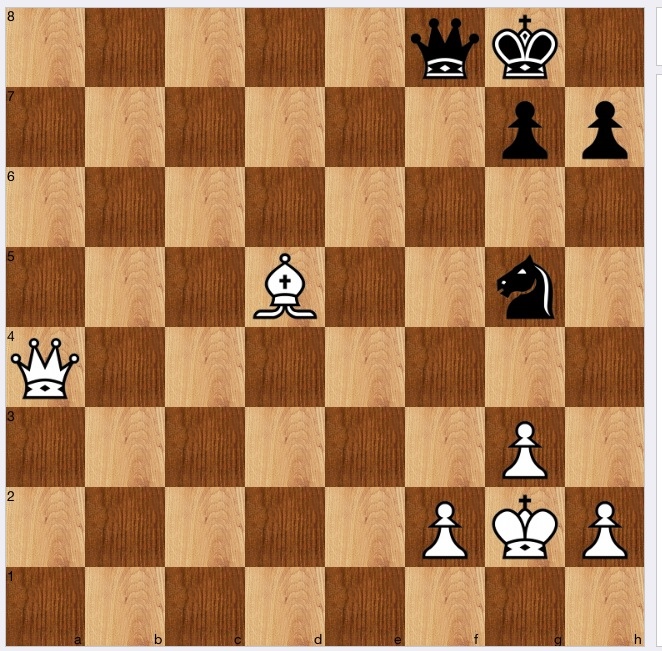
D Wolf v D Macfarlane 1983
Reitstein's rubric (slightly amended) was: White played 1 Qa4 here, and doubtless thought his winning prospects were now high. But Black's reply came as a surprise and White had to find the only move which secured the draw. What was black's reply to 1 Qa4 and then what?
Solution
Today is my birthday, so I was hoping the daily Reitstein would be a good one; and it didn't disappoint, even if, as we shall see, it is slightly cooked. It is a good exercise.
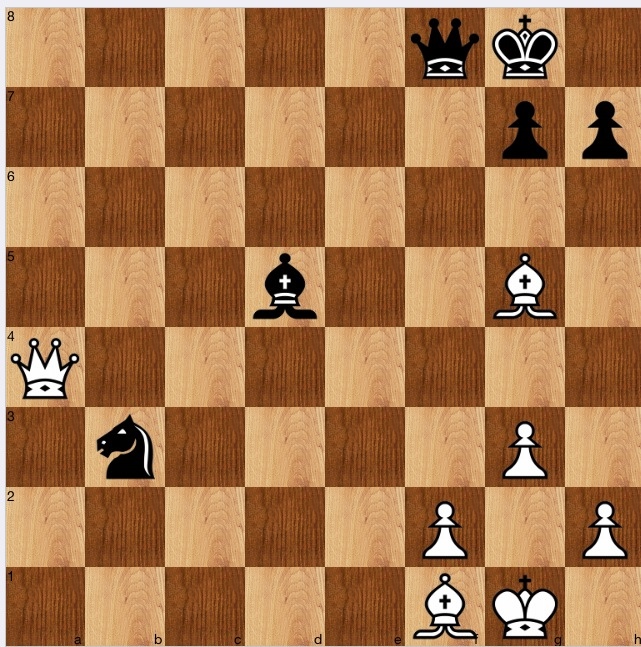
The disadvantage of a puzzle book with rubric is that it provides hints (the advantage is that it provides colour). So here, one knows that black's move has to be a surprise, and it is easy to see that since 1…Qf3 fails to 2 Qe8+, the move has to be a deflection from e8 of the white queen, so 1…Nd4! is not too hard to find.
Then, it is clear that 2 Qd4? would be a blunder, probably losing to 2…Qf3: I say probably, because after 3 Qd5+[] Qd5 4 Be3, white might be able to form a fortress.
White might have a fortress?
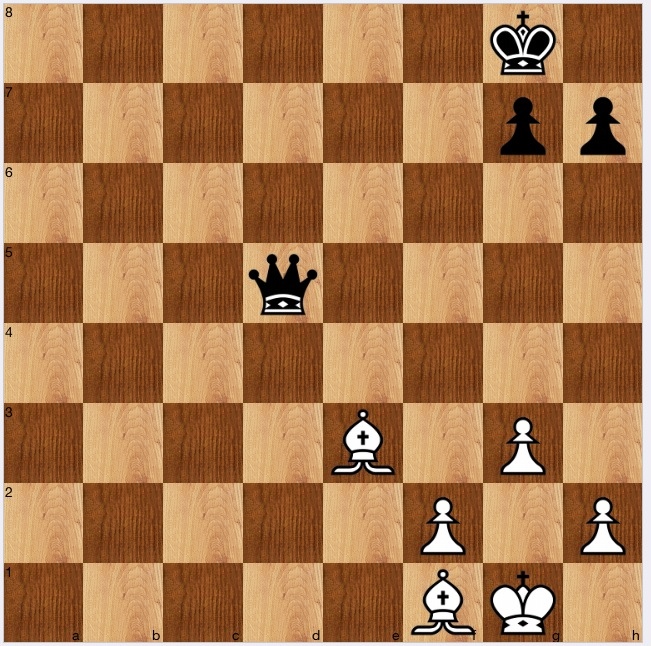
(I suspect white does have a fortress here; by the way, the term/notion of fortress is something I learned in my forties. To my knowledge, or at least based on the endgame books I studied as a teenager (not many) the term wasn't then used – perhaps I am showing a lack of chess culture here)
But back to the main line. As soon as I saw 1…Nd4! I also saw 2 Bc4!, and, thinking it was the only move, turned to the solution: 2 Bg2: so I looked a bit more, and saw that both bishop moves at least save the game, but in fact 2 Bc4! is better.
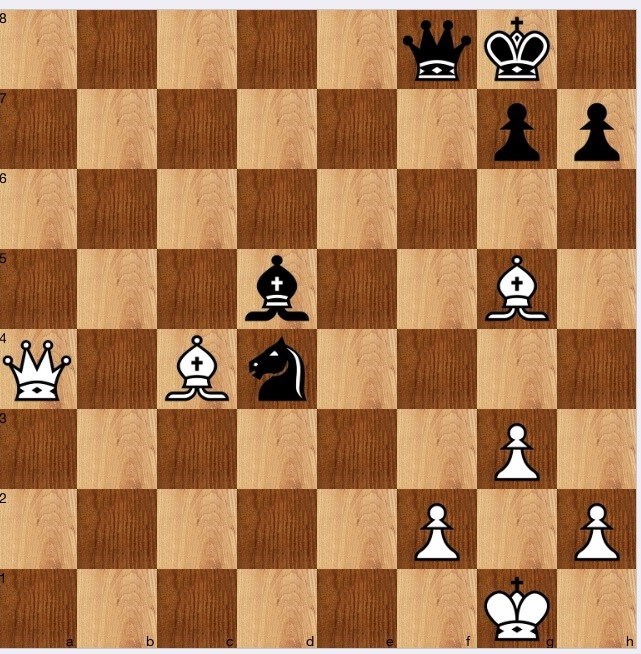
Black can't of course take on c4 (2…Bc4 3 Qd4+ and the LPDO Nd4 drops off) nor can he support the Bd5 by 2…Qf7 (2…Qf7?? 3 Bd5 Qd5 4 Qe8mate) so he must either check on f3, or retreat 3…Be6. I think 3…Be6! is best, when after 4 Be6+ Ne6 5 Be3(say) no-one is winning (or, at least, only Carlsen is winning, whichever colour he is).
3…Nf3+ is more fun, though. 4 Kg2 Ng5 5 Bd5+
Black can either play Nf7, or wait for h4 kicking it there. So 5…Nf7 6 Qf4! and this position is reached.
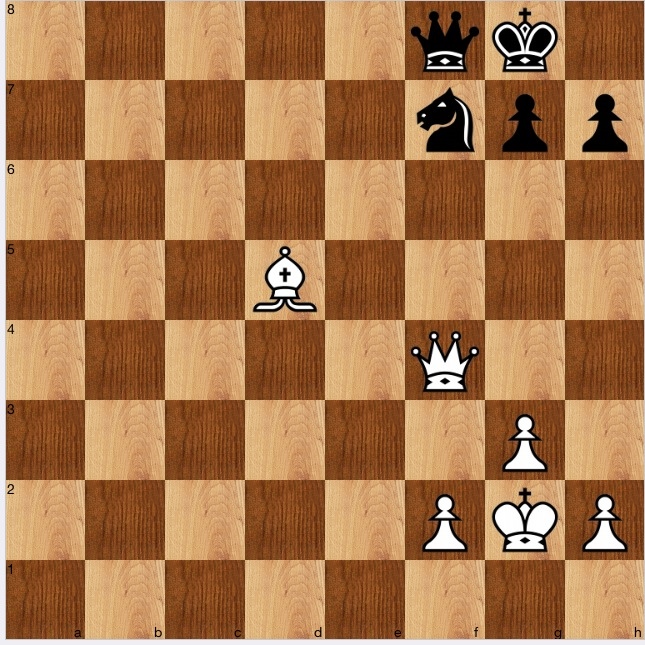
It is clear that black is trussed up, but is the tightness sufficient? I played it out as white against Stockfish, and it squeezed out, but when I changed the colours and tried to defend, its squeeze was cobra like. Instructively, it made a series of super moves from this position, improving the queen first before advancing the pawns. At the end of this posting I give some comments, but I would recommend this position to study.
Problem: how to maximise this position as white?
(Comments below, at the end of this posting)
2 Bg2
Here, the draw is closer. Personally, I would play 2…Bg2, when after 3 Kg2 Qf3+ 4 Kg1 Qe4! the a8 and e8 squares are covered, and there is a N check threatened, winning the LPDO Qa4, so white has to do a few checks to get his queen to safety (5 Qc4+ Kf8[] 6 Qc8+ to start with), then protect his bishop, and then hope there is not a winning Q+N attack: in practice, it is the sort of position I would have kittens playing white, despite the pawn advantage. However, Stockfish prefers 2…Nf3+ when after 3 Kh1 white is trussed up, and can't be better: level.
Returning to the Nf7 Qf4 line, Stockfish first of all improves his queen: Qe4! to prevent Qe8 or Qe7;
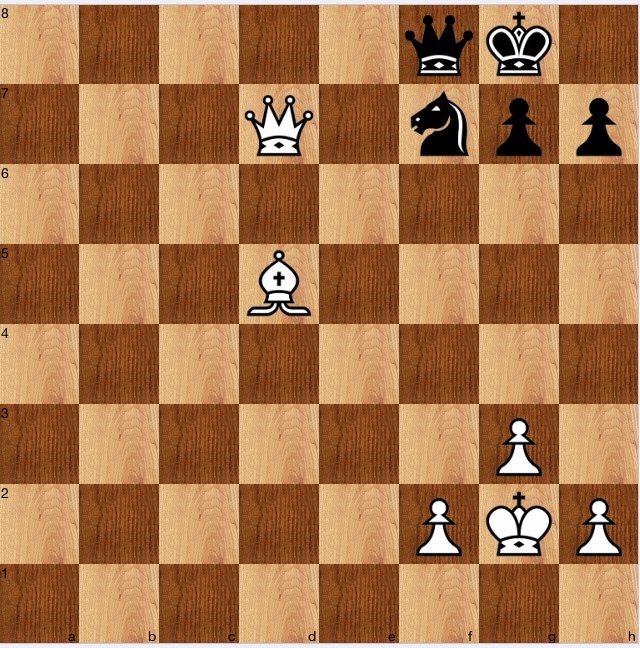
Qe6! to force black's queen to stay on or return to f8; and Qd7! to control not only e8 and e7 but also to pin the N and K after …g6 and Kg7. Only then does white trundle up with his pawns. Black has plenty of defensive options, and one could delve into lots of computer lines (eventually white must try to break through with his pawns, and then it is open season, but the art in white's play is to restrict black's options when the position does open).
I suspect it the sign of a super GM to play such positions as white to perfection.
Finally, when writing the above up about Qf4 and the wiggly improvement path Qe4-e6-d7, I realised that 6 Qf4! is not good (well, it is not best) and that 6 Qd7! gets there in one. Optically, Qf4 looks stronger, but in fact Qd7 is much better, for the reasons mentioned: seals black's queen in by controlling e8 and e7 and anticipates a pin when the king comes to g7. Instructive. Of course, when I switch Stockfish on, it suggests 6 Qd7 immediately.
 Posted with Blogsy
 allanbeardsworth