Another puzzle for an easy Reitstein day
Black to play and win
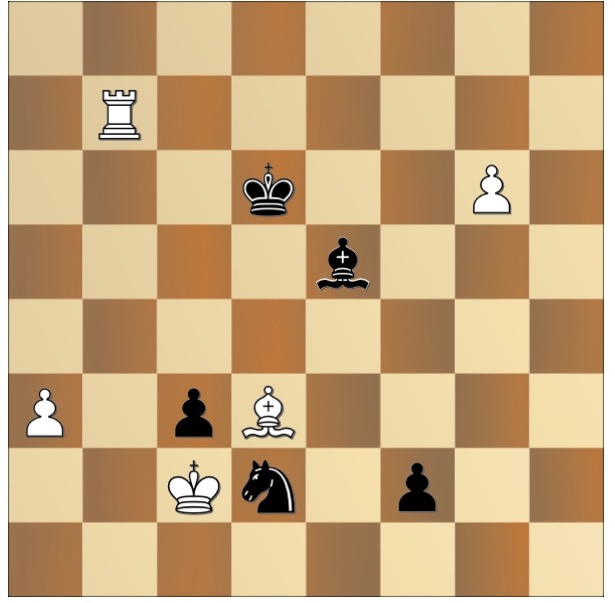
Szabo, Laszlo v Kholmov, Ratmir; 1967 October Revolution USSR Chess Championship, Kharkov, 12/67
Solution
The position looks dire for black, with seemingly no way to promote the f pawn, and the likelihood of having to exchange one of the minor pieces for the g pawn.
Having first tried and failed to find a way to distract the Bd3 from the a6-f1 diagonal- for instance, 1…Ne4 fails simply to 2 g7 Nf6 3 Rf7 Ng8 4 Rf8- I knew it had to be some knight trickery, and before too long found 1…Ne3! threatening Ne1+ forking K and B, and, moreover, winning the B. It took a moment or two to see how strong Nf3 actually was.
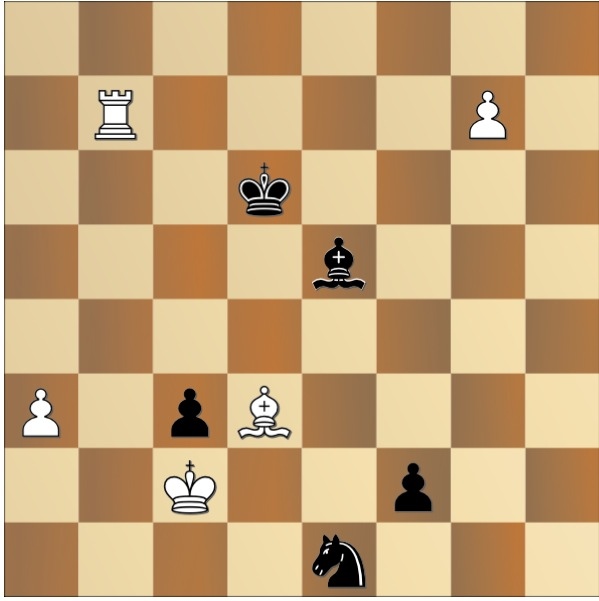
The move has the second point that from e3 it enables c2: so, 1…Nf3 2 Bf1 Ne1+! 3 Kd1 (say) c2+ 4 Kc1 Bf4+ 0-1: black's pieces coordinate superbly.
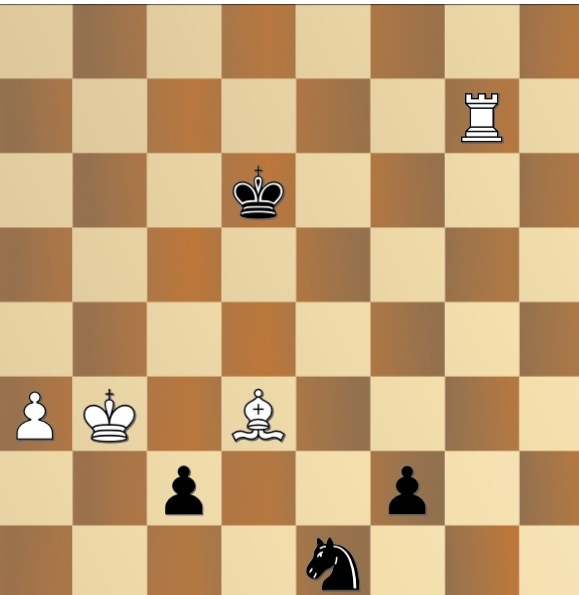
In the game, white played 2 g7, and the game ended 2..Ne1+ 3 Kd1 Bg7 4 Rg7 c2+! and one of the pawns queens.
One advantage of the Chessbase online iOS app is that it has a 'play through' button. One click, and you can sit back and watch the moves played through a decent pace, not too fast, not too slow. This game was a classical Nimzo Indian, where in the early mid game an imbalance was created, with black swapping a rook for minor piece and two pawns, and then the game being a dog fight between an active rook and active minor pieces. I haven't analysed it properly, but suspect it was roughly level, probably advantage to black throughout, though I wouldn't be too surprised if an engine showed a losing blunder somewhere near the end. This is especially so since black's knight gave white headaches near the end:
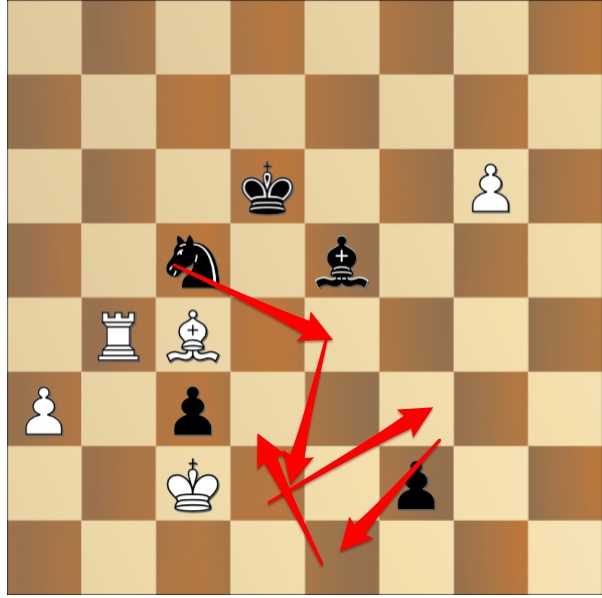
It is times such as this which are why the knight is my favourite piece.
 Posted with Blogsy
 allanbeardsworth