Test your chess: Reitstein problem 177: a special problem
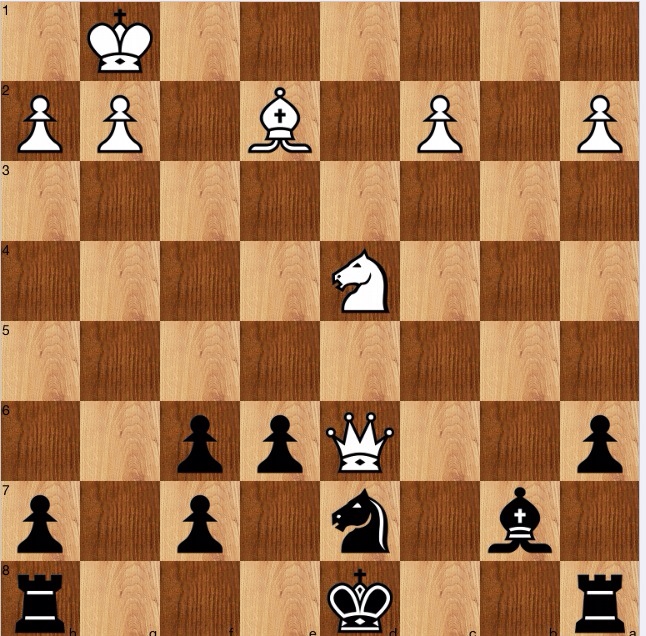
Black to play: 1…Kd8 or 1…Kf8?
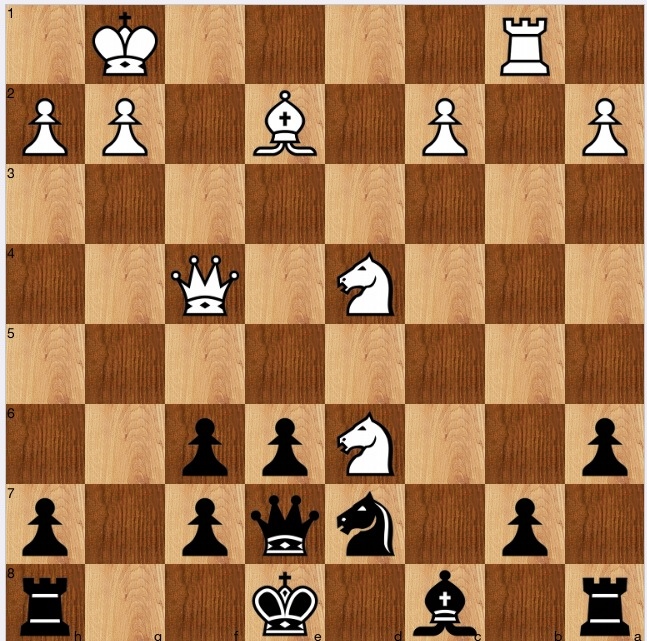
TJ Kett v MC Rubery 1984
Today's puzzle is, I think, especially good, and is worth taking time on. Intuition may or may not guide you correctly, and there are many lines to calculate. I thought I did a good job myself, but when writing this blog up with the aid of Stockfish, the engine had a surprise in store.
So, for readers with the available time, I would recommend:
I) making a decision as if in a game, analysing and deciding as best you can;
2) setting up the pieces and having a further look;
before reading on.
The easy question is: which opening was the game from?
Solution
Which opening?
Starting with the easy question, I would put good money on the opening having been the Poisoned Pawn variation of the 6Bg5 Sicilian Najdorf. I don't know for sure, but from the few Mark Rubery games on chessgames.com he is or was a Najdorf player; none of the games on that site were 6Bg5, but the hallmarks are still there.
Where to move the king?
1…Kf8
Next, the correct solution is to follow 'intuition' and play 1…Kf8. Tucking away the king on the wing would be the move one would play in bullet or blitz, and you would hope that after 2 Qh6+ Kg8 there was time if needed for Nd7-e5-g6 if nothing else. It is not too hard to see there is something else, namely (in this line) 3 Rb3 Qd6 4 Rg3+ Qg3 5 hg when the position is balanced.
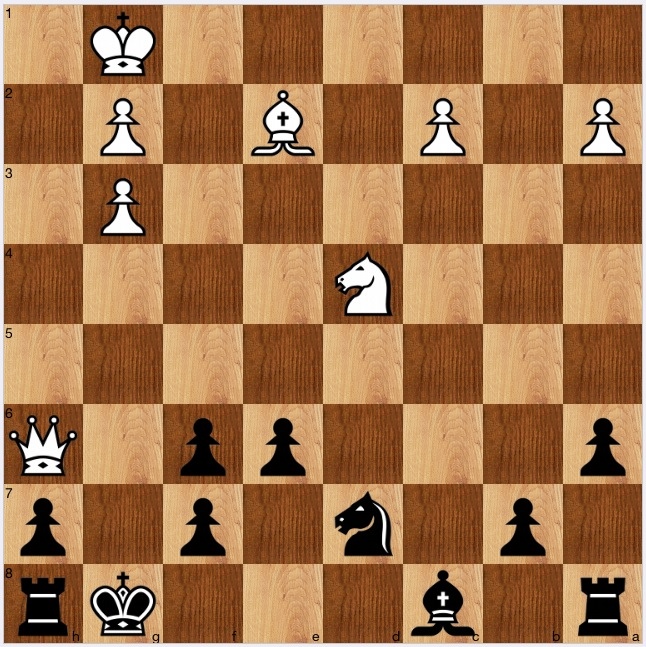
I wouldn't like to play either side here; if forced to, I would pick black, and hope that Ne5-g6 wasn't fatal, noting that Qf6 typically permits h5 when the rook may get out.
There is one line I must record. If after 1…Kf8 2 Qh6+ Kg8 3 Rb3 black decides to defend by 3…Nf8?? To block the g file then white has an extraordinary win, found of course by Stockfish. 4 Ne4! Ng6[] and now 5 Rb6!!
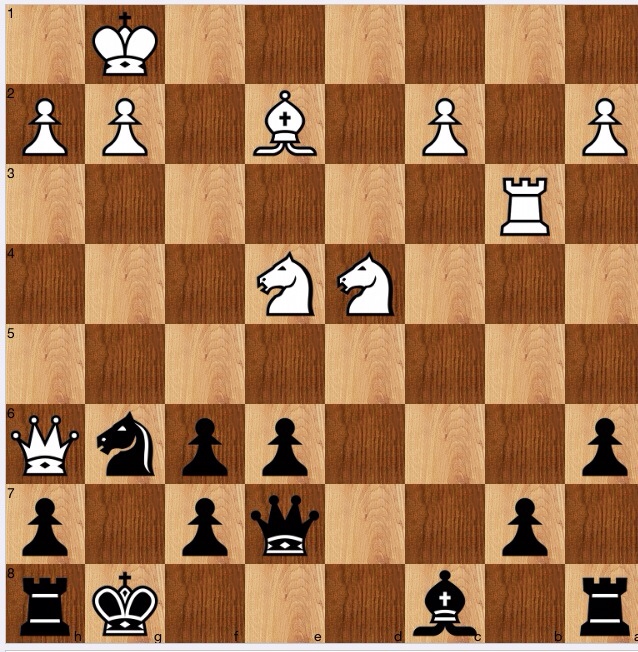
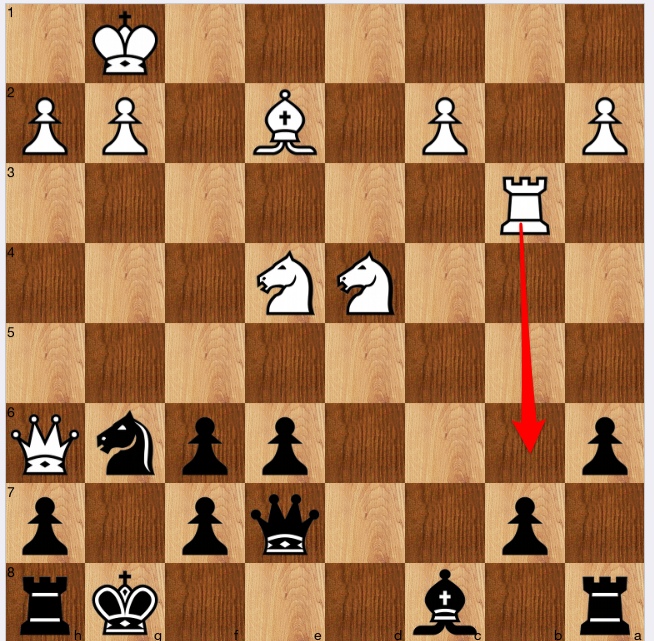
It was not clear to me why this was so strong.
Question: why is 5 Rb6!! so strong?
Solution
Stockfish must have read CJS Purdy since one of the strengths of the move is that it looks at f6- there is a jump biff Rb6*f6 so that the effect is the Pe6 is pinned, the effect of this in turn being that f5 is unprotected. At the right moment, Nf5 can come in, and then if that N is captured, Nf6+ follows. Brilliant.
There is a second effect of 5Rb6: it puts black in near zugzwang. For insurance, if 5…Bd7, 6 Rb7 pins the
Bd7 and threatens to capture it, followed by Nf6+. The near zugzwang means that white also has time to improve his worst placed piece, and play Be2-c4, ’threatening' a jump-check on f7.
The net result is that white plays 5 Rb6, and depending on black's reply, 6 Bc4 and 7 Nf5!, the end result being white's Rf6 and Bc4 will both be hitting f7.
1…Kd8
This is the move Reitstein said Black was right to avoid and, on balance, he was right. 'On balance', because there is a twist, which I will come to at the end of this posting.
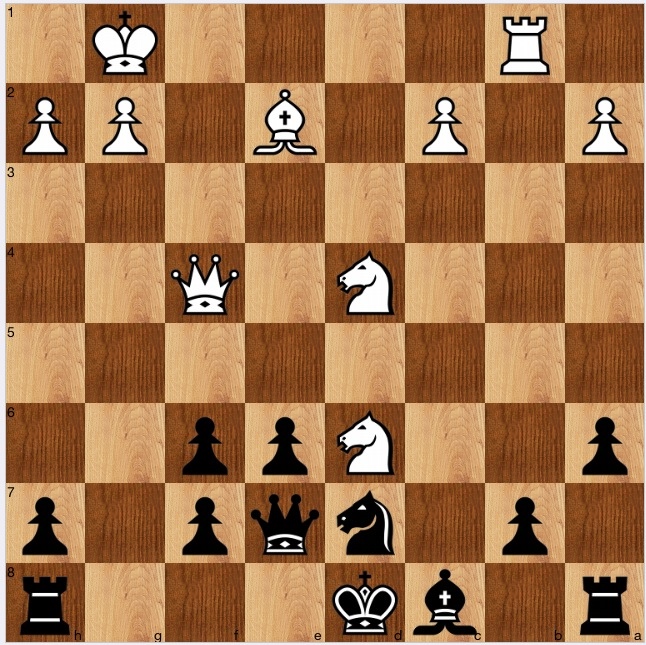
It took me a while to see what might be wrong with Kd8, though intuitively I would play 1…Kf8 anyway- partly because d8 is central, partly because of Nc6+ forks. I first looked at moves like 2 Bh5; 2 Nf7+??; 2 Ne6+?? and 2 Nb7+. The latter is more 'sensible', but fails after 2…Bb7[] 3 Rb7 Qc5! which covers everything, and black is winning.
Then, I saw the problem: 2 Rb7! and after 2..Bb7 3 Nb7+ we reach the following position.
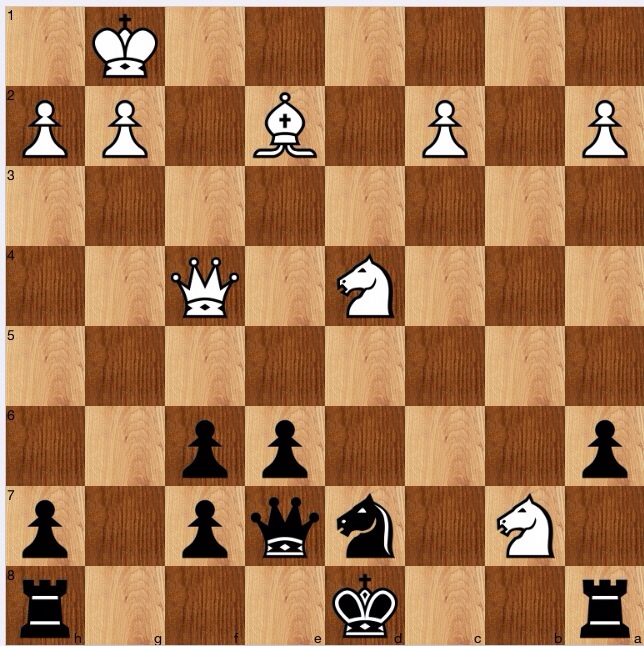
3…Ke8?? clearly loses to the 4 Nc6+ fork, so 3…Kc8 is forced. One of the facts I have to face, thirty years on from my teenage chess peak, is that I no longer calculate messy positions well (I am thinking in terms the thickets of variations described in Kotov's 'Think Like a Grandmaster', a book which is largely discredited nowadays, but which, for want of much else, I devoured in my teens).
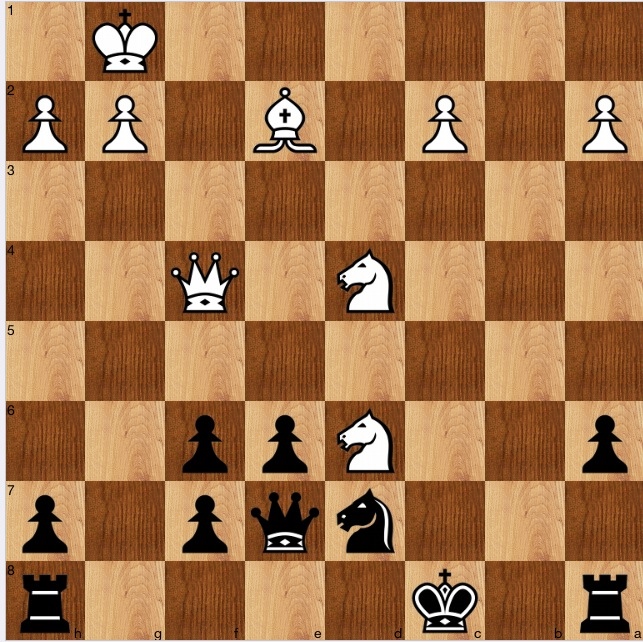
It took me a while to bust 3…Kc8, but it shouldn't have been too hard: 4 Nd6+ Kc7 5 N6b5+! Kb6 6 Qc7 mate, since the Nb5 is defended by the Nd4.
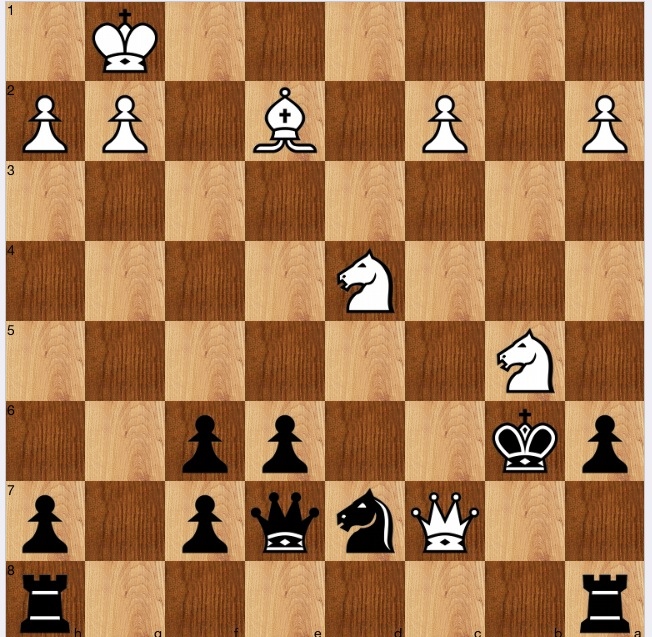
So, I thought that 1…Kd8?? was busted, and that my intuition was right. Turning to the solution, Black did indeed play 1…Kf8, and Reitstein gave a smidgen of the above lines to show why 1…Rd8 would have lost.
So, as is my norm, I then load the position into Stockfish on my iPad, so that I can take screen prints of various positions for insertion into my blog. Surprise, surprise, it only gives a slight advantage to white after 1…Kd8 2 Rb7.
Question
Why does Stockfish not say that 2 Rb7 is winning for white?
Solution
How many times should I remember CJS Purdy's consider all biffs. I think the fact that it is so hard to apply in practice is one key to my lack of mastery of the game. Stockfish shows that 2…Qd6!! (doesn't really deserve the exclamation marks, except that the capture is 'hard to see') 3 Qd6 Bb7, Stockfish gives the position as balanced, assessing it as 0.0.
Moral
I have really enjoyed analysing this problem. The need to examine all biffs at move 2 also makes me think it worth pointing out that 1…Qd6 should also be looked at, for the same examine all biffs reason. It is of course bad, but I bet if I and other players could routinely examine all biffs that practice alone would add rating points.
 Posted with Blogsy
 allanbeardsworth
Greetings from Mark Rubery here. Yes, I still play the Najdorf. Sent your link to Tim Kett and it was an interesting trip down memory lane-more for him as he won the game!
Cheers