Test your chess: Reitstein problem 195
White to play and win
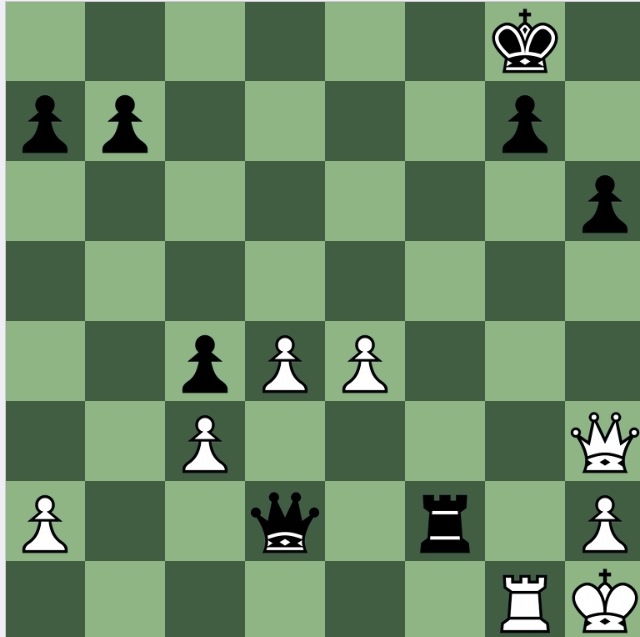
Position after Rf8-f2
M Blieden v BE Siegheim 1912
Solution
In the game, white played 1 Qg3, preventing Qf4, and the game went on: I don't know the eventual result. Reitstein says that white missed a winning move here, and after ruling out 1 Qh6??, which hangs the queen, it became a choice between 1 Qe6+ and 1 Qc8+.
I found choosing between the two hard, but eventually plumped for 1 Qe6+!, which was the correct choice! but I missed why 1 Qc8+ was poorer.
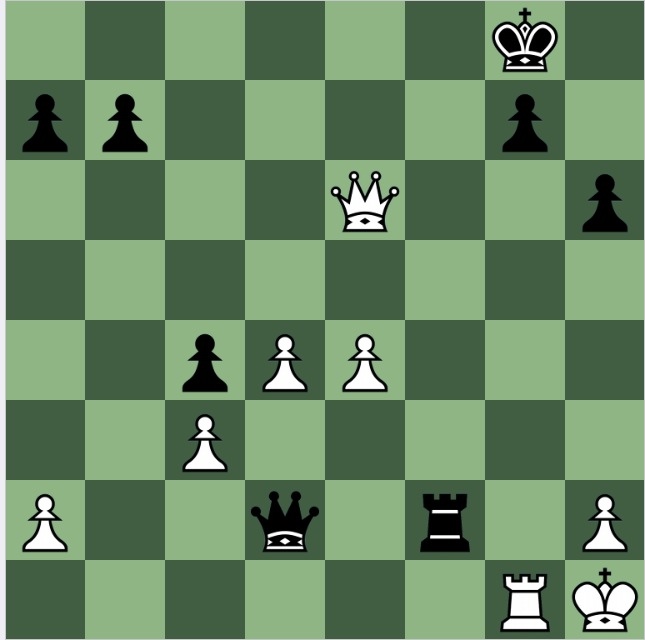
Black has four moves. 1….Kh8 and 1…Kh7 can be dealt with summarily: 2 Qe8+ Kh7 3 Qg6+ and 4 Qg7 mate against 1…Kh8, and the same mate one move earlier after 1…Kh7.
The main other thing to see is how to defeat 1…Rf7: 2 Rf1! wins the rook, and there are no good checks. So the final tax is to defeat 1…Kf8. I think in practice it isn't needed to see to the end, but just to see 2 Qc8+ Kf7 3 Qd7+ Kf8 4 Qg7+ and then reassess.
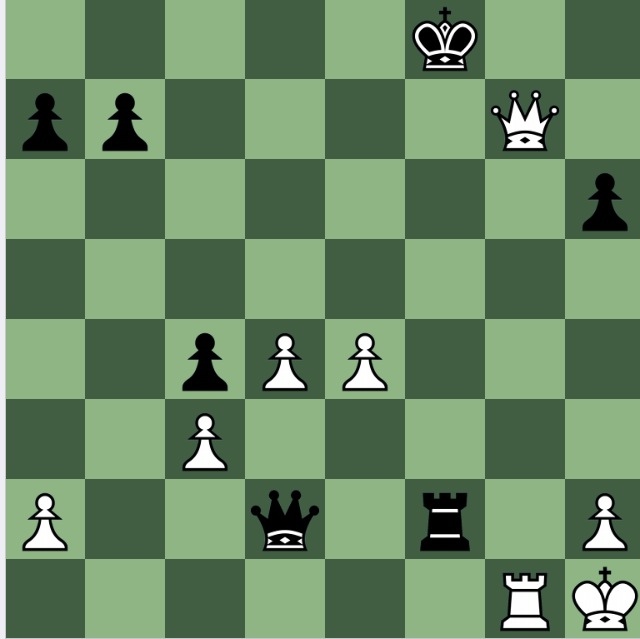
After 4…Ke8 white can either check on the back rank, but that permits the rook to retreat, or 5 Qe5+ which contains the king: clearly better, and Stockfish confirms it is forced mate, though in practice I doubt I would see its line: 5…Kf8 6 Qb8+ Kf7 7 Qg8+ and then the rook enters with check.
The above is sufficient to solve the problem, but leaves as open why 1 Qe6+! is superior to 1 Qc8+. I will deal with this in a separate posting.
 Posted with Blogsy
 allanbeardsworth