Test your chess: Reitstein problem 221
Black to play and win
A good exercise: try to solve this puzzle on the presumption that white is an engine, and will put up the best defence.
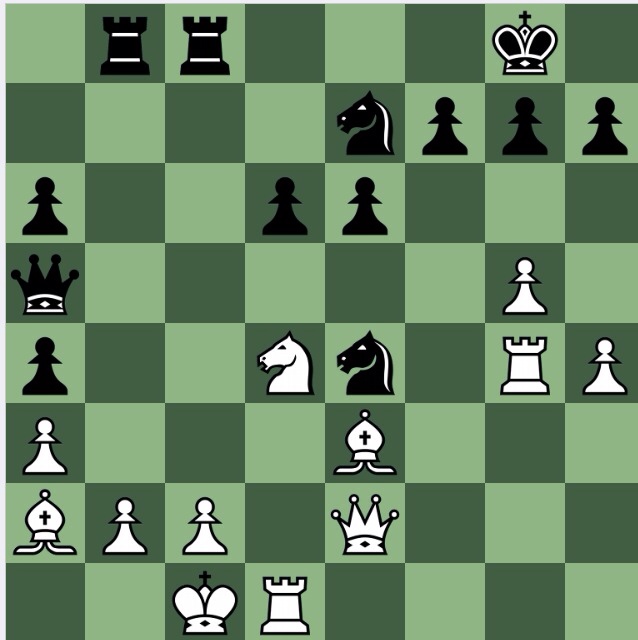
V Huang v M Levitt 1981
Solution
I put the rubric up, since 1…Rb2! is pretty obvious, but with the pieces tangled up, it isn't too easy to see all the lines. Had it been blitz, it would be easy: Rb2, see what happens, if 2 Kb2 Qc3+, see what happens. But classical chess is harder.
Having said that, it isn't much harder in the present case, since black is a piece down, and has to go 'all in'.
So, 1…Rb2! 2 Kb2 Qc3+ 3 Kc1 d5 and 4…Ba3+; 3 Kb1
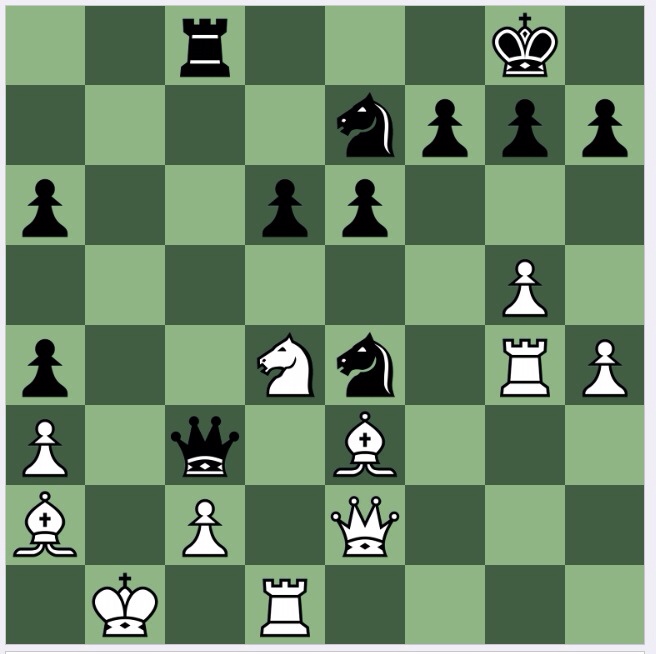
3…Rb8+ 4 Bb3 (this is the line Reitstein gives as his main variation) 4..ab 5 Nb3 Rb3+ 6 Kc1 Ra3 'and wins'.
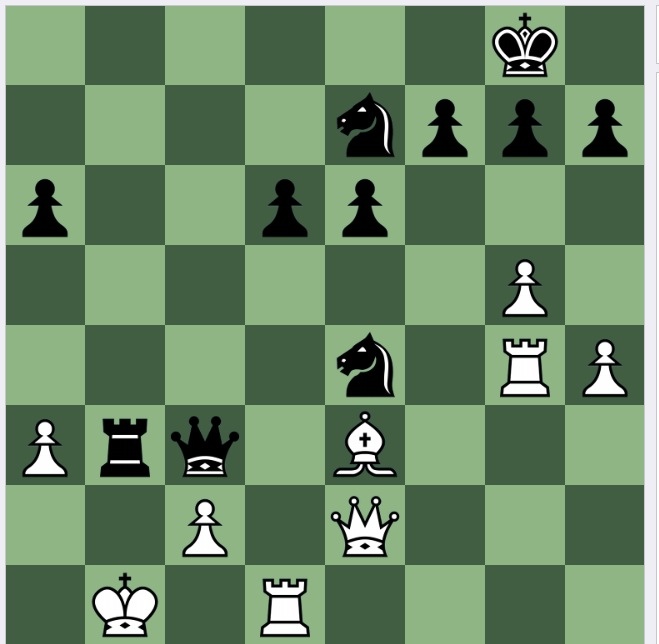
Alas, there is something wrong with this line. Instead of 6 Kc1, 6 cb is natural, and is equal. 6..Qb3+ 7 Kc1 Qc3+ perpetual (white can't interpose 7 Kb2 since the Rd1 is LPDO).
Double alas, there is something more seriously wrong with this line. Instead of 4 Bb3?, which we have seen is dead equal, 4 Nb5! is advantageous to white. 4…Rb5+ 5 Qb5 ab and 6 Re4, and white has too much wood: some advantage to him.
Position before 6 Re4
So, is white better after 1…Rb2? No! Stockfish shows me black can still fight for the advantage, but by a move I would never have considered
After 1…Rb2! 2 Kb2 Nc3! is strong.
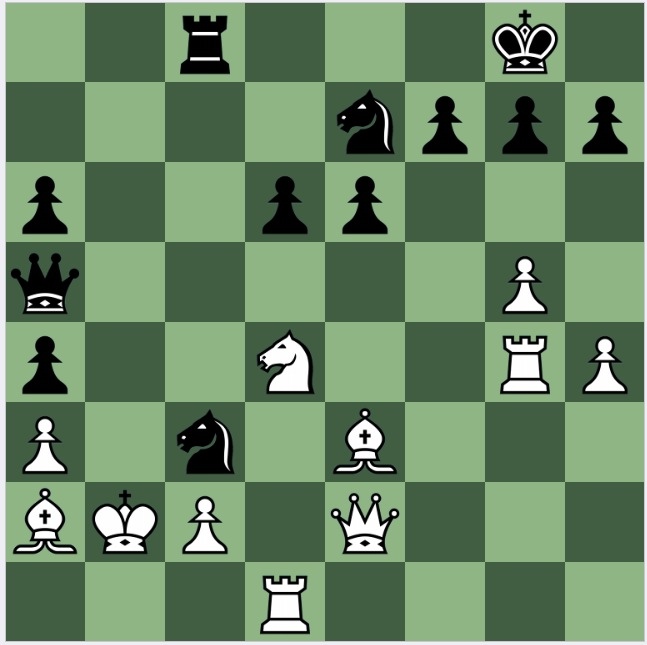
2…Nc3! is a move I would never even consider, and if I did follow CJS Purdy's consider all biffs I would reject it encase because of 3 Qd2, which itself isn't best! 3…:Nd1+ 4 Qd1? Qc3+ 4 Kb1 Qe3 and black wins. The open b file will mean that white has to give a minor piece back.
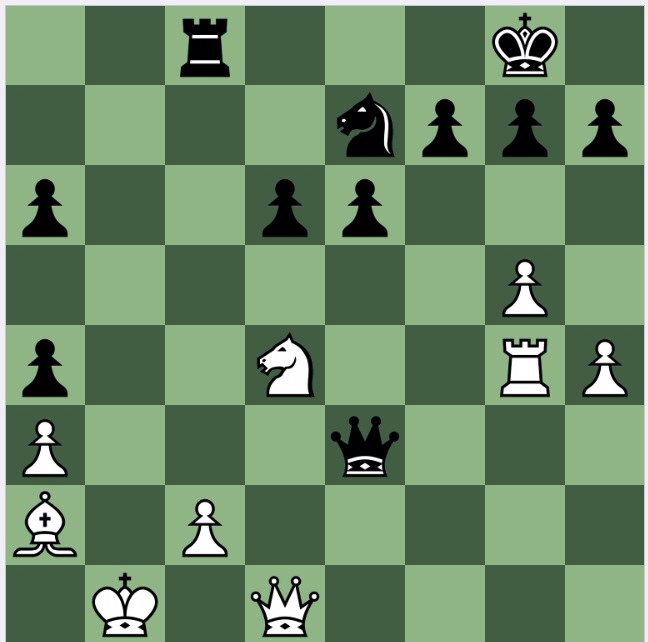
The best line appears to be 2…Nc3! 3 Qd3! Nd1+ 4 Ka1! and black is better, but the game goes on.
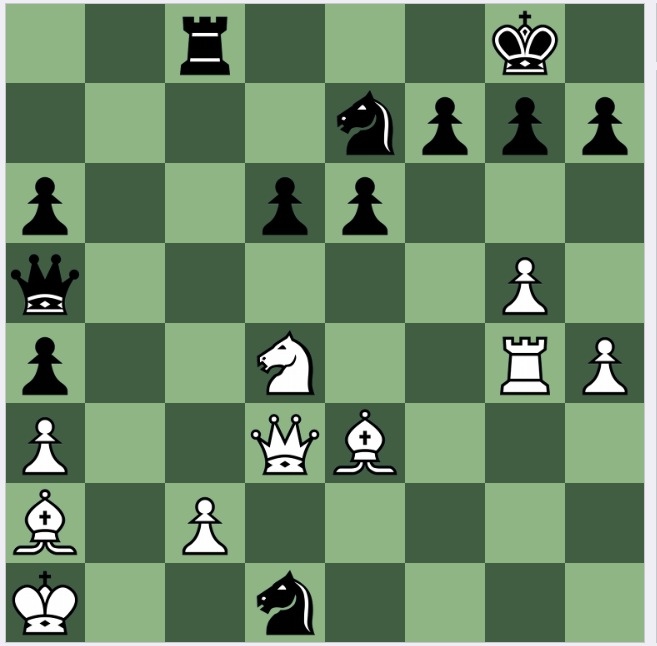
Stockfish gives a half point advantage to black after 4…Qc3+, taking off the queens.
In the game, white didn't take the rook after 1..Rb2, instead playing 2 Re4 Ra2 3 Kb1 Ra3 and white lost after 4 Bc1 Rb8+ and wins, for instance 5 Bb2 Rb2+ 6 Kb2 Qc3+ and 7 Ra1 mate. White has other tries, such as 3 Bd2, but this too loses after 3…Qb6
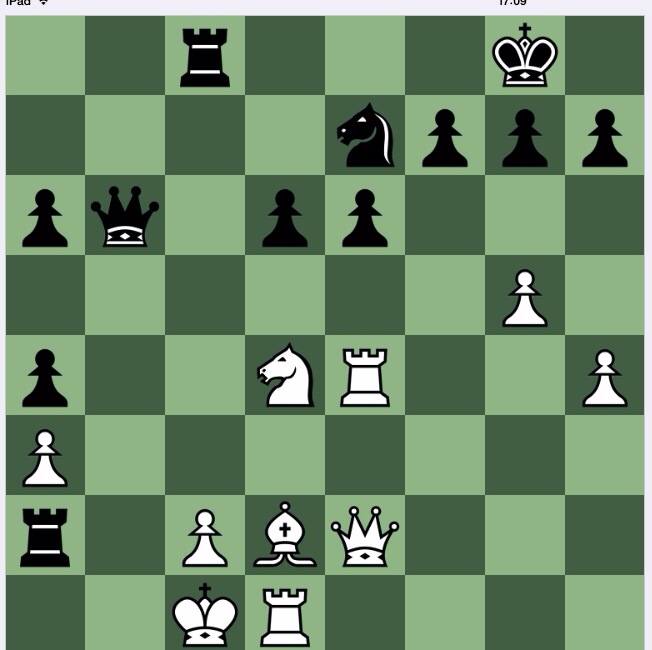
White can only play 4 Bb4 but the bishop has no stability on this square and can be biffed by 4…a5.
In short, an exercise worthy of Jacob Aagaard: plenty of scope for further study, and another humbling example of how hard chess is: I missed lots.
 Posted with Blogsy
 allanbeardsworth
Reblogged this on Chess Musings.