Test your chess: Reitstein problem 223: a nice point
In my earlier post this morning, I gave position 223, and one of the lines resulted in the following position, with black to play.
Black to play
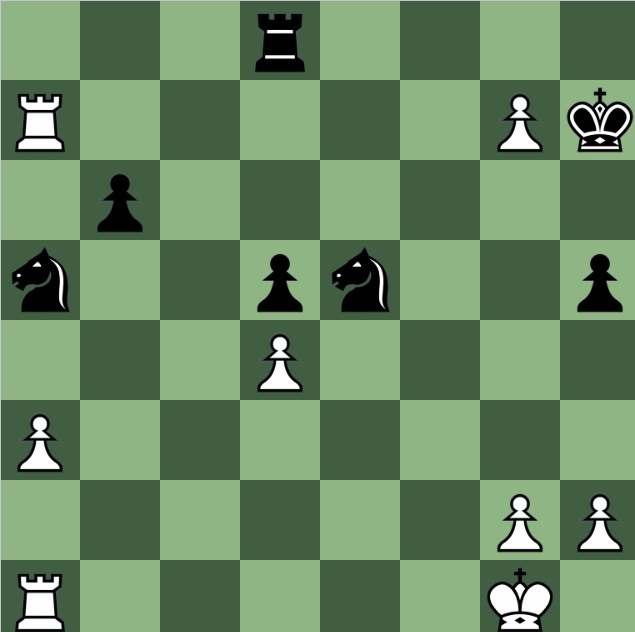
I reached the positon in my analysis, and assessed it as 'and the game goes on', Jon Speelman's phrase. I thought 1…Nc6 2 Rc7(say) Nd4 and I somewhat preferred black: one point is that 3 Rd1 doesn't win the LPDO Nc4 (LPDO because the Pd5 is pinned, because of the jump biff Rd1-d8, the Rd8 being LPDO. It doesn't win it because 3..Ne6! both biffs the Rc7 and defends the no longer LPDO Rd8.
However, Stockfish meets 1…Nc6 not with 2 Rc7 but with?
Question: how to meet Na5-c6?
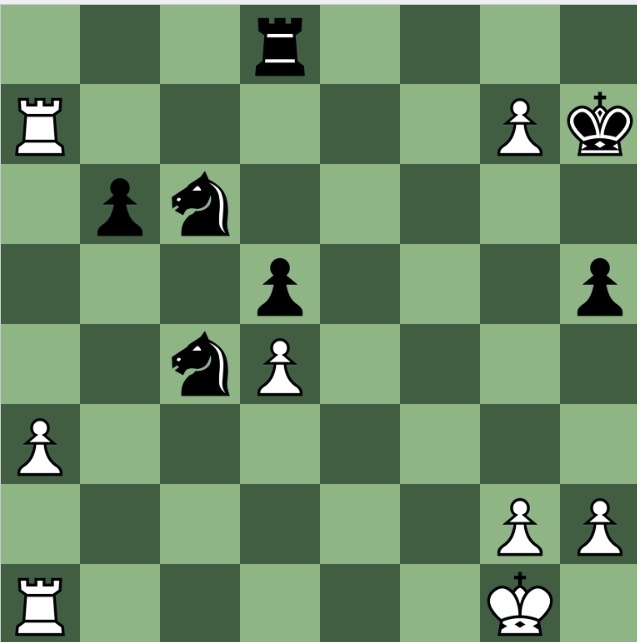
Solution
When in need of chess instruction, turn to the writings of CJS Purdy:
Purdy on threats, In Search of Chess Perfection, pg 289
You must see all real threats. That means you must also see the unreality of real threats…. When in doubt, you can always save time by remembering it is really your move. Try then the following way of thinking:
Imagine the threat could not possibly be executed. Then what would be my best move? Try out each attractive move separately, considering each one as follows. Visualise the whole position as it would be after this move of yours, and then work out whether the opponent would gain by executing his 'threat'.
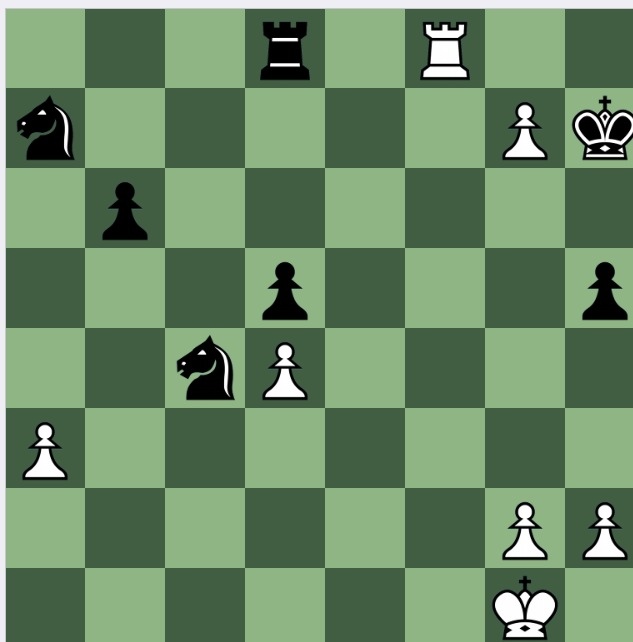
So, 1 Rf1!! and it is still equal after 1…Kg8! 2 Rc7- all that has happened is that white has improved his rook with a tempo gain. The point is that 1…Na7?? loses to 2 Rf8! winning the LPDO Rd8, since otherwise the g pawn queens.
It really is telling how often attention to the basic concepts: pins, nets and ties, and LPDOs, help solve chess positions. It is also humbling that, despite the fact that I know such things, in practice I so often forget- and by in practice I also include cases where I have all the time in the world to look at positions.
 Posted with Blogsy
 allanbeardsworth