Reminiscences: Adams-Almasi; Calvia Olympiad
Yesterday was round three of the Tromsø Olympiad. I am writing this from our home in Kas, Turkey where we arrived on Sunday. Through travelling and then because the internet was down I missed the first two rounds, but not to worry, the hard matches started yesterday.

With teams from 180 nations taking part, this is one of the biggest sporting events. As others have commented, it just had to be the case that on the precise hundredth anniversary of the outbreak of WW1 England were paired against Germany.
The joy of the round was Matthew Sadler's fine win against David Baramidze, a game I intend to study since from first impressions, I really don't understand it, but can tell Matthew played fine chess. The ordeal of the round was Michael Adams' defending a Ruy Lopez Berlin defence against Arkadj Naiditsch. Fortunately, despite to my mind Mickey's position always seeming questionable, he held on to secure a draw: yet again, Mickey shows his true supreme qualities by successful defence.
Watching Mickey's game reminded me firstly of his recent loss in the same defence against the man of the moment, the new world #2 Fabiano Caruana, who also yesterday won as white against the Berlin (against Parimarjan Nagi) but also took me back to the Calvia Olympiad of 2004.
A seminal moment for me was standing by the players watching Mickey defeat Zoltan Almasi in a Berlin. Of course, I have long known how great a player Mickey is, but in that game I started to fully appreciate the difference between playing through a game in a magazine, taking five or ten minutes, and the enormity of a the real time struggle that is top level chess. I also realised how tactical positional chess can be, and how deep the elite players think.
White to play
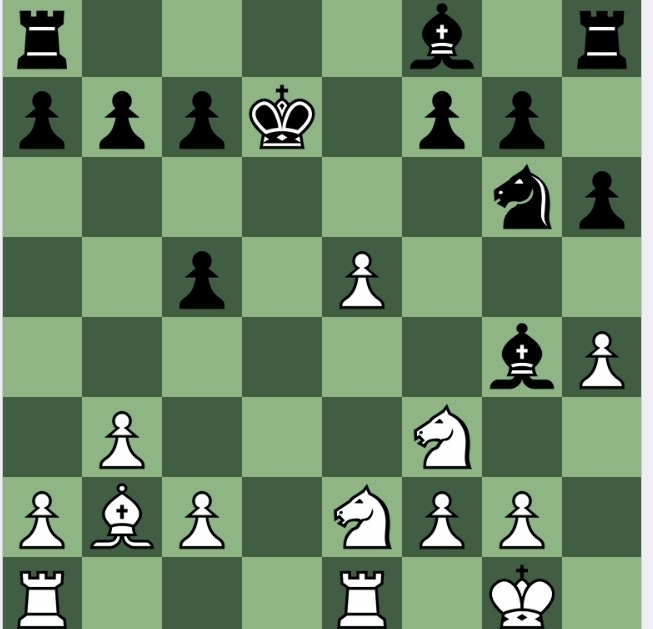
Adams-Almasi
A typical Berlin. At his last move, Mickey had surprised me by 15 h4, a move which I thought just created a hole at g4, which Zoltan filled with Be6-g4. (My engine suggests that 15…h5 was better, conceding a hole to at g5 but keeping the position closer.
Mickey's next move, 16 e6+!! shook me. Ten years later, I have seen the e6 push several times in the Berlin, and now know it is thematic, but this was the first time, and I recall not knowing what would have happened if black had taken with the bishop.
Evaluate 16…Be6
I would never play 16 e6+! since I couldn't evaluate the position after the bishop capture. In fact, white's position is dominant. 17 h5! pushes the knight back to e7:
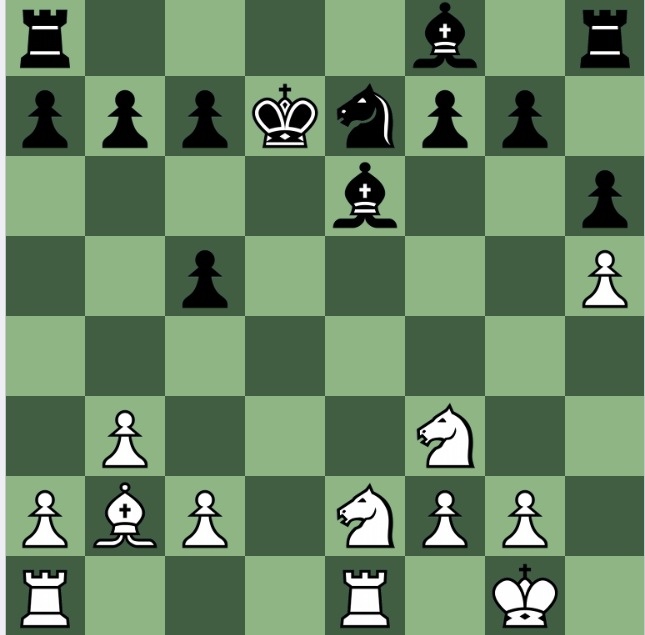
White plays 18 Rad1+, when the engines say 18…Ke8 is best: I have tried 18…Kc6 and can see why the machine prefers to seek safety, since c6 permits Ne5+ and the pieces swarm in. After 18…Ke8, the reason (and this took time to see) white is better is that all his pieces are out, his rooks are connected, and furthermore black's are struggling. Black also has weaknesses on e6, f7, and in some lines (e.g. after Kc6 or Kc8 there are Bg7! motifs – if the Be6 has moved, the Bf8 is overloaded having to defend the Ne7 and Pg7.
Zoltan captured instead with the pawn, accepting a structural weakness.
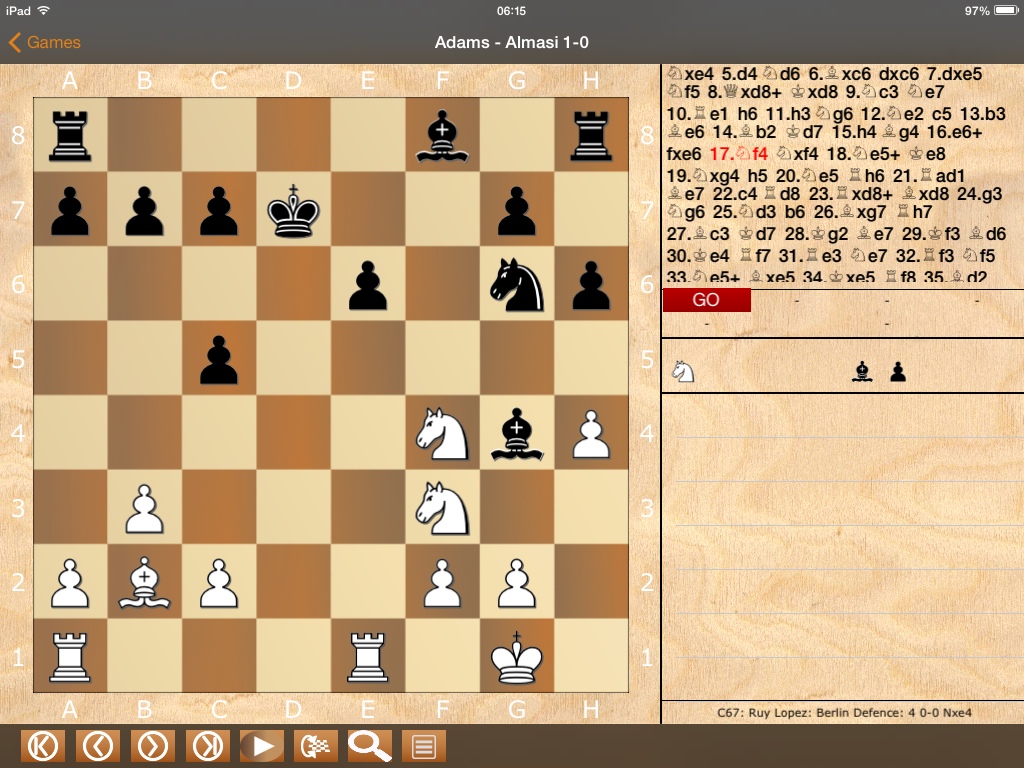
Again through (what Nigel Short and I called in our schooldays, tictacs – small tactics- here Ne2-f4- Mickey got a statically better position which he converted in fine style. The whole game is worth replaying.
 Posted with Blogsy
 allanbeardsworth