A subtle ending: Ljubojevic – Browne, 1972
My current bedtime reading is 'My Chess' by Hans Ree. It is a collection of short articles from Hans' life in chess. I am only a short way into it, but I can already tell that it is a book that I will love. Since it is a light read with no games, no diagrams, no analysis, it is ideal last thing at night reading.
Some of his articles have anecdotes from games. He doesn't give the game scores or positions, just alludes to, and those which take my fancy I then have to look up. One of which is Ljubojevic – Browne, Avro 1972.
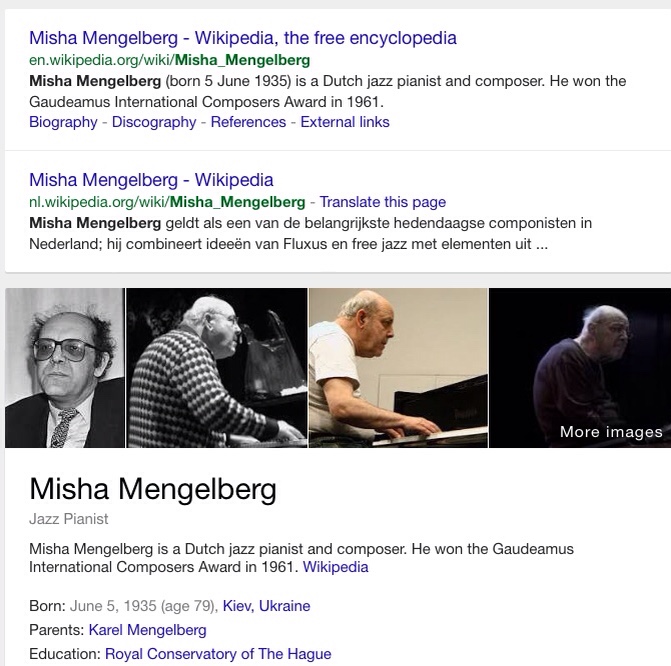
Hans writes that one of the kibitzers was the Dutch musician Misha Mengelberg.
After the game finished in a draw, Misha asked the players 'what would have happened if black had played …? (I have omitted the move, to make it into a puzzle). The players initially paid no heed to the amateur kibitzer, but after some thought realised that black had missed a win.
Black to play and win

Consider this ending, and looking at the game continuation, where did black miss a win?
(Complexity: fiendish, despite, or maybe because of, the reduced material).
I suggest readers have a go at solving the above, before reading on, where I will make the problem somewhat easier.
Black to play and win (slightly easier framing of the puzzle, but still very tough)
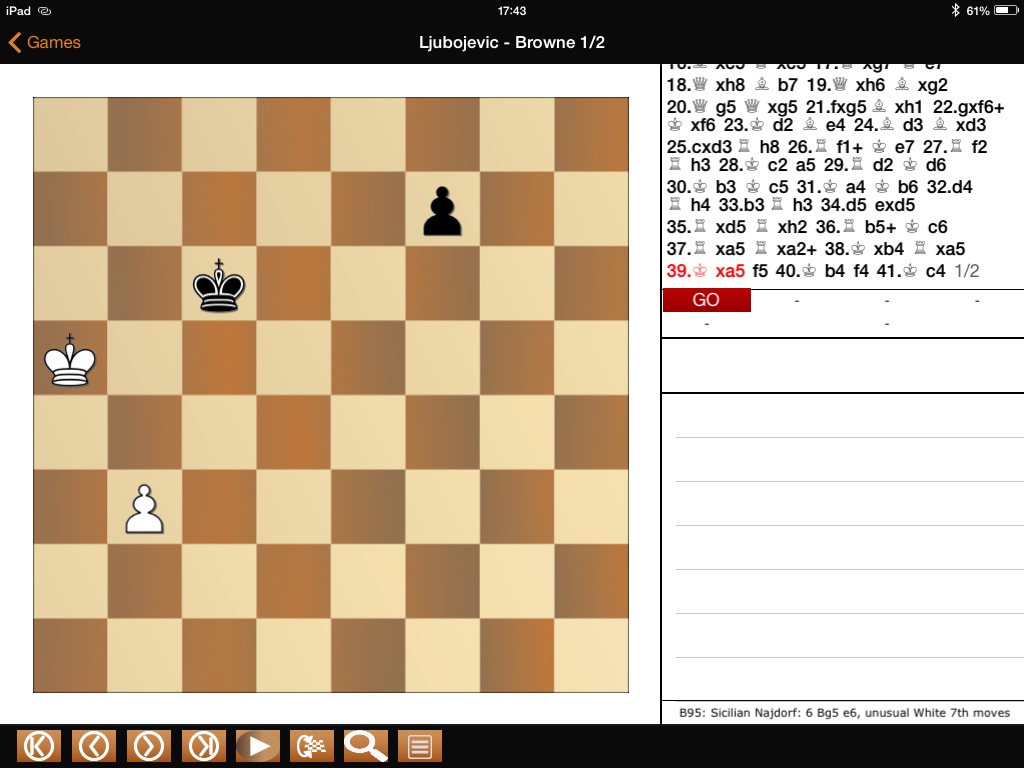
This was where Walter Browne missed the win. What should he have played, and why?
(To me, this puzzle is at the limit of difficulty: in a game I would have played just like Walter did)
Solution
I have annotated the ending here. If the link doesn't work, it is here. http://www.viewchess.com/cbreader/2014/11/3/Game249727031.html
The position is very profound. Black's king must first try to body check white's king, so 1…Kd5!! with the idea that if white's king tries to get back to the f pawn by 2 Kb4, it is stopped by 2..Kd4!!. So white has no option other than advancing his pawn and then when it reaches b6, black's king retreats to c6, forcing white to advance his king to the mined square a6, which results in black's pawn promoting with check: white then only has a choice of ways to lose, with eg Ka7 being met by Qa1 mate, or Ka5 by Qa1+ and Qb1+ skewering.
 Posted with Blogsy
 allanbeardsworth
Trackbacks & Pingbacks