Another puzzle from Dragoslav Andric’s 1981 book “Matni Udar”.
White to play and mate Black
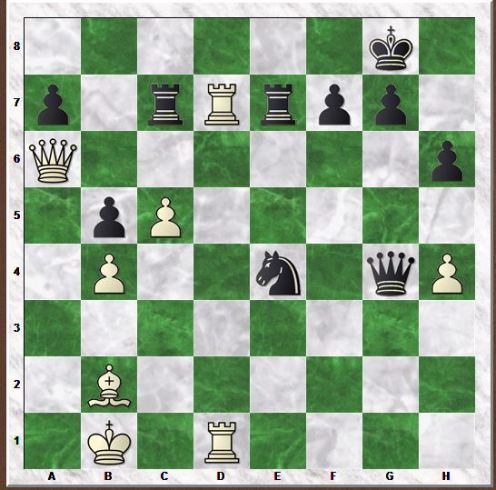
Arakelov v Litvinov, Moscow 1959
Solution
A pretty one, but a fairly well known theme. 1 Rc8+ Kh7 2 Rh8+!
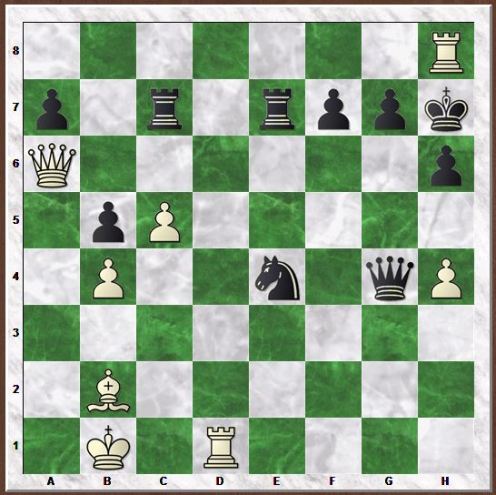
and 3 Qh6+ and 4 Rd8+ etc.
FEN
6k1/p1rRrpp1/Q6p/1pP5/1P2n1qP/8/1B6/1K1R4 w – – 0 46
Another puzzle from Dragoslav Andric’s 1981 book “Matni Udar”.
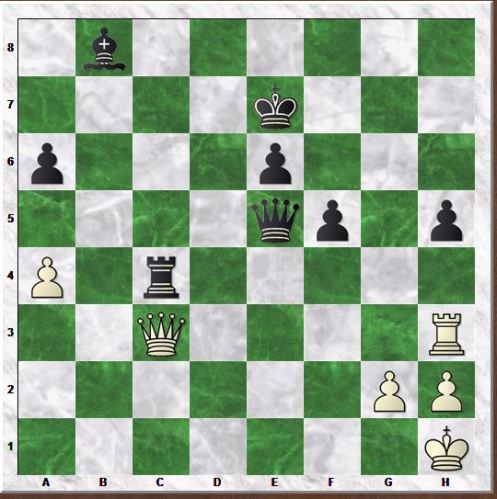
Black to play and mate White

Gaprindashvili v Nedeljkovic, Kiev 1959
Solution
Not too hard: White’s Queen is tied to the back rank, and his King is in a mating net, so, 1…Rc8! overloads the Queen.
And if 2 Bc4, as played in the game, 2…Rc4 continues the overload.
FEN
1b5r/4k3/p3p3/4qp1p/P7/2Q4R/4B1PP/7K b – – 0 31
Another puzzle from Dragoslav Andric’s 1981 book “Matni Udar”.
Black to play and mate White
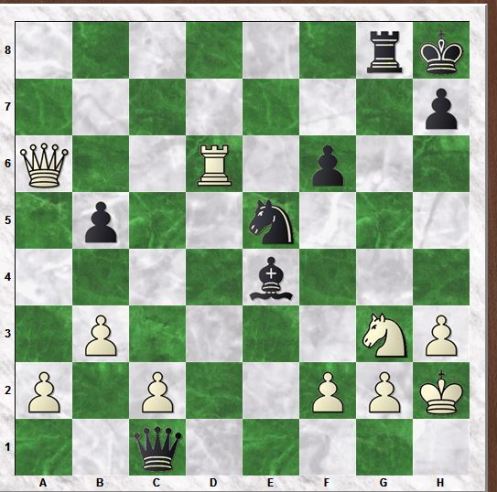
Bakulin v Chistiakov, Moscow 1959
Solution
This one took me a while to see: I intuitively knew that there must be some way to get through to the White King, trying the usual suspects such as 1..Nf3+ 1…Ng4+ 1…Rg3 1…Qh1+, all to no avail, before seeing 1…Qf1!
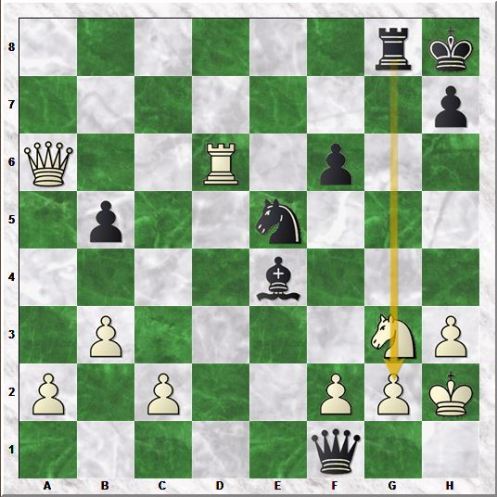
Once seen, it is “obvious”.
2 Nf1 Rg2+ 3 Kh1[] Rf2+ 4 Kg1[] Rg2+ 5 Kh1[] Rc2+ 6 Kg1[] Nf3+ 7 Kh1[] Ng5+ 8 Kg1[] Nh3 mate.
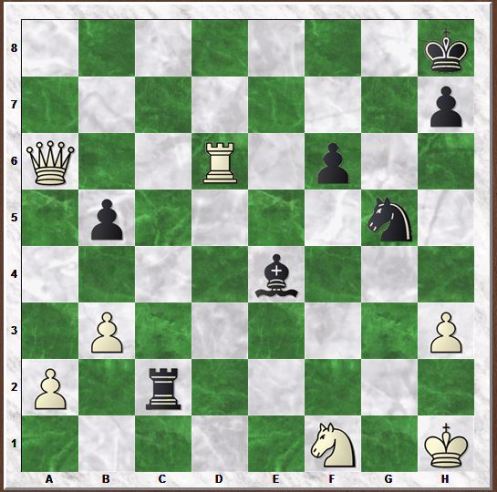
FEN
6rk/7p/Q2R1p2/1p2n3/4b3/1P4NP/P1P2PPK/2q5 b – – 0 1
Thank you, to my life-long friend Malcolm Pein, for this problem in his 4th February 2017 (yesterday’s) Daily Telegraph column. (“Thank you” is barbed in a way, but is actually genuine).

Note the “An endgame worth knowing” hint.
Quick as a flash, I knew the solution. There are some Q vRP endings were you let the pawn Queen, and then mate: Kd3; Qc2; kb1; qa1.

I don’t have great endgame knowledge, but there are some things I know
So, the puzzle was how to get the King to the right zone.
But: three moves, and the pawn queens.
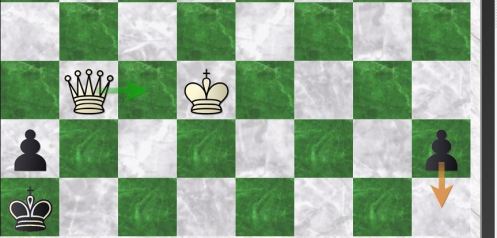
So, instead, I could see it was a juicy problem, and wondered how Mickey solved it, perhaps with little time, but certainly with the clock ticking. Not being obvious in my head, I got my pocket set out, moved the pieces around, and settled in for the long haul.
I quickly realised that the solution had to be to check-check-check along the first two ranks and take the h2 pawn; and then check and check and check again until somehow the desired promotion-takes-a-square away trick works.
And I noted that in the checking process, if Black’s King tries to run to the 3rd rank, it risks a Qa1 or Qc1.
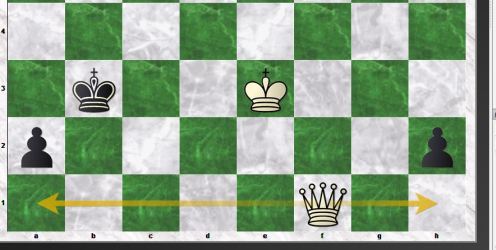
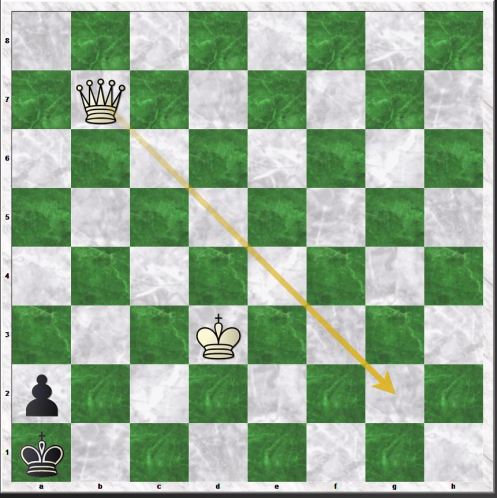
Next, when the Q is on g2, play Kd3 to set up the promotion-takes-a-square position. White plays Kd3 in the position below.

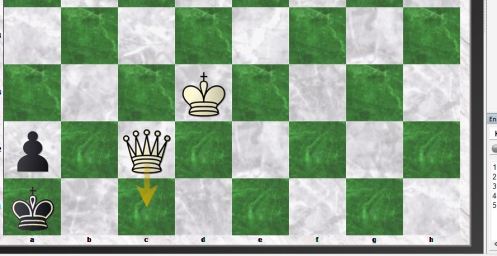
Final stages now. Black sacs his h pawn, queening, and then the only question is can the desired position be reached, without a stalemate. And I felt proud to find the checks fitted into place. hq(Q) Qh1 Qg7+ Qg2!
And a slightly different mate, but one consistent with the planned one: Qg2 Kb1 Qc2+ and Qc1 mate.
So, mate in about 20, depending on Black’s replies. And actually tricky but no too hard, if you know what you are looking for, which I did.
Or thought I did.
The horrible thought then occurred to me: why not Qc2-c1 in the original position?
And, indeed, it is only a mate in 2.
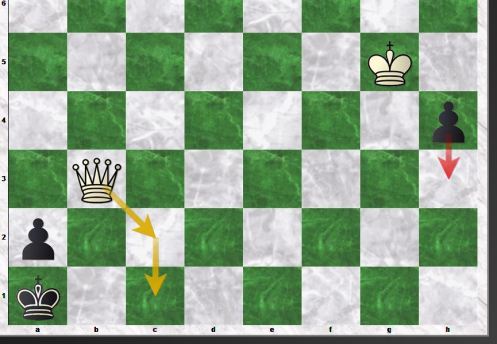
Why, oh why, did Malcolm put the “an endgame worth knowing” in the caption?
But I am actually glad he did: a had a very pleasant hour or so proving the long winded ‘technical’ win.
Another puzzle from Dragoslav Andric’s 1981 book “Matni Udar”.
White to play and mate Black

Katalimov v Mnacakanjan, SSSR 1959
Solution
I fluffed this one: I chose 1 Bh6 Rh6 2 Re6 thinking that after 2…Re6 3 Qf8 is mate; but 2….Qe6 is 0-1.
Right idea, wrong execution.
1 Rd7! Bd7 2 Bh6! works.

Komodo 10 says that 1 Be5 is also +-, and it does, but in the sense of being an exchange up in the ending (a simple ending): 1 Rd7! mates.
FEN
1rq1B2k/2p1Q1pp/pb2br2/5p2/1P3B2/6P1/5P1P/3RR1K1 w – – 0 1
Another puzzle from Dragoslav Andric’s 1981 book “Matni Udar”.
White to play and win

Eggenberger v Schulmacher, Basel 1959
Solution
Quite nice today: combining various Purdy themes, like Black’s king being in a net, and Black’s queen being tied to defending e7, with John Nunn’s LPDO acronym, leads to 1 Qd2! and 1-0.
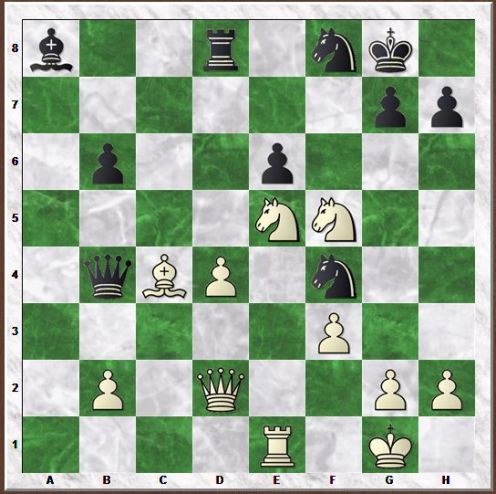
If 1…Qd2 2 Ne7+ and 3 Nf7 mate; Black is helpless. If 1…Nd5 2 Qb4 and now the N is tied to e7.

FEN
b2r1nk1/6pp/1p2p3/4NN2/1qBP1n2/5P2/1P4PP/3QR1K1 w – – 0 1
Another puzzle from Dragoslav Andric’s 1981 book “Matni Udar”.
Black to play and mate White

Parma v Bielicki, Muenchenstein/Basel 4/8/1959
Solution
Examine all biffs: 1…Qc2+!! is clearly the move to make, and it isn’t hard to see White is in a short mating net after 2…Be4++.

FEN
1kr5/1p1r1pR1/p1bbpP1p/2q5/3pN2P/5B2/PPP3P1/2KRQ3 b – – 0 26
Another puzzle from Dragoslav Andric’s 1981 book “Matni Udar”.
White to play and win
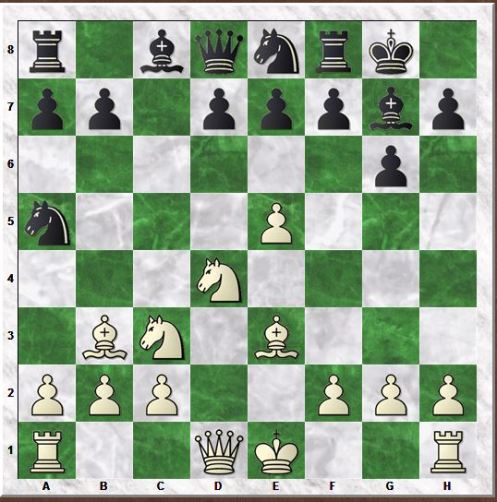
Fischer v Reshevsky, New York 1958
Solution
One from my childhood: 1 Bf7+ Kf7 2 Ne6 is a famous motif.
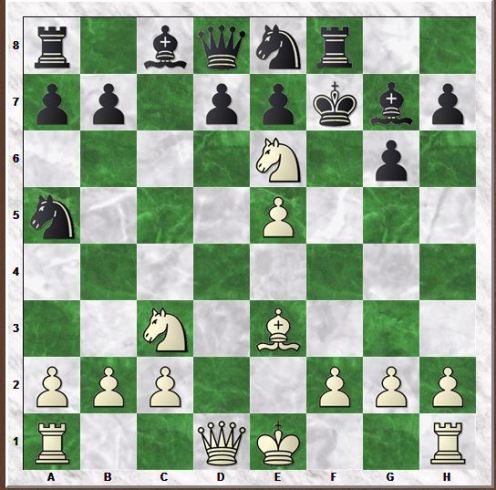
Looking at the game in Megabase now, it is strange that Reshevsky held on for a further 30 moves before resigning
FEN
r1bqnrk1/pp1pppbp/6p1/n3P3/3N4/1BN1B3/PPP2PPP/R2QK2R w KQ – 0 10
Another puzzle from Dragoslav Andric’s 1981 book “Matni Udar”.
Black to play and mate White
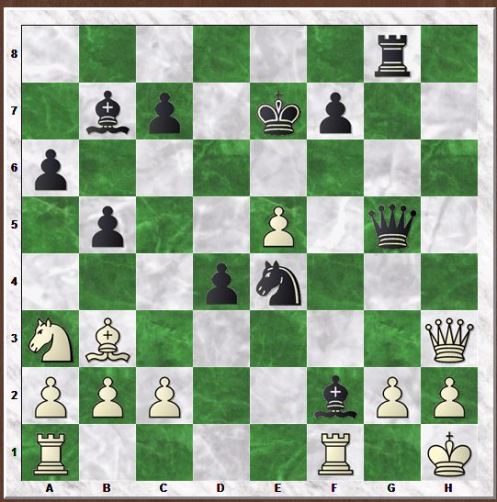
Honan v Mandle, corres 1959
Solution
A slight variation on a standard theme: 1…Qg2+! is a nice first move, forcing 2. Qg2, when 2…Ng3+! forces 3 hg, after which 3…Rh8 is mate.
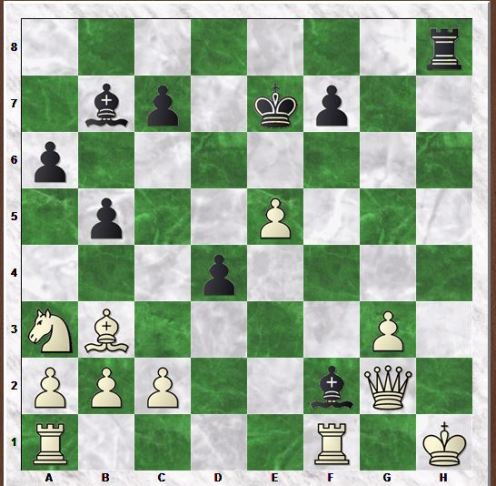
FEN
6r1/1bp1kp2/p7/1p2P1q1/3pn3/NB5Q/PPP2bPP/R4R1K b – – 0 1
Another puzzle from Dragoslav Andric’s 1981 book “Matni Udar”.
White to play and mate Black
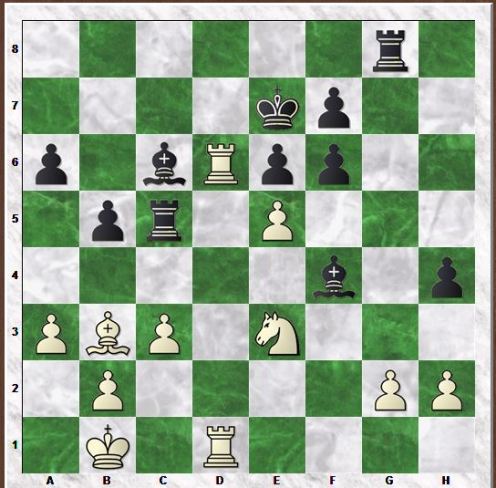
Gligoric v Nievergeld, Zurich 1959
Solution
A nice little ‘tictac’ solves this: 1 Nf5+ and 1…ef 2 ef+ Kf8
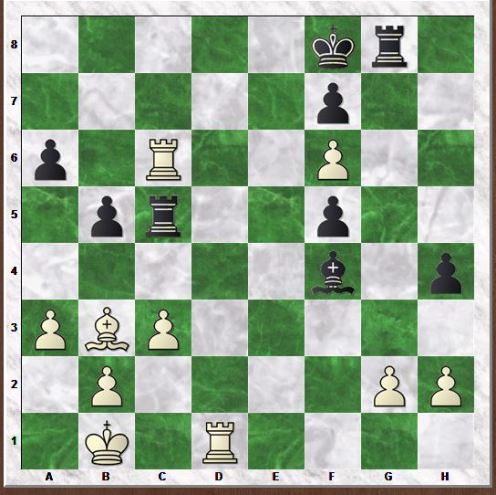
3 Rc6! 1-0; mate on d8 next move.
The game has some interesting annotations in Megabase 2017.
FEN
6r1/4kp2/p1bRpp2/1pr1P3/5b1p/PBP1N3/1P4PP/1K1R4 w – – 0 28
 allanbeardsworth