At the start of January, I did a daily blog about my pick of the moves of 2016: a dozen moves I had enjoyed seeing during 2016.
The idea of doing the posts only occurred to me in December; so my memory being what it is, my selection was likely skewed to more recent games. I have made a mental note to keep tabs of brilliant and other memorable moves throughout 2017.
But the game of the year is already decided. My school friend Nigel Short’s victory yesterday against World No 2 Fabiano Caruana in Gibraltar.
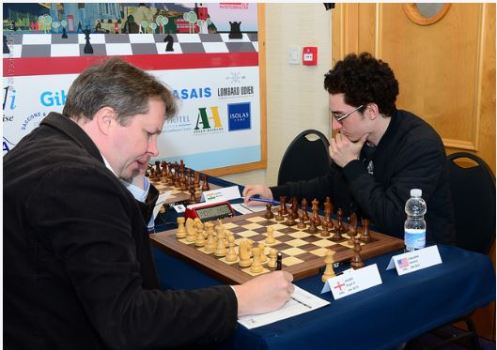
Start of the game, photo by John Saunders on Gibraltar chess website
I look forward to seeing analysis of the game, but very briefly:
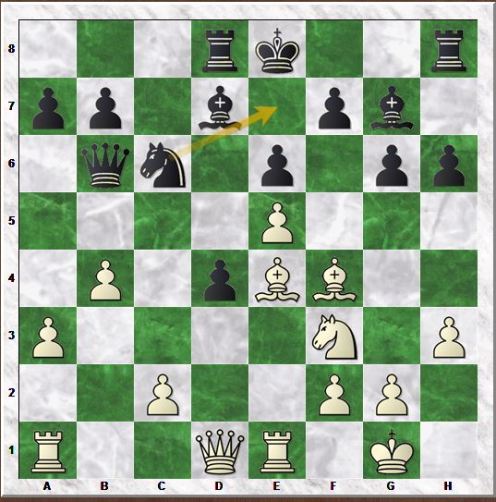
Fabiano played 16..Ne7, and Nigel took the d4 pawn
Nigel was able to coordinate his pieces so that he preserved his extra pawn.
Later, two moves stand out:
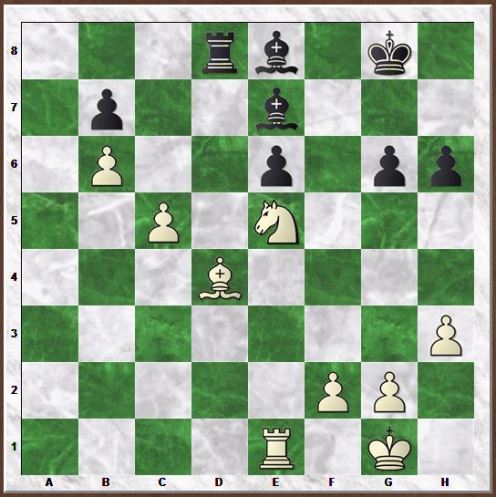
Position before 36 c6!!
and a few moves later
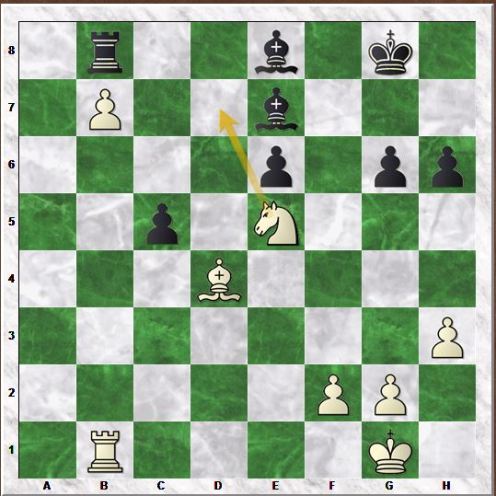
Position before 39 Nd7!!
Such moves require deep calculation, and great to see Nigel can still play so well.
And at the end of the game, with Jovanka Houska in the commentary box.
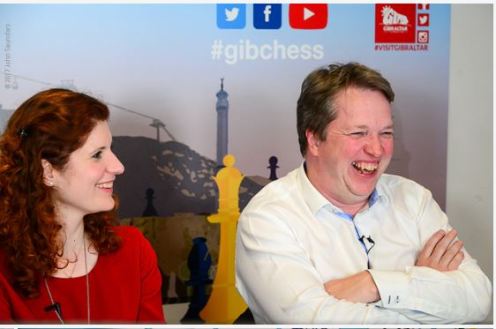
After the game had ended, photo again by John Saunders
A wonderful game, a joy to see.
The only way in which this game won’t be my game of the year in 2017 is if Nigel wins an even bigger scalp, or plays another even more fabulous game.
Another puzzle from Dragoslav Andric’s 1981 book “Matni Udar”.
Black to play and mate White
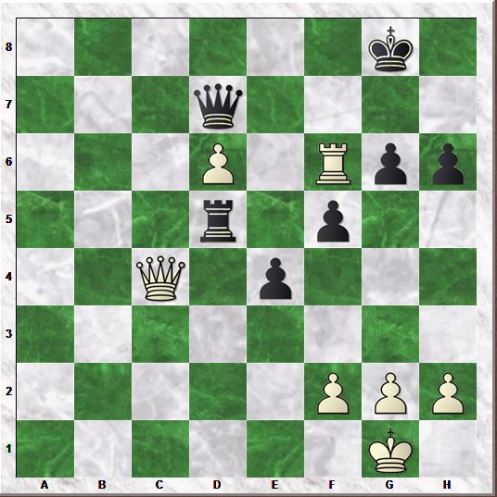
Gligoric v Olafsson, F, Portoroz Interzonal 1958
Solution
An unusual motif: Black breaks the pin on his LPDO Rd5 by 1…Qc6!, exploiting White’s back rank mate weakness and LPDO Qc4.
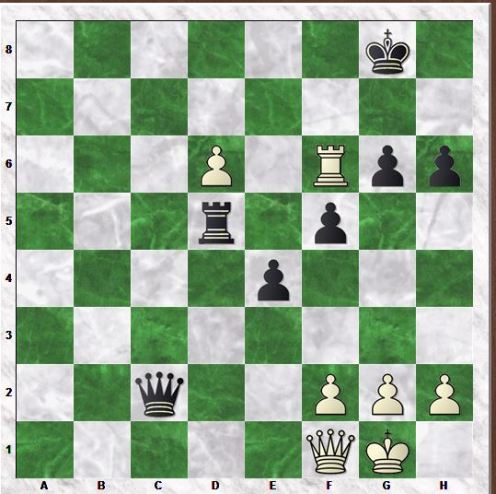
After 2 Qf1 Qc2 White resigned.
FEN
Another puzzle from Dragoslav Andric’s 1981 book “Matni Udar”.
White to play and mate Black
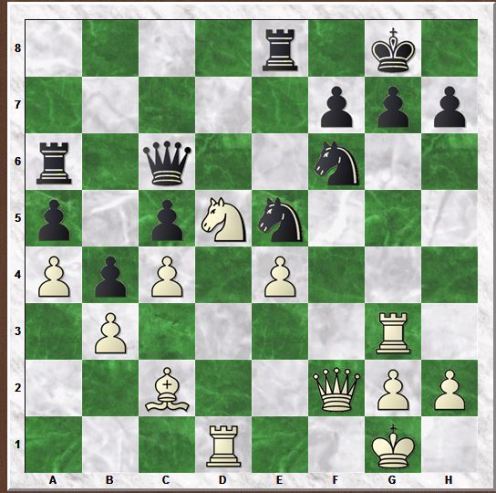
Gragger v Dorn, Vienna 1958
Solution
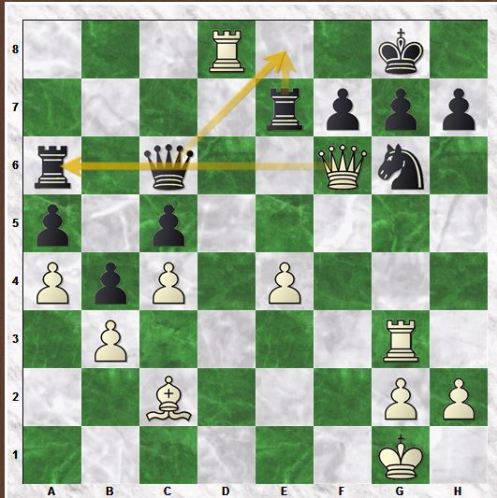
Not too hard, but nice today. 1 Ne7+ Re7[] 2 Qf6!
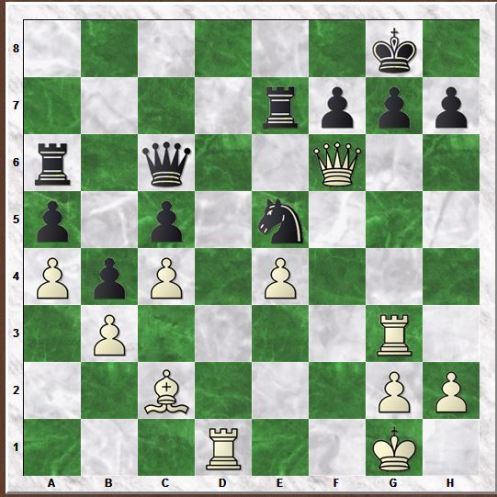
2…Ng6 3 Rd8+ Re8 4 Re8+ and when the queen captures, the Ra6 is LPDO.
FEN
4r1k1/5ppp/r1q2n2/p1pNn3/PpP1P3/1P4R1/2B2QPP/3R2K1 w – – 0 1
Another puzzle from Dragoslav Andric’s 1981 book “Matni Udar”.
Black to play and mate White

Muller v Dummer, 1958
Solution
Nice, but in my case, I suspect I have seen it before: 1…Rh3+ 2 gh[] Qh2+! (2..Rf2 wins prosaically).

3 Kh2 Rf2++ 4 Kh1 Rh2 mate.

FEN
1k6/1pp3Q1/p2b3p/8/3P1r2/N3r2P/Pq4P1/R5RK b – – 0 1
Last night, I watched the excellent masterclass hosted by Stuart Conquest by Veselin Topalov.
Veselin created a talk around one theme: the mistakes which even the World’s top players by making automatic moves which are not automatic. I heartily recommend the masterclass: in fact, great thanks to Stuart, the organiser, and the the sponsors of the tournament, for always putting on such a great event, which I have been lucky enough to visit once.
Giri v Harikrishna, Tata Steel Chess, 27/1/17
Position after an exchange sequence: Re6*Re1; Rh1*Re1; Re7*Re1.
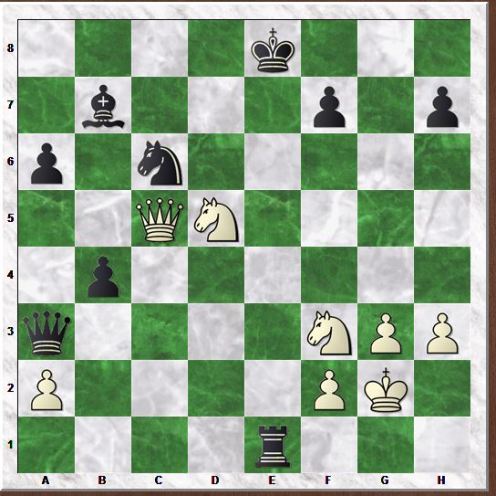
Giri was not in time trouble, and after a few moments thought, played the automatic 32 Ne1. The game was drawn after various more ups and downs.
However, the non-automatic move 32 Qd6!! seems far stronger. Not an outright win in human terms, since by the best defence Black can struggle on, but the twin threats of Nc7 mate or Nf6 mate cause concessions.
The game, with some very light annotations except for the position I am commenting on, where I go into more detail, is in my Chessbase 14 Cloud database.
The game was another great fight: the engine assessment swings a lot, so doubtless overnight many commentators will put proper analysis up on various aspects of the game. My contribution is only to show the relevance of Veselin’s timely lecture.
Another puzzle from Dragoslav Andric’s 1981 book “Matni Udar”.
White to play and mate Black
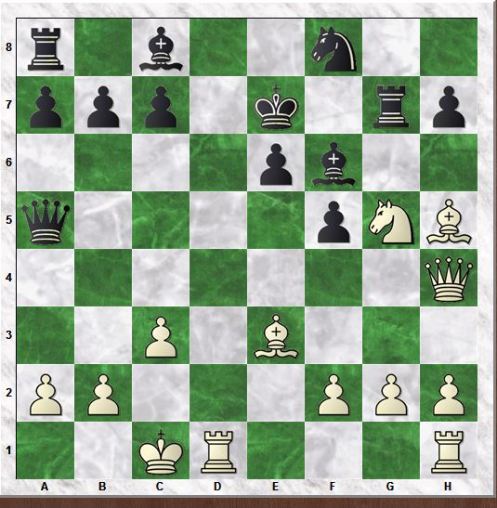
Kobr v Bohac, Czechoslovakia 1958
Solution
“Not too hard” …provided you see it, which fortunately I did, instantly. It is perhaps a standard decoy idea: 1 Qa4! and if 1…Qa4 2 Bc5 is mate.
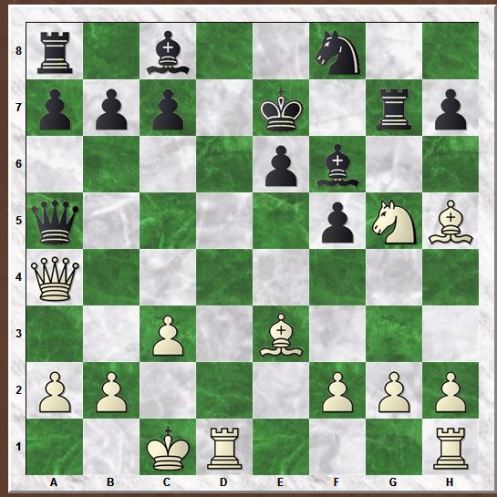
In CJS Purdy terms, the Qa5 is tied to c5, and the Ke7 is in a net.
FEN
r1b2n2/ppp1k1rp/4pb2/q4pNB/7Q/2P1B3/PP3PPP/2KR3R w – – 0 1
Another puzzle from Dragoslav Andric’s 1981 book “Matni Udar”.
White to play and mate Black
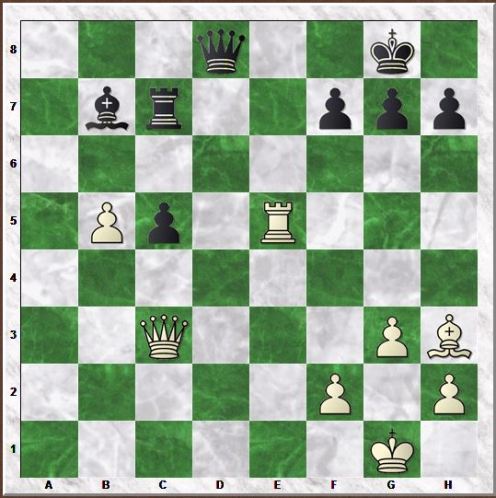
Ivkov v Eliskases, Municl Olympiad 1958 (1)
Solution
Quite like the famous Torre-Lasker back rank mate repeated “sacrifice” of the Q.
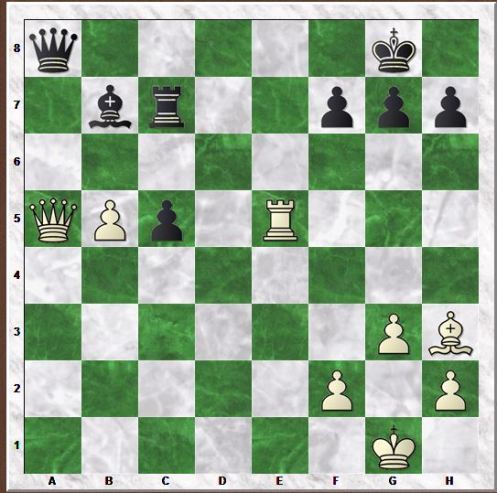
1 Qd2! Qa8 2 Qa5! and say 2…Qd8 3 Qc7 1-0
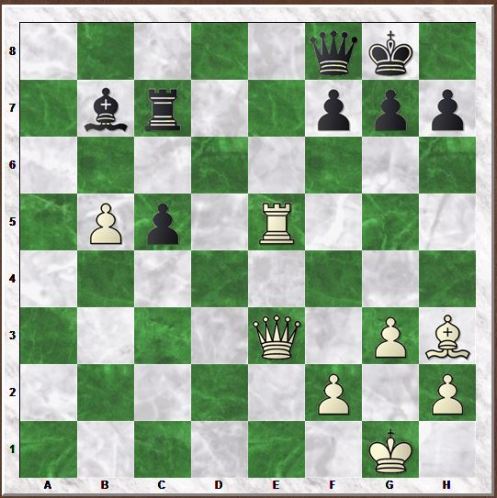
In the game, Black played 1…Qf8, and lost after 2 Qe3.
FEN
3q2k1/1br2ppp/8/1Pp1R3/8/2Q3PB/5P1P/6K1 w – – 0 30
(1) the book says Monte Carlo, but I will go with Megabase.
Another puzzle from Dragoslav Andric’s 1981 book “Matni Udar”.
White to play and mate Black

Macukovic v Bodisko, Tula 1958
Solution
The first move has to be 1 Qe6+, and the only move worth considering is 1…Ke6, when 2 Bc4+ Kf5 is forced.

Here, all you can hope is that there is a mating net, and that you haven’t the solitary escape route that might exist. In this position, there is no escape route, and the main line is 3 Nh4+ Kg4

and now various moves win: I chose 4 g3 since if 4..Kh3 5 Be6+ mates; but 4 h3+ Kh4[] 5 Be2 is the engine’s choice, and mates one move quicker.
FEN
r1q2b1r/2pnpkpp/p1Q1bp2/2P1p3/1P6/2P1BN2/P4PPP/R3KB1R w KQ – 0 1
Another puzzle from Dragoslav Andric’s 1981 book “Matni Udar”.
White to play and mate Black
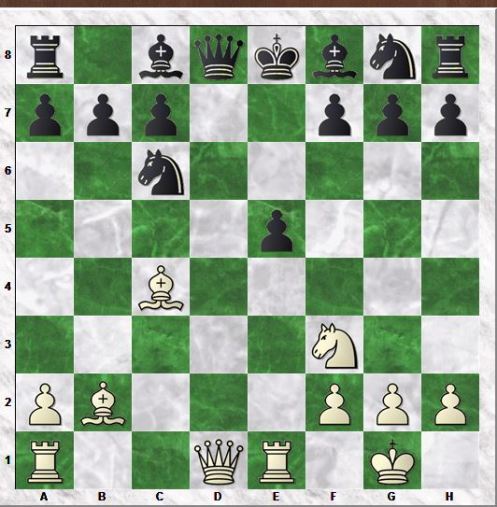
Dorazil v unknown, 1958
Solution
I wouldn’t be surprised if this were an odds game, though it could have been a Scotch gambit. Anyway, either the move suggested in the book, 1 Ne5! or the move I chose, 1 Bf7+, win easily.
I prefer 1 Bf7+: after 1…Kf7 2 Ne5+ exploits the Nc6 being tied to the Qd8
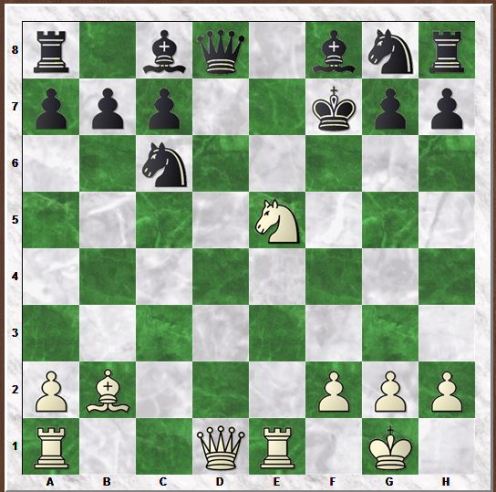
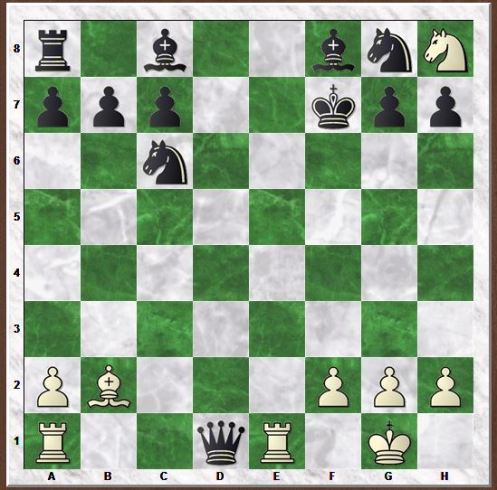
The game continuation is prettier, but isn’t forced: 1 Ne5 Qd1 2 Bf7+ Ke7 3 Ng6+ Kf7 4 Nh8 mate.
FEN
r1bqkbnr/ppp2ppp/2n5/4p3/2B5/5N2/PB3PPP/R2QR1K1 w kq – 0 1
Another puzzle from Dragoslav Andric’s 1981 book “Matni Udar”.
White to play and mate Black
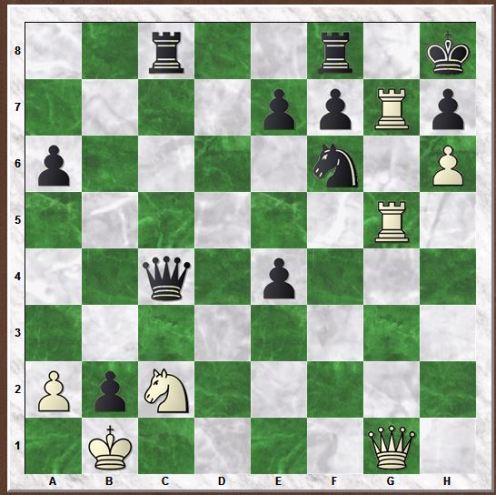
Heemsoth v Heissenbuttel, German championships (1) 1958
Solution
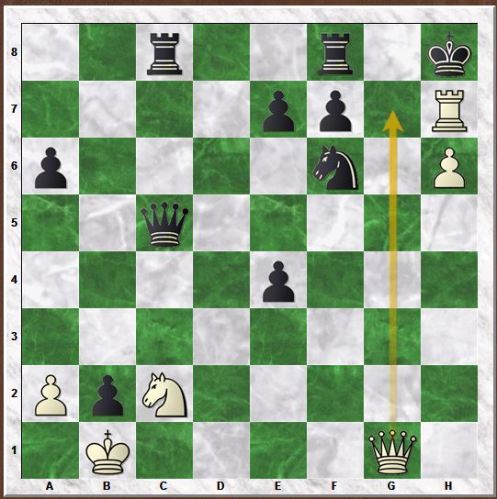
It is clear that the solution is a “line clearance” so that Qg7+ can be played, mating. But how? A little thought shows the first move has to be (has to be: it is the only winning move) 1 Rc5![]
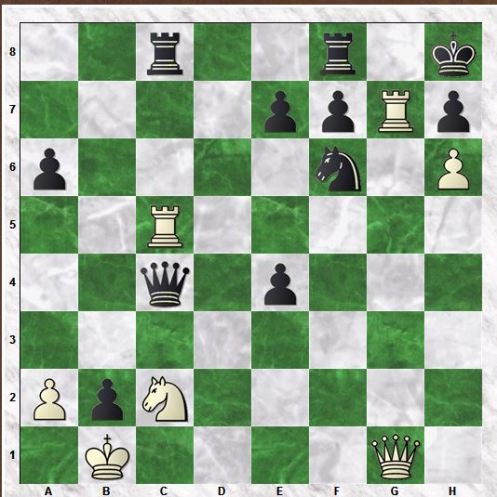
1…Qc5 2 Rg7+ and 3 Qg7 mate. Nice.
FEN
2r2r1k/4ppRp/p4n1P/6R1/2q1p3/8/PpN5/1K4Q1 w – – 0 1
(1) the book says “Zap. Njemacka” which using google translate seems to be “commander Germany” which I have presumed is “German championships”.
I have also corrected White’s surname to Heemsoth
 allanbeardsworth