Another puzzle from Dragoslav Andric’s 1981 book “Matni Udar”.
White to play and mate Black
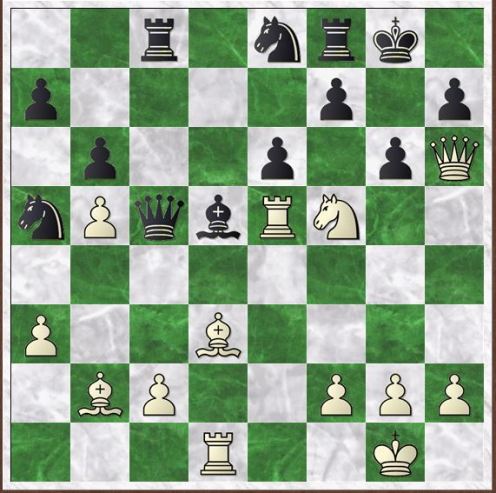
Spielmann v Honlinger, Bec 1929
Solution
A ‘standard’ motif, but nice nevertheless to work out the correct order of moves to achieve the aim.
1 Ne7+! Qe7[] (1…Kh8 2 Qf8 mate) 2 Qh7+! Kh7[] 3 Rh5+ Kg8[] 4 Rh8 mate. In the game, Black resigned after 1 Ne7+.
I haven’t heard of Baldur Hoenlinger, but the game was the 8th of a match against Rudolf Spielmann. The five games from the match on Megabase were +3 =2 to Spielmann.
FEN
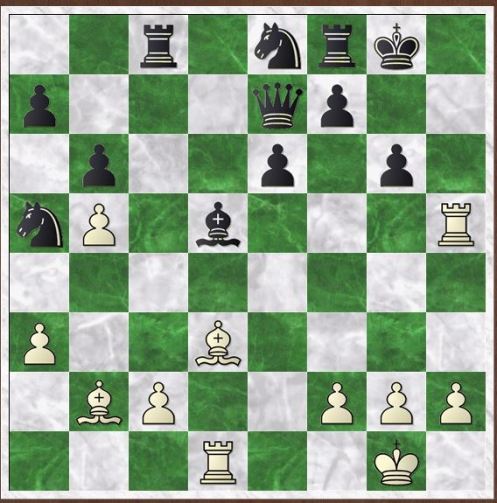
2r1nrk1/p4p1p/1p2p1pQ/nPqbRN2/8/P2B4/1BP2PPP/3R2K1 w – – 0 25
Another puzzle from Dragoslav Andric’s 1981 book “Matni Udar”.
White to play and mate Black

Steinbrecher v Banzinger, Monaco 1929
Solution
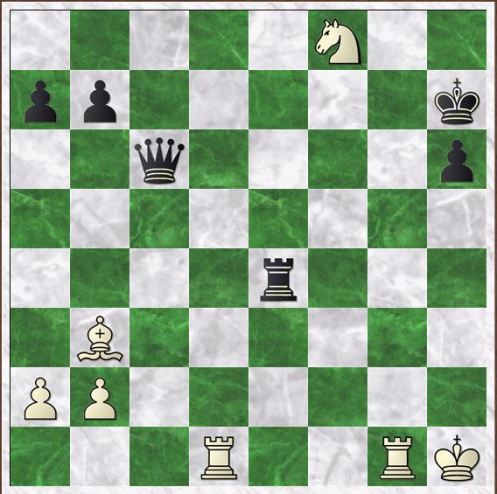
Straightforward today, since examining all biffs means you have to look at the only capture: 1 Qh6+! gh[] 2 g7+ Kh7 and the only thing to see, but which is pretty, is the next move, 3 gf(N) mate.
FEN
5r1k/pp4p1/2q3Pp/8/4r2Q/1B6/PP6/3R2RK w – – 0 1
Another puzzle from Dragoslav Andric’s 1981 book “Matni Udar”.
White to play and mate Black
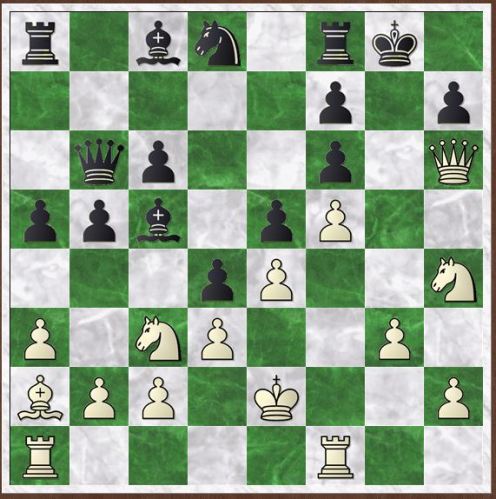
Alexander v Marshall, Cambridge 1928
Solution
I can’t find the game in my databases, but assume White would be the young (b 1909) CHO’D Alexander, Hugh Alexander, of British chess and Bletchley Park fame . I am assuming it might have been a student game whilst he was up at Cambridge.
Having first looked at 1 Ng6 and seen it does nothing if Black ignores the piece, the idea must be to to mate on the g file, and having first looked at the R lift Rf4-g4, seeing it can be captured, but then that recapturing g3*f4 opens the g file, the kernel of the solution had been found.
All that is needed was to see that 1 Rf4? ef 2 gf fails to 2…dc, which opens the diagonal to g1.So 1 Na4! to block the diagonal, and it all works.
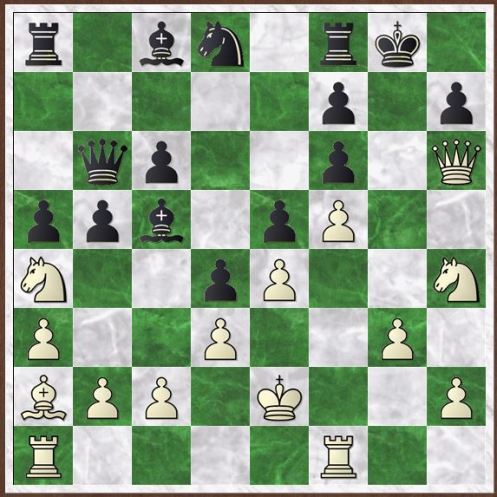
1 Na4 ba[] 2 Rf4 ef (2..Kh8 3 Qf6+ and 4 Rg4 mate) 3gf Ne6 4 Rg1+
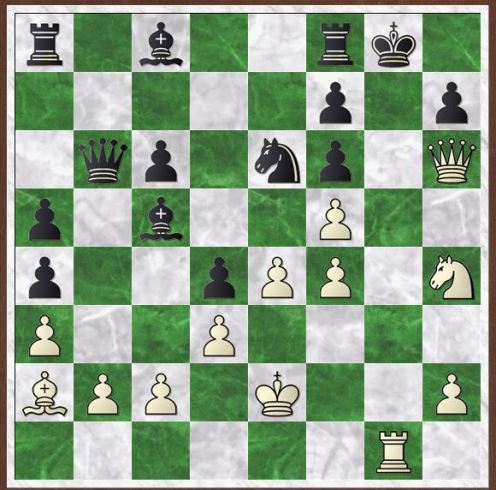
4…Ng5 and 5 Qf6 or 5 fg 1-0.
FEN
r1bn1rk1/5p1p/1qp2p1Q/ppb1pP2/3pP2N/P1NP2P1/BPP1K2P/R4R2 w – – 0 1
Another puzzle from Dragoslav Andric’s 1981 book “Matni Udar”.
White to play and win
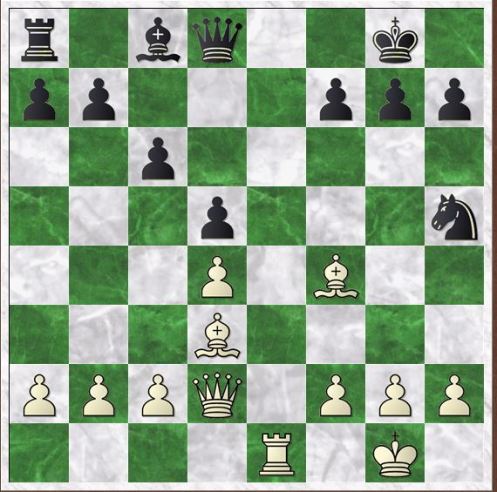
Jahrblum v Unden, Liege 1928
Solution
A nice puzzle today: the main motif is fairly easy to see- exploiting threats to Black’s bank rank. The execution needs care.
1 Bc7! Qf8[] 2 Bd6! Qd8[].
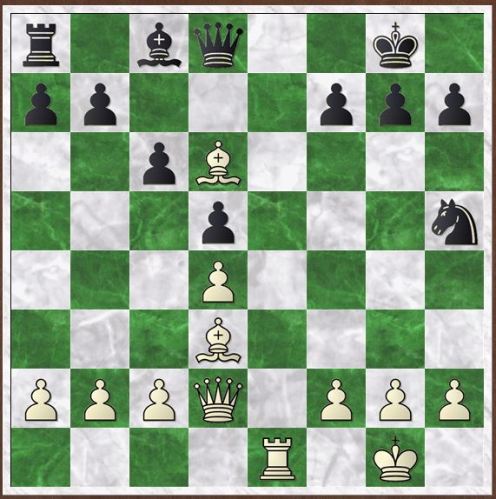
Now 3 Qg5 is clearly best, bringing one more piece to the party: but I couldn’t see how to defeat 3…Nf6, mainly since the White Re1 is LPDO, so there is a pin after 4 Be7 Qe8
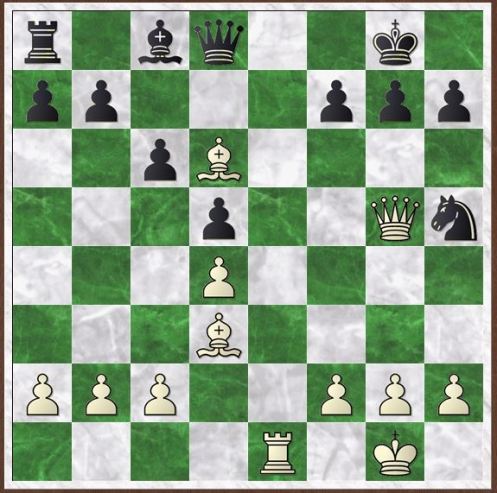
But then 5 Bf6! and after 5….Qe1+ and 6 Bf1 decides.
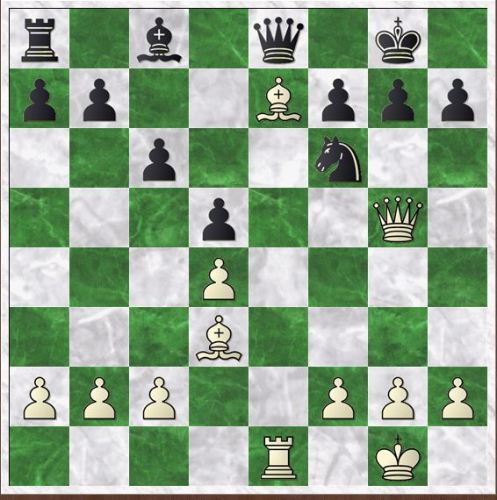
FEN
r1bq2k1/pp3ppp/2p5/3p3n/3P1B2/3B4/PPPQ1PPP/4R1K1 w – – 0 1
I really enjoyed Sagar Shah's recent posting on Chessbase about learning from the classics. Rather than give my usual daily puzzle, instead some other thoughts for my readers to reflect on, based on some material I have recently learned from.
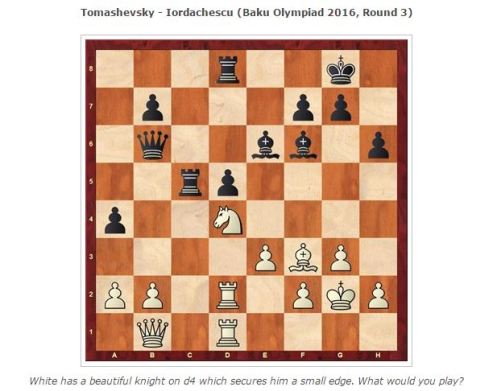
Tomashevsky followed Karpov by exchanging on e6:
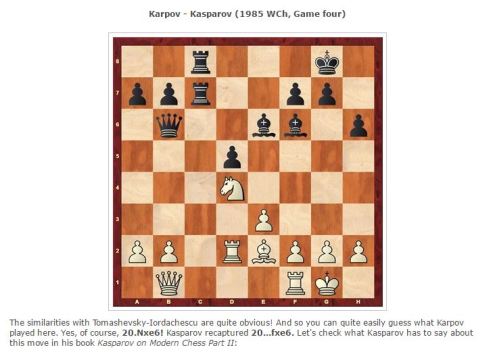
Kasparov's commentary cited by Sagar is very insightful. In brief: exchanging a great piece for a lesser piece is justified because it creates white square weaknesses in Black's king side, which White's Q and B can aim to exploit, especially with Black lacking his white squared bishop.
Why am I blogging about this?
I am presently working my way through the really interesting Lessons with a Grandmaster by Boris Gulko and Joel Sneed: a very interesting, and fresh, way to provide instructive material.
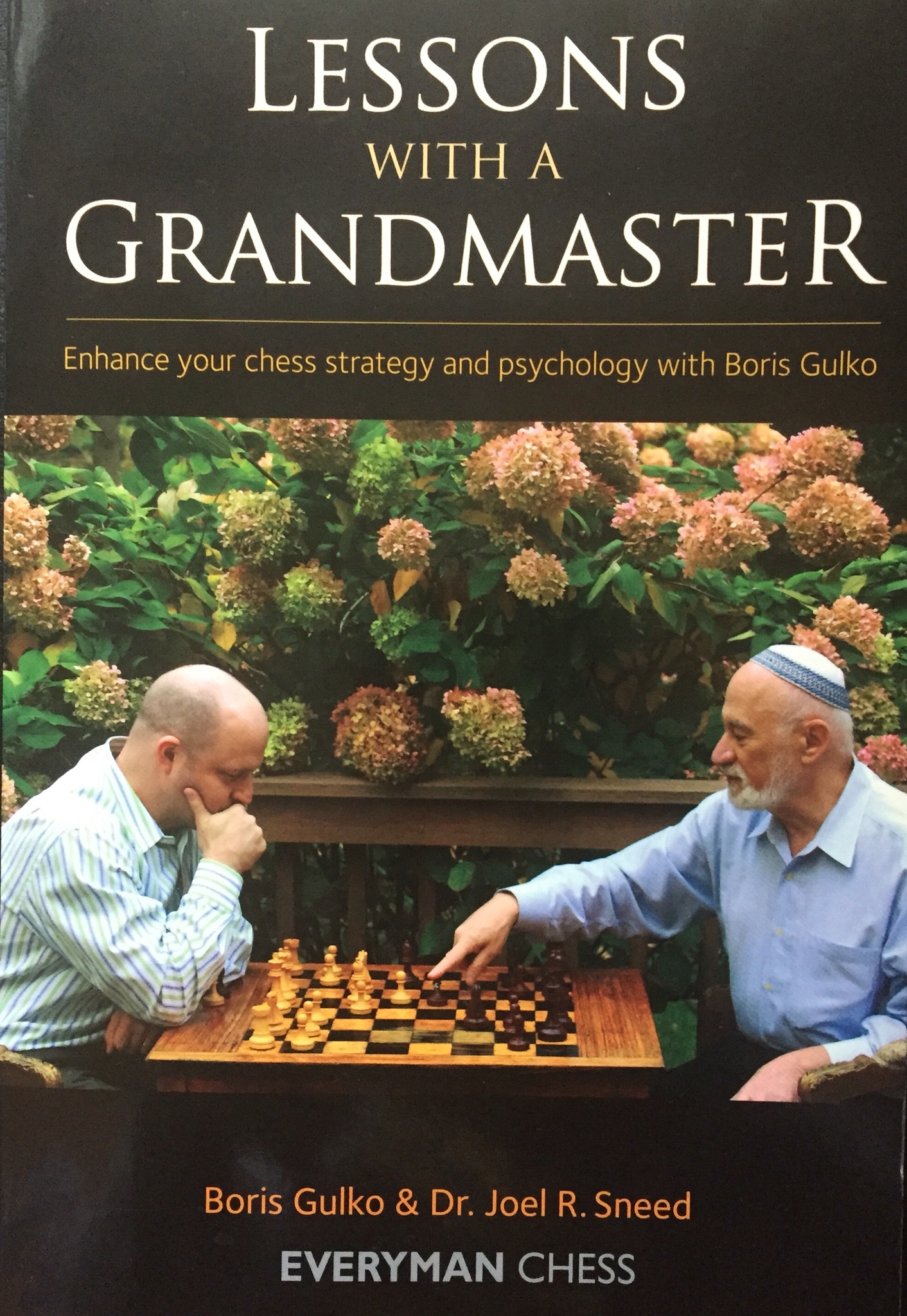
In summing up lessons from Gulko-Ponomariov Pamplona 1996 he writes:
..exchanging off your opponent's best defensive piece is sometimes the best way to increase the pressure.
He is referring to this position:
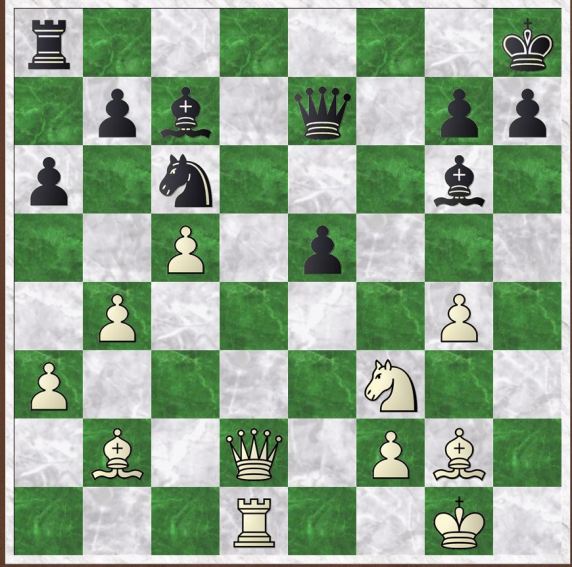
where Gulko played 25 Qg5! offering the exchange of Qs or forcing Black to give a concession.
Gulko's summary commentary continued:
For a great example of this method, see Smyslov -Reshevskly, World Championship Tournament 1948 11th round. This is a game I didn't recall, but Megabase has the game annotated by Garry Kasparov, the key position being:
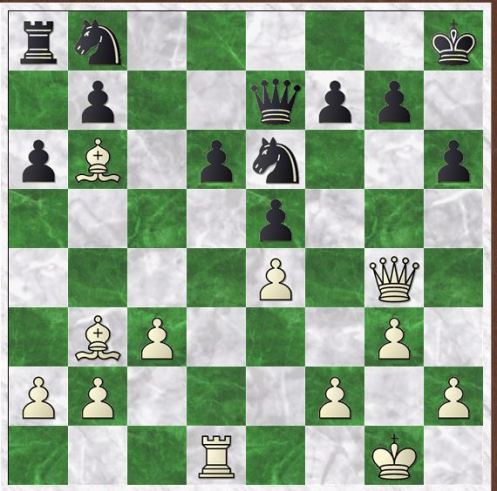
Smyslov's 25 Be6! is very similar in concept to Karpov-Kasparov: White gives up the strong bishop on b3 to take advantage of Black's remaining pieces lack of development and coordination.
There is a further parallel to Gulko-Ponomariov. After 25 Be6! fe White played 26 Qh4! which in precisely the same way offers Black the no-win choice between exchanging his sole active defender or making concessions.
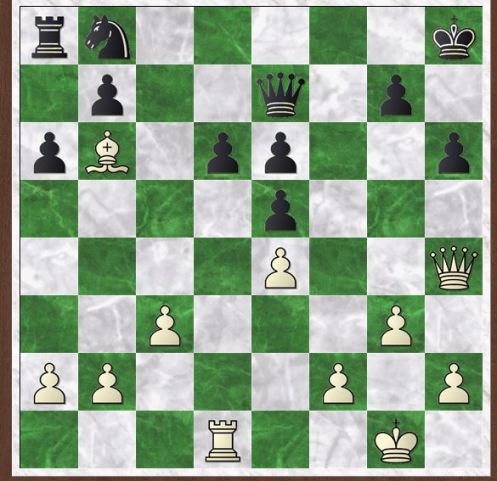
Black chose 26…Qd7, met by 27 Qd8+ and queens came off regardless, and White won the d6 pawn and converted the advantage (I should add “it's not over yet” after 27 Qd8+: Reshevsky defended resourcefully for many moves, but Smyslov steered the game into a rook and pawn ending and then “but it is now”.
Truly, learn from the Classics. The idea of transformation of the advantage by offering or actually exchanging the best defenders is a new concept for me.
 Posted with Blogsy
A few days ago I posted this puzzle
“White to play and win”
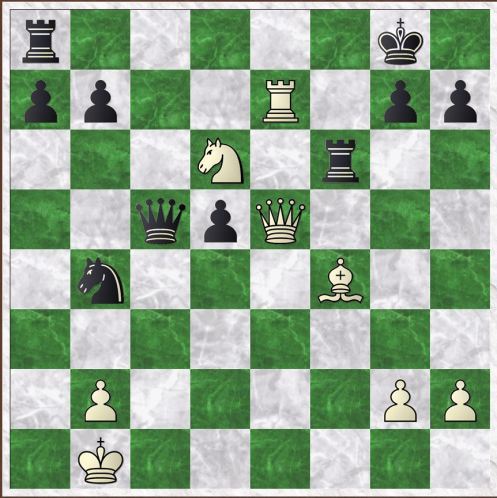
My solution correctly shows that the problem is cooked: 1 Rg7+ doesn’t win, but gives White only a small advantage.
A reader asked me:
i) to add FEN to my blog posts, which I have now started to do (thank you for that suggestion)
r5k1/pp2R1pp/3N1r2/2qpQ3/1n3B2/8/1P4PP/1K6 w – – 0 1
ii) wondered why 1 Re8+ didn’t work.
I should have considered it, because I have drilled into myself Purdy’s requirement to examine all biffs.
So, for today’s problem, why doesn’t 1 Re8+ work?
Solution
The answer is not:
1…Rf8?? – the natural move: 2 Qe6+ Kh8[] 3 Nf7+ Kg8[] 4 Qg8+! Rg8[] 5 Nf7 mate, the well known smothered mate technique that all beginners learn.
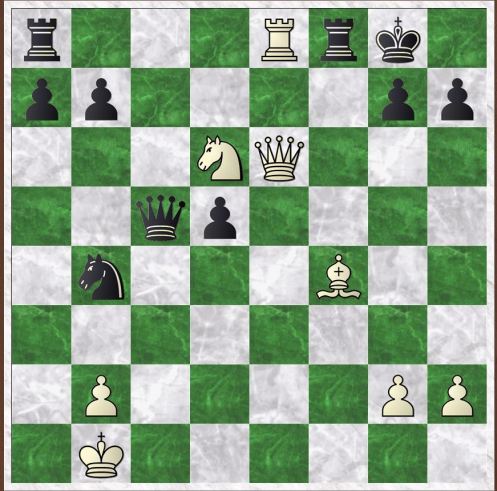
But
1…Re8! [] 2 Qe8+ Rf8 3 Qe6+ Kh8[] 4 Nf7+
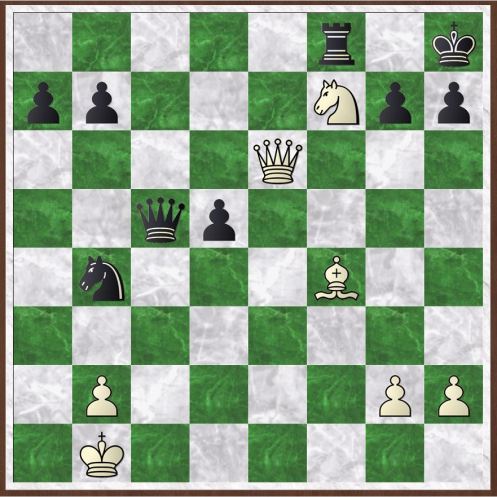
and now the crucial difference:
4..Rf7! since if 5 Qe8+, 5…Rf8 and the rook is defended by the Qc5: Black emerges a rook ahead.
Not obvious at all: especially since 1..Rf8?? is the natural reaction to 1 Re8+
Another puzzle from Dragoslav Andric’s 1981 book “Matni Udar”.
Black to play and mate White
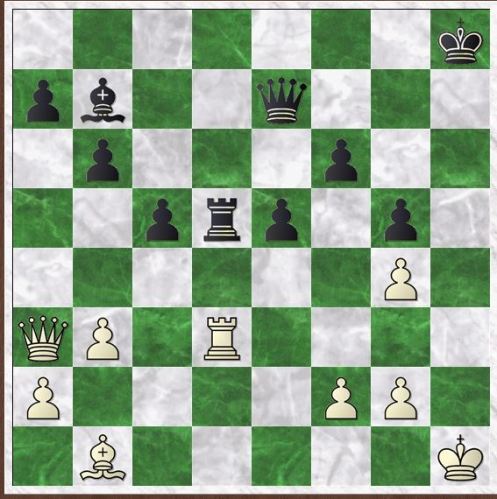
Schatz v Gigold, Hoff 1928
Solution
Whilst I don’t remember this position, I suspect I have seen it, because the mating line was instantly familiar to me: only a moment’s checking was needed to be certain.
1..Qh7+ 2 Rh3 (2 Kg1 Rd3 is prosaically won)
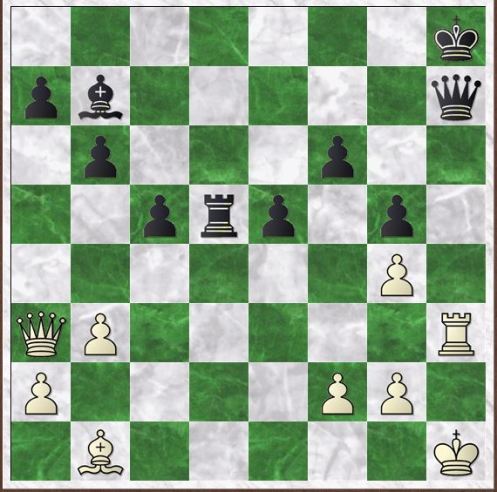
2..Rd1+ 3 Kh2[] Rh1+!
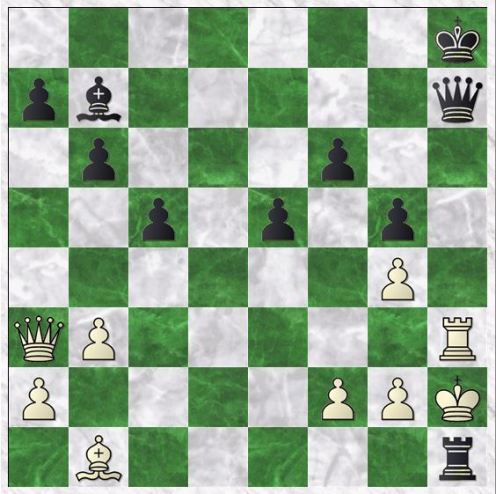
and mate after 4 Kh1 Qh3+ 5 Kg1[] Qg2 mate; or 4 Kg3 Rh3+ 5 gh[] Qh4 mate, or better, 4….Qh4+! 5 Rh4[] gh mate.
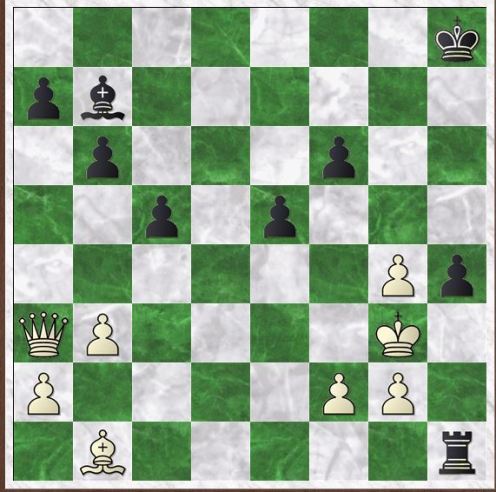
Pretty.
FEN
7k/pb2q3/1p3p2/2prp1p1/6P1/QP1R4/P4PP1/1B5K b – – 0 1
Another puzzle from Dragoslav Andric’s 1981 book “Matni Udar”.
White to play and mate Black
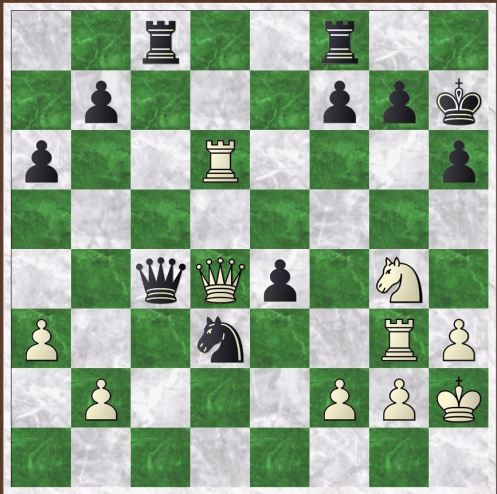
Mittelmann v Klausen, Altona 1928
Solution
I immediately saw the two forcing moves which “had” to be the solution. I chose 1Nf6+ Kh8 2 Rg7 and sure enough that wins in a move or two: 2..Kg7 3 Ne8++ 1-0
The alternative is 1 Rh6+, which I thought was more or less equivalent: 1…gh[] 2 Nf6+ Kh8 3 Rg7: and it is, except Black can play desperado moves like Qc7+ (to prolong the game)
FEN
2r2r2/1p3ppk/p2R3p/8/2qQp1N1/P2n2RP/1P3PPK/8 w – – 0 1
Another puzzle from Dragoslav Andric’s 1981 book “Matni Udar”.
Black to play and mate White
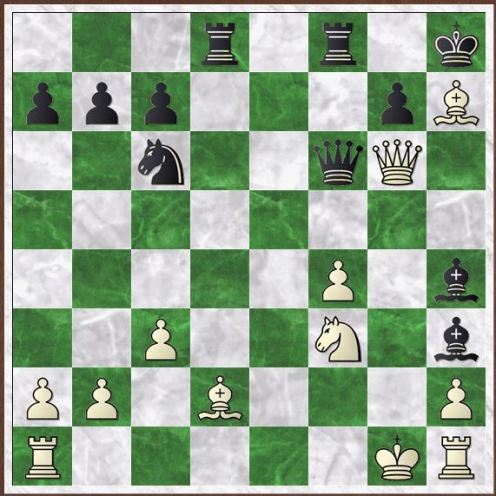
Marshall v Soldatenkov, New York 1928
Solution
I am assuming White was Frank Marshall, though I can’t find this game (nor any others by his opponent) in Megabase.
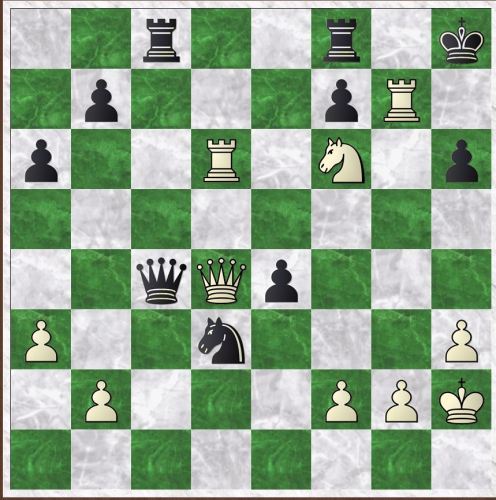
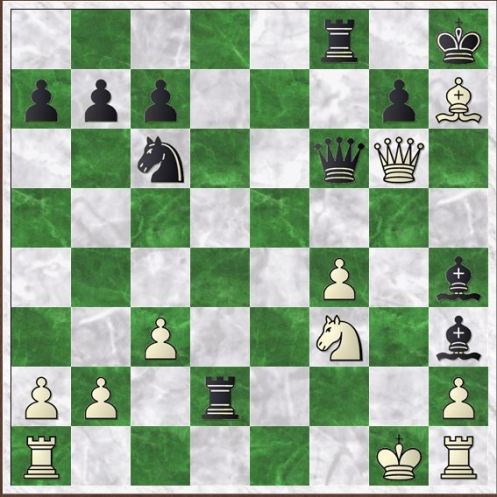
Black is winning by various means: 1…Ne5! is practically enormously strong, winning the Queen since 2 Ne5 Qe5! is brutal (3 fe Bf2 mate) and 2 fe Qf3 is also terminal. But Black also has the natural first move 1…Rd2! which is even more forcing: 2 Nd2 Nd4! which is where I stopped:
But if then 3 Qh5 Black has the glorious deflection 3…Qg5+!! 0-1.
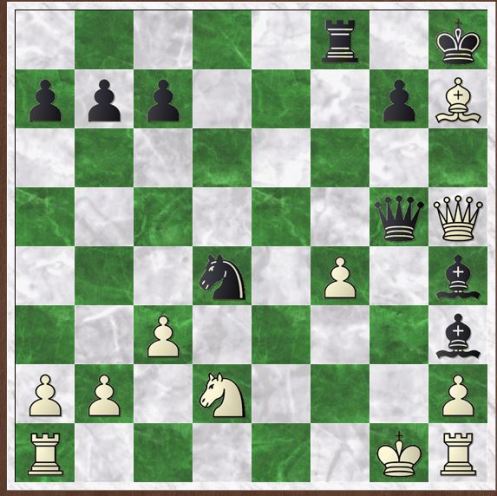
FEN diagram
3r1r1k/ppp3pB/2n2qQ1/8/5P1b/2P2N1b/PP1B3P/R5KR b – – 0 1
Another puzzle from Dragoslav Andric’s 1981 book “Matni Udar”.
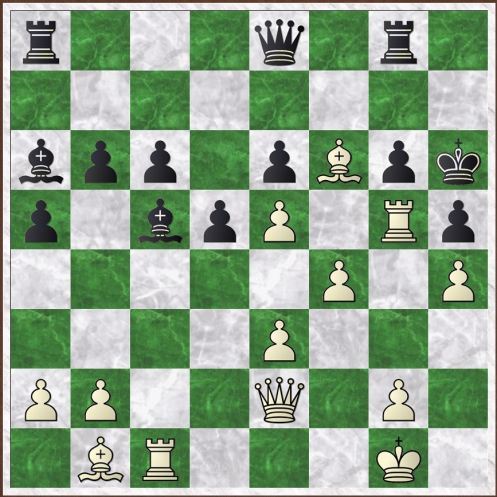
Gilg v Mueller, Keckemet 1927
Solution
Knowing it is a puzzle, I more or less immediately found 1g4!, winning-when checking on Chessbase, my engine says mate in 9: but it is clear that if 1..Be2 then 2 Rh5+ gh[] 3g5 mate.
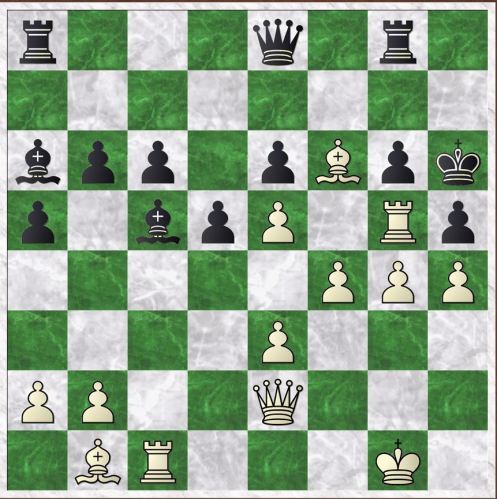
This is the line given in the book, as if it they were the moves played in the game, but Megabase reveals the finish was far more prosaic: 1 Qf3 and winning less forcefully.
FEN position
In response to a request from one of my readers, I will from now on, wherever possible, paste the FEN position into my daily chess blogs.
r3q1r1/8/bpp1pBpk/p1bpP1Rp/5PPP/4P3/PP2Q3/1BR3K1 b – – 0 31
 allanbeardsworth