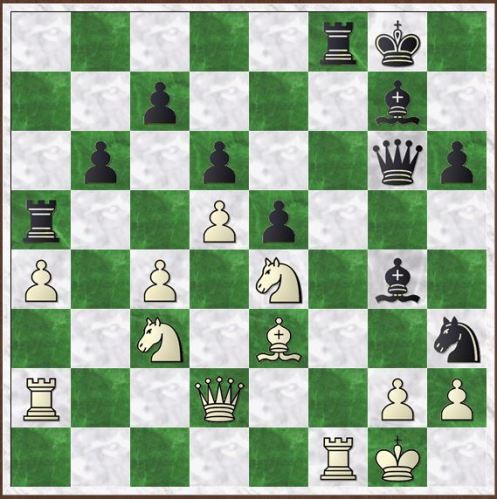
White to play and win (look for the best way to win)
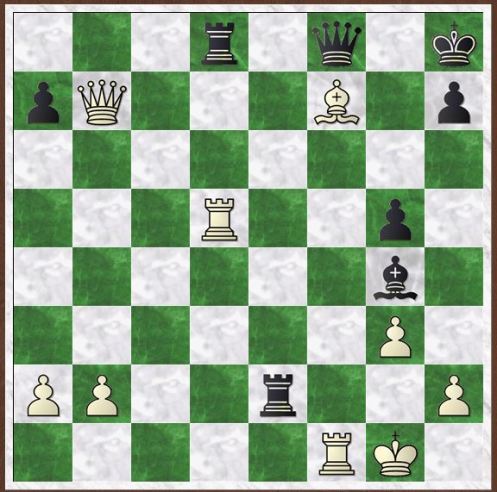
Belousenko v Pugachov, corres 1966-68
Solution
I failed with this puzzle, playing 1 Bg6!, which wins, but Black can play 1…Rg2+! 2 Kg2 Bh3+! and get quite a few checks.
My engine tells me that 1 Qc6! is also super strong, but the move played in the game, is as strong and far prettier: 1 Qb4!!
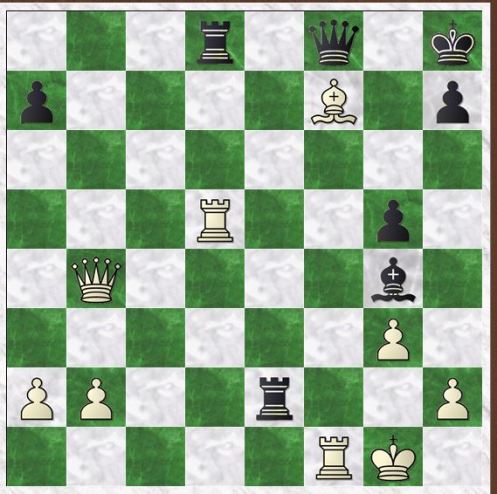
Then Black can grovel, but note that the Bg4 is LPDO; and with checks like Qc3+ also being possible, it is game over. So 1…Qb4 is the fair thing to do, when faced with 1 Qb4!!, and after 2 Rd8+ Kg7 3 Rg8+ Kh6 4 Rf6 is mate.
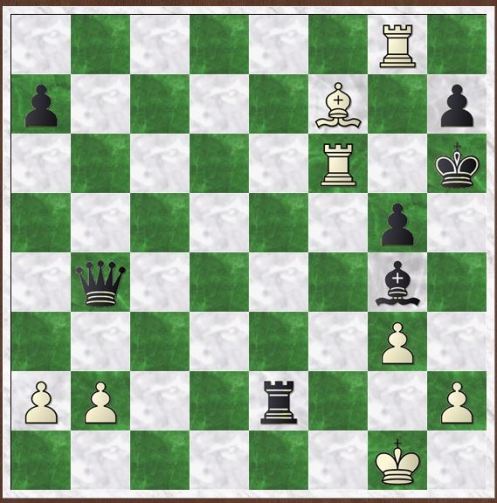
White to play and win
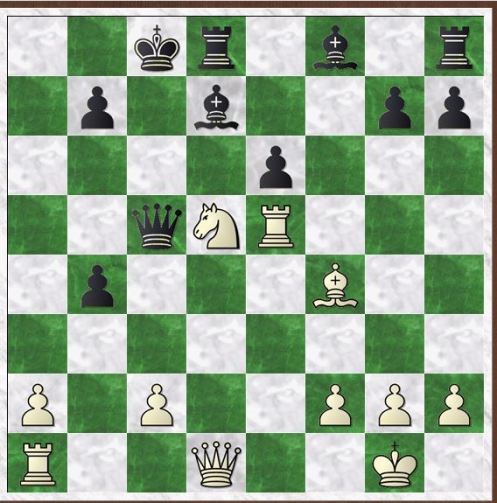
Gurgenidze v Grigorian, Gori 1968
Solution
This is one of those positions in which it helps to know that it is a puzzle. I am not sure in a game I would have believed 1 Ne7+!!, even if I had considered it; though knowing it is a puzzle, it is easier to look at it.
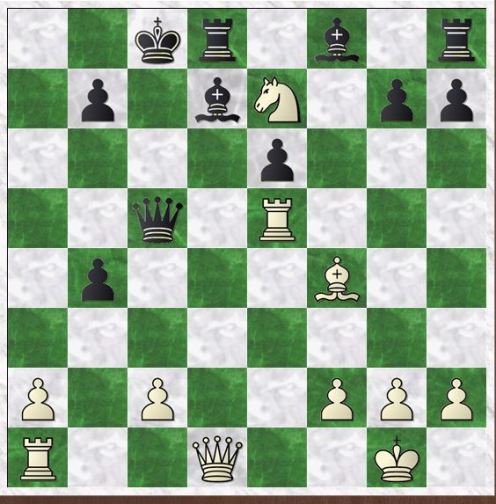
Firstly, the move played in the game was 1… Be7 when after 2 Rc5+ Bc5 3 Qh5 Whire had a comfortable edge, and duly converted: material up, with Black’s king also being in the open.
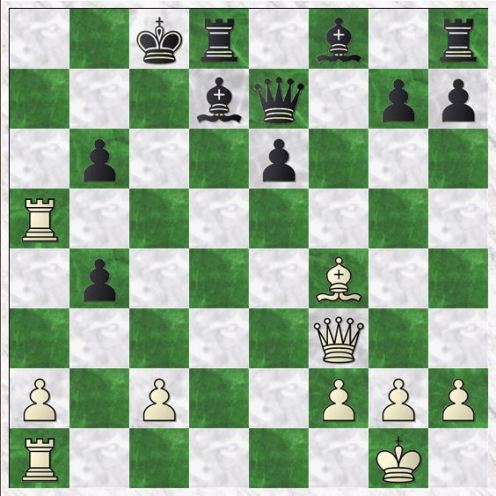
The move I looked more at was 1…Qe7 when 2 Ra5! is natural.

It took me a while to see 3 Qf3! after 3…b6. Without Qf3, Black is better, but after it, he is lost.
Black to play and win
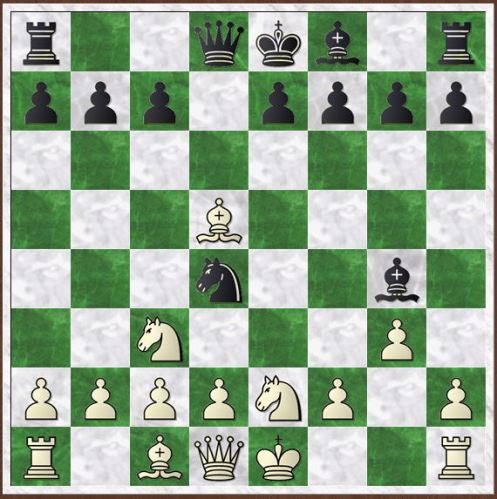
Gibbs v Schmid, Lugano Olympiad, 1968
Solution
A total rest day: 1..Qd5, and since 2 Nd5 Nf3+ 3 Kf1 Bh3 is mate, White must play 2 f3 when 2..Qf3 hits the Rh1, 3 Rf1 Qg2 0-1.
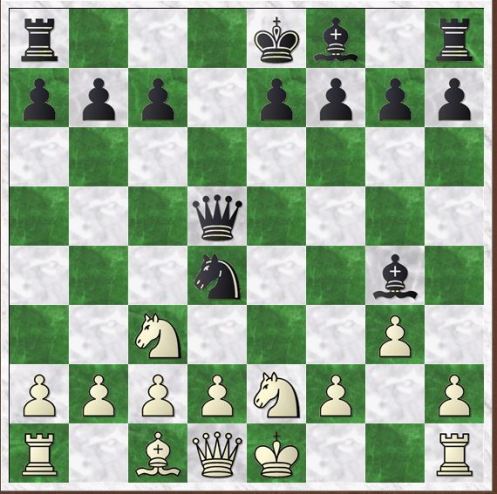
Lubomir Kavalek’s latest article on ChessBase, centered on the recent spectacular game Carlsen- Li, has one piece of ‘hyperbole’ which intrigued me.
Another unique feature is that both kings line up at the corners of the long diagonal after only 15 moves – perhaps for the first time in chess history.
Prior to having read Jon Edwards’ book ChessBase Complete, I wouldn’t have known whether the statement was true or not, but having learned how to do at least basic filters, I decided to check the position. The easy part in ChessBase is to put the pieces in the diagram; the key nuance is to limit the search to a last move of 15.
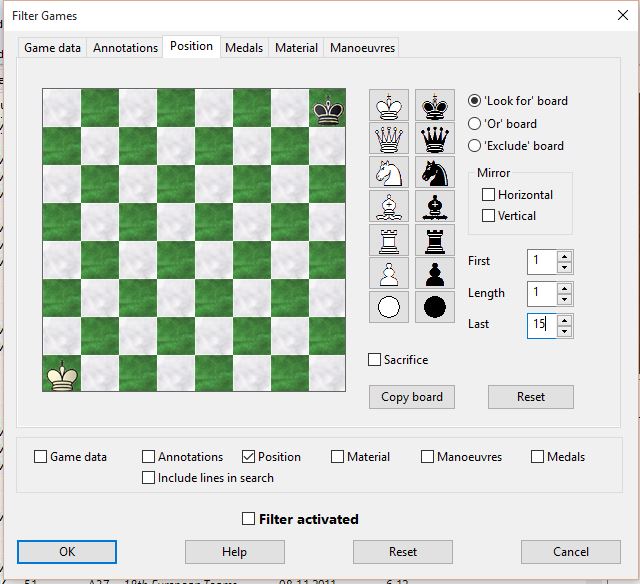
A few seconds later (few, because I had to do the search in both Megabase 2012, my latest version, and TWIC, and then de-dupe) I had the list:
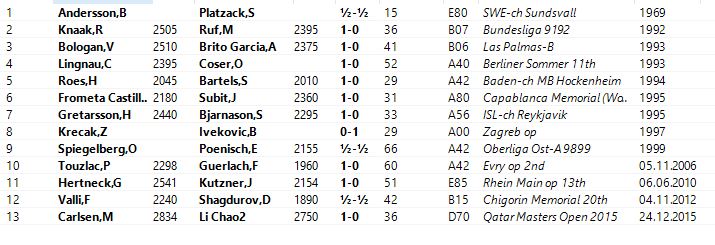
So, 15 Ka1/Ka8 is rare, but not unique.
Changing the filter to 14 showed only two results, of which one, the record holder, was after 13 moves:
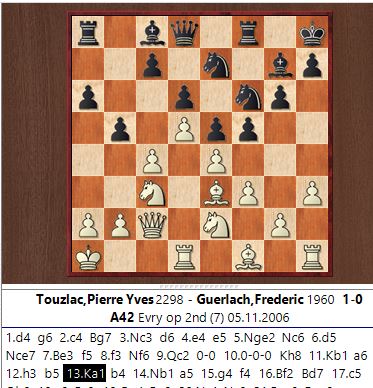
Wonderful what can be done with ChessBase.
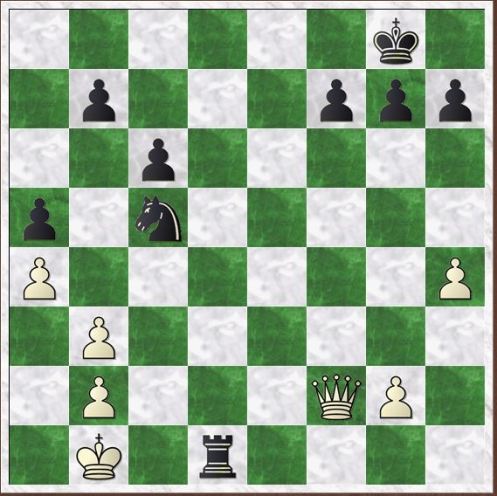
Black to play and win, after 1 Rd1??
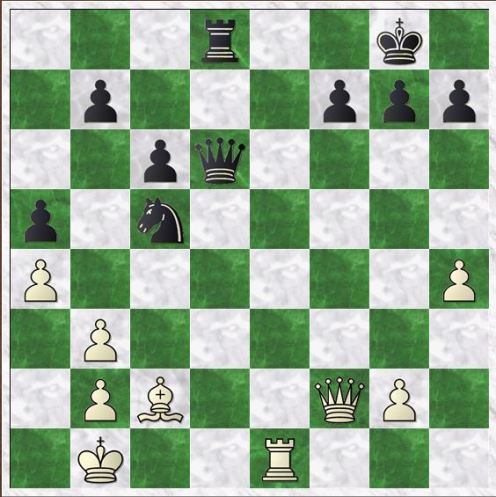
Dubinsky v Bikhovsky, Moscow 1968
Solution
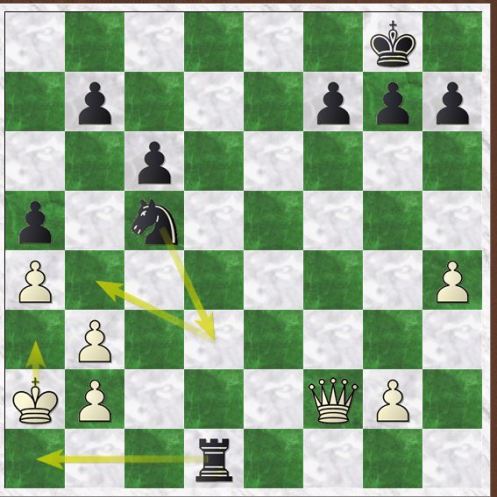
Examine all biffs immediately leads to 1… Qd1+ 2 Bd1 Rd1+; and all that has to be seen is that after 3 Kc2, 3…Rc1+! forks the King and Queen whether or not White captures it ( 4Kc1, 4…Nd3+; 4 Kd2, Ne4+).
And if White instead plays 3 Ka2, then there is a nice mate after 3…Nd3 biffing the queen en route to Nb4+ Ka3[] Ra1 mate.
White to play and win (cooked: instead, analyse and assess the position)
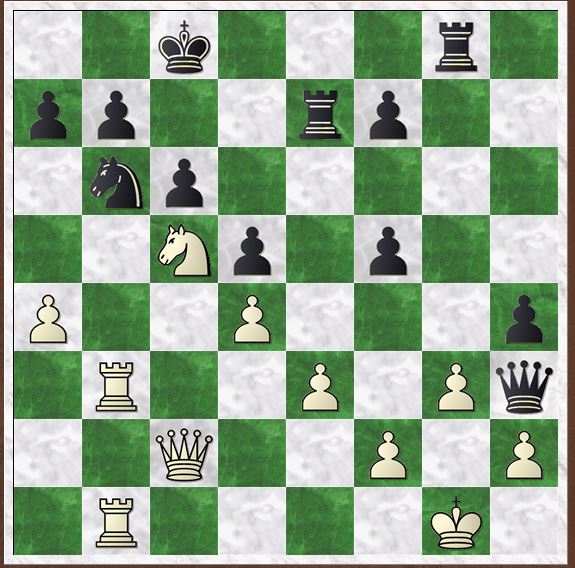
Lengyel v Rubinetti, Lugano Olympiad, 1968
Solution
The solution is the obvious 1 Nb7 but I couldn’t break 1…Rb7, for the reason…that White only has a minor advantage.
In the game, Black played the weaker 1..Kb7, which is well met by 2 Qc5 hitting the LPDO Re7 and threatening to sacrifice on b6.
I have attached a game file here with analysis.
Black to play and win, after White plays 1 Rf1??
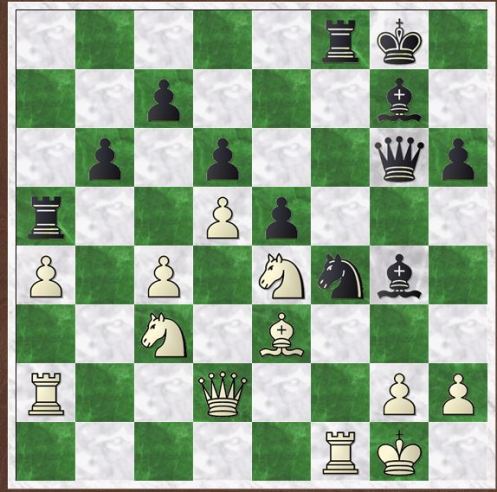
O’Kelly v Yanofsky, Lugano Olympiad, 1968
Solution
A rest day today: 1… Nh3+ and if the King moves, 2 …Rf1 is mate; and if the N is captured, 2…Bh3+ also mates next move.
White to play and win, after Black played 1…Bd6??
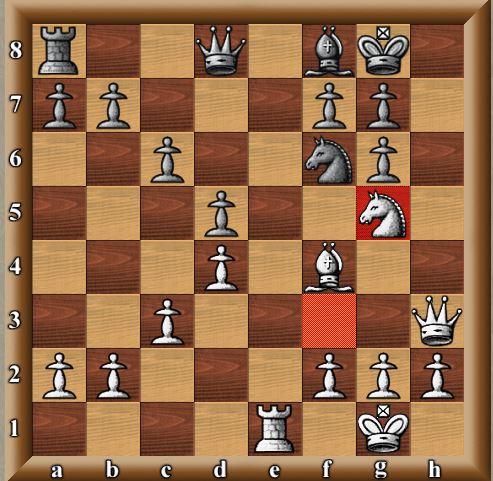
Allan Beardsworth v “Lzikon”, ICC 3 minute blitz
Solution
Today, it being New Years’ Day, a departure from the daily Teschner book puzzle, and instead a position from one of my 3 minute blitz games; I was pleased to spot the tactic in an otherwise near level game.
1 Nf7!! double attacks the Qd8 and Bd6; and if 1…Kf7, then 2 Qe6+ is another double attack, and the Bd6 drops off with fatal consequences.
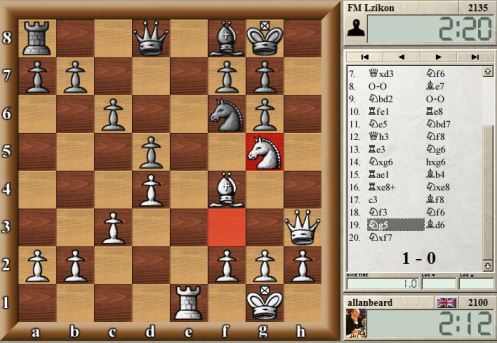
May be doing daily tactics helps? It is nice to play such nice ‘tictacs’ now and then.
White to play and win
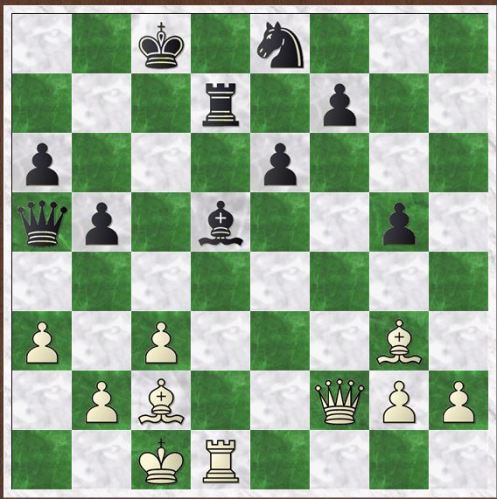
Schmidt v Padevsky, Polanica Zdroj 1968
Solution
An unusual and lovely position today: several themes are used. The solution came to be quickly, but seeing how it works is pretty. 1 Qc5+! both hits the K and also sets up a jump-biff against the LPDO Qa5. So 1…Kd8 2 a4!!
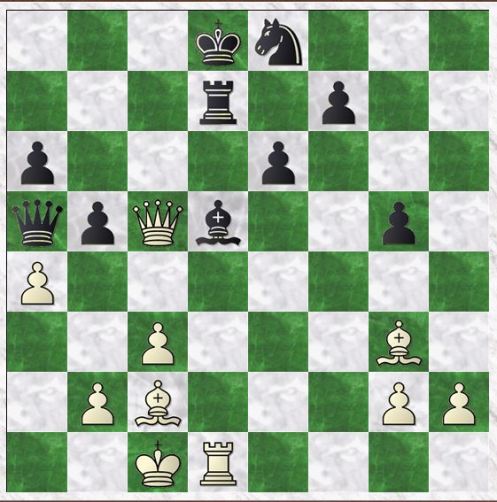
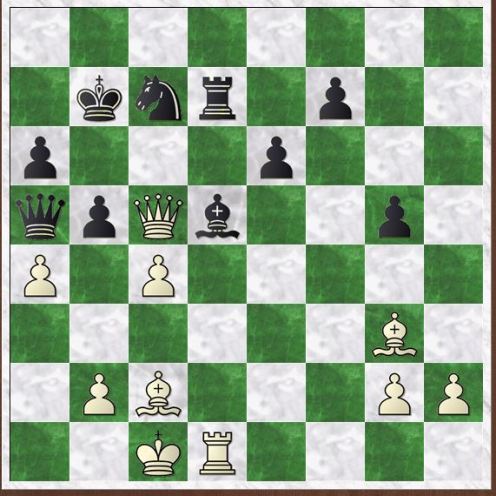
White threatens the horrible 3 b4!! revealing that the Qa5 is both LPDO and in a net: so 2….Rb7[] to permit the Q to escape to b6, when 3 c4!! is a double pin.
The same motifs apply if Black instead defends by 1… Nc7
A fitting end to 2015.
Black to play and win
Epstein v Veroci, Lipetsk 1968
Solution
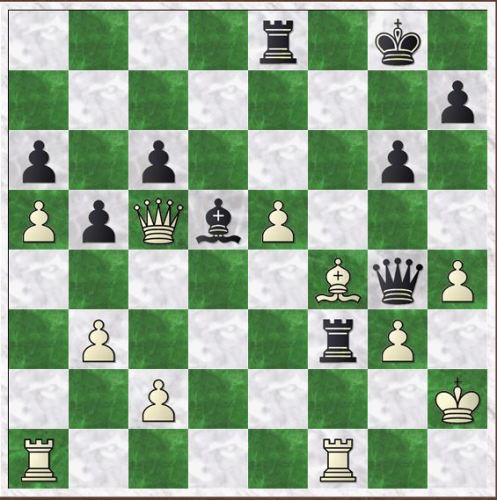
A pretty one today, with an unusual motif. It took me a few minutes to spot it, but examine all biffs leads to 1…g5!! and White’s position collapses.
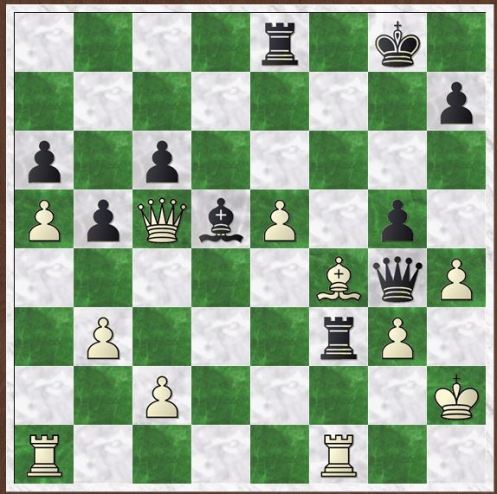
The Bf4 is tied to defending the g3 pawn; if instead the h4 pawn captures, then the h file is opened and Black wins on the light squares. (1 hg) 1…Qh5+ 2 Kg1:
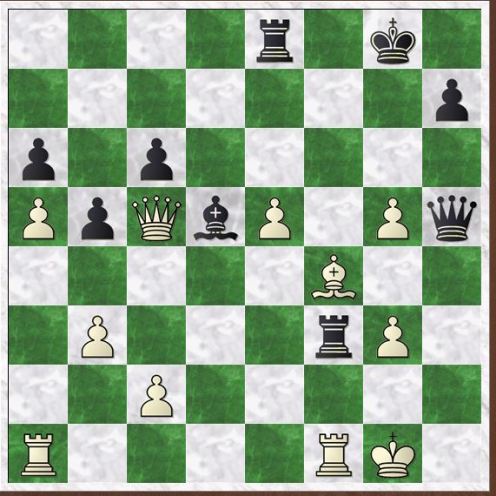
Now, Rf8 threatening R8f4 is the engine’s favourite, but Rf4 as played is crushing too.
 allanbeardsworth