Black to play and win
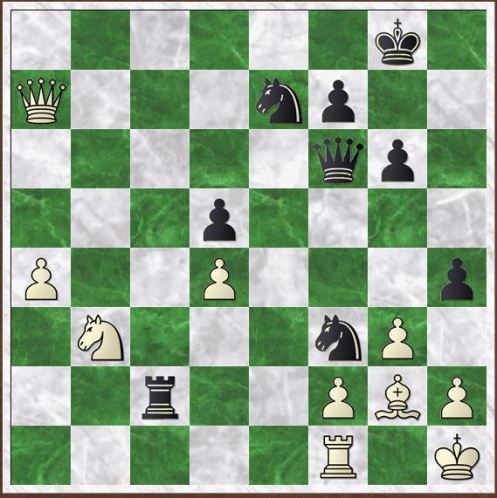
Petrosian v Teufel, Bamberg 1968
Solution
Not too hard today, since 1..Nh2 is one of the only reasonable biffs. In the game, if Megabase 2012 is correct, Black played it and the game was drawn immediately!
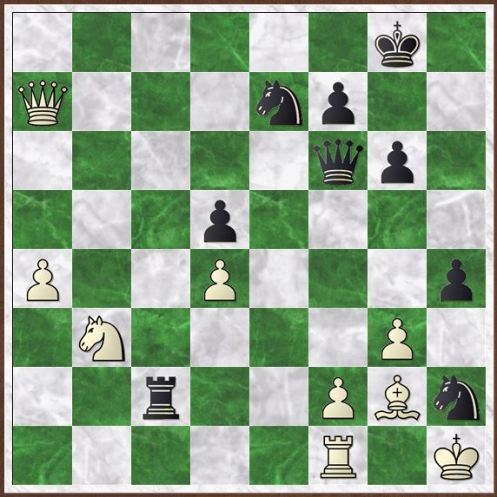
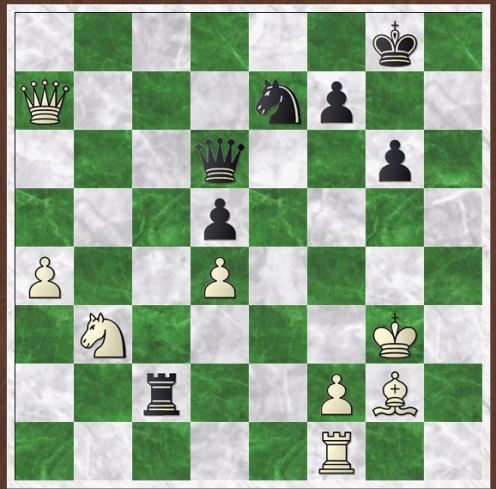
But Black is winning. If for instance 2 Kh2 hg+ 3 Kg3 Qd6+ 4 f4 Nf5+ all the pieces combine for a mating attack (5 Kh3 Qf6-h4).
It is a factor of my age: my children are now late teens/early 20s, and so are those of many of our friends. As a result, during the last year or so I have had several discussions trying to guide undergraduates and graduates on choosing firms, choosing departments.
Often, I say similar things to each; I do try to tailor to their background, understanding and preferences, but there are common themes. This short series of blog postings is an attempt to record several such thoughts. For ease of expression, I will refer to the people I am trying to help as undergraduates.
Random career paths
Ask your parents to describe their careers; ask your aunts and uncles; ask other adults that you know, especially those in say their 30s, 40s or beyond whose careers are passed the initial years. How many planned when they were your age to be where they now are? I suspect, hardly any.
Where a person ends up in his or her career depends on the vagaries of life. Effort, hard-work, direction, planning come into it, but so do chance, luck, if and who you partner with, if and when you have a family, illness of selves, parents, caring responsibilities. Very, very few people whom I know, and have talked about such things in the past, had planned as undergraduates to be where they now are in their mid- or later- career stages. I think my philosophy of career planning is: stuff happens. Lives and careers may be capable of being understood in hindsight, but with rare exceptions, the randomness of life is the paramount factor.
So, this philosophy is central to my perspective not to specialise too soon, not to decide based on frankly limited or no information to specialise is a particular area of tax or accountancy. Instead, keep options open.
In fact, I think there is a trick which is played on new starters as they train to be Chartered Accountants. The trainees themselves think the main requirement is to digest and regurgitate masses of technical information, never to be used again; memorise, memorise, memorise. But no, whilst this is a major factor, I think the early years are more about learning working life skills. Getting up on time, getting into work on time come what may, wearing a suit or work clothes, looking presentable, balancing work and social life- having a social life, including transitioning from the cacooned buzz of university life int0 the wider world-putting in the hours. I think these work aptitudes, the mind set to serve clients, to work hard, to try, to be honest, to suffer the review process, to learn from the review process, all these work skills are I would say just as important.
Three or four years later, once qualified, much of what you learnt in the ICAEW or other syllabuses will have been forgotten (hopefully some will remain) but the drive, the effort, the commitment to do a good job will remain. Such work skills are why you will progress if you stay in your training firm, or be recruited to where you apply if you choose to leave. They will also be why in time clients come to you for advice.
So don’t fret about which department or role. Don’t try to over think about what areas you would be most interested in- you really have no idea-just seek and relish the chance to work in a top employer and, once recruited, put effort in.
My mentors
Writing these blogs brings back memories. Probably the first person I learnt from when I moved into tax was a senior manager at Deloitte, Peter de la Wyche, who happened to be someone I was assigned to do a lot of work for.
Peter was a stickler for accuracy. Good enough wasn’t good enough. Tax reconciliations- quite a hard, and sometimes a very hard, exercise for large groups didn’t need for Peter to be done just to “materiality” but had to be done to the £. Often a pain, some times a considerable pain, and often not very useful, because you normally knew by feel whether the figures were right. But, fortunately, very quickly I learn that Peter’s approach was right, for professional pride in a job well done (think: the electrician who tidies up before leaving the customer, leaving things spick and span) and also because on occasion the requirement for accuracy leads to insights.
Years later, nearly 30 years later, when I retired from Deloitte I got numerous emails and letters (numerous emails; several letters). One letter I received was from a long since former colleague, now a partner in a mid-tier firm, some one who I thought was narked whenever he worked for me. But he wrote how for years he was indeed peeved whenever he worked for me, because, unlike other partners, I insisted on things being right, often sending him away to prove things to the £ or amend an already good report to make it even better. But in his letter he wrote that, looking back, it was the best thing that happened to him, propelling him to go for the best and eventually getting him his promotion to partner.
My point in relaying this story is that in your first several years in a professional services firm, whether audit, tax in my case, or, I suspect many other disciplines, is to learn the rudiments of professional life- hard work, attention to detail, quality, reliability…and turning to my main subject of guiding undergraduates in selecting departments, it really, to use present teenage text speak, “DM” – doesn’t matter.
White to play and win
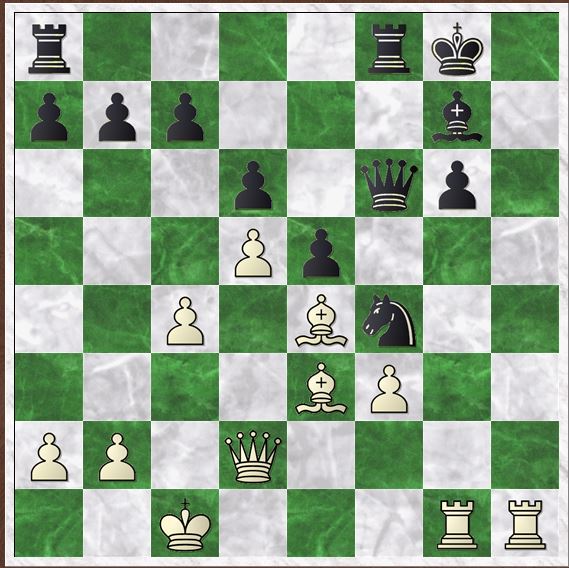
Kavalek v Martinovic, Sarajevo 1968
Solution
I solved this prosaically, and, strangely, in the way my engine gives as best, but only in the sense that +4 is better than +3.8: 1 Rg4! breaks Black (1…g5 2 Bf4 ef 3 Qg2 and so on). But Kavalek found the far prettier:
1 Rg6!!
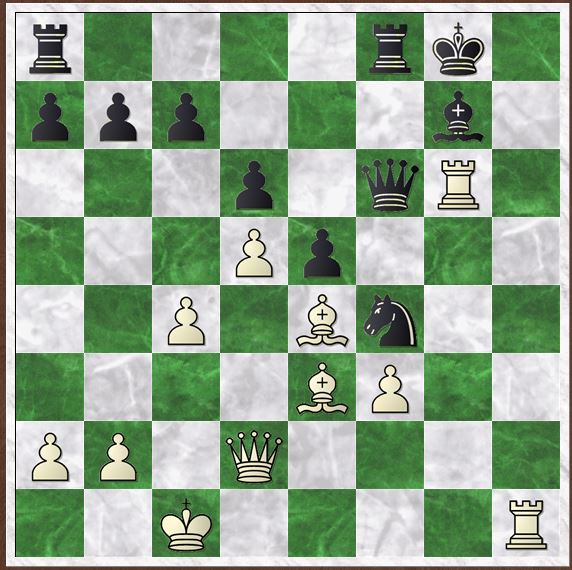
1…Ng6 (of course, I saw this far, but either didn’t see, or didn’t appreciate the strength of)
2 Bg5!!
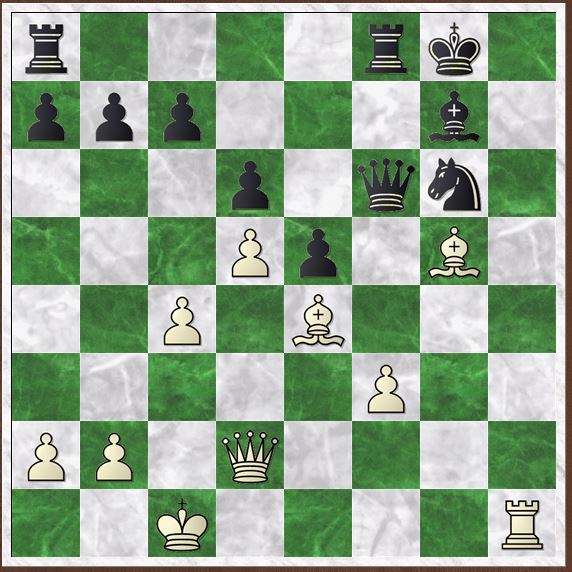
and if 2…Qf7 then the f7 square is blocked, so 3 Qh2 and crashes through.
It is a factor of my age: my children are now late teens/early 20s, and so are those of many of our friends. As a result, during the last year or so I have had several discussions trying to guide undergraduates and graduates on choosing firms, choosing departments.
Often, I say similar things to each; I do try to tailor to their background, understanding and preferences, but there are common themes. This short series of blog postings is an attempt to record several such thoughts. For ease of expression, I will refer to the people I am trying to help as undergraduates.
Which area in taxation?
This is a FAQ.
The answer is guesswork. There are numerous disciplines, each of which can provide a good or bad career. Someone at the start of a medical degree can’t reasonably be told “which is the best area of medicine to specialise in”. A variation of the FAQ is “which are good tax specialisms for women” (recognising the possibility of career breaks” to which the answer is similarly known.
To emphasise this, let’s remember the wise words (despite him being pilloried, they were wise) of Donald Rumsfeld:
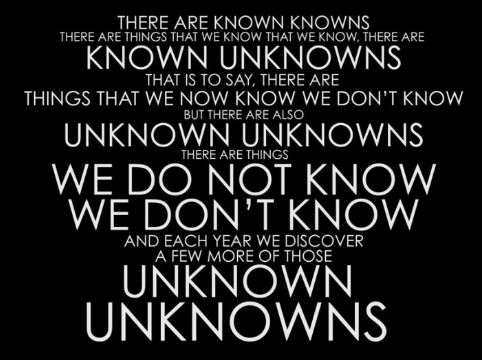
I have no idea what the future holds for careers in tax both in general and for a particular undergraduate. One big unknown unknown is the extent to which further computerisation, artificial intelligence or even robots will have on professional services. Robots probably a long way off, but even now, in the last decade, the internet, cloud computing etc mean that many lower skilled jobs can be done elsewhere in the world; and improvement in technology means that clients can now do more work in house. The tax profession changed in my thirty years, and will change in the undergraduates thirty years.
Some thoughts, even though there are very few known knowns.
Try and to be as general as possible first, selecting and specialising as you understand more about tax as a profession. This goes against employers’ interest of specialising ab initio (free bonus tip: there is no need to know Latin to be good at tax, but knowing a few such terms can be a good pretence of knowledge). But unless an undergraduate has a clear understanding of why they want to specialise in transfer pricing, or in expatriate tax or in share schemes or R&D credits…I would caution against. Taking the last one as a good (bad) example, what happens if R&D credits were to be abolished? Taking expatriate tax as a better example- there will always be a need for advice for international secondees and other globally mobile executives- at least one firm, for its business reasons, only trains its intake for the CTA exams, not for the broader ICAEW or ICAS exams. CTA is a top qualification (I am one) but ACA is broader, and, and I might be wrong, broader is good.
One factor in choosing, if there is choice of where to apply to, is any interest in travelling. I never had, but many do. Specialising in VAT for instance is probably not portable outside the EU (thought for the day: what will happen to VAT if there is a Brexit?) ; specialising in expat taxation or transfer pricing is likely to be portable to numerous countries.
Another factor, and a big one, is “what type of person are you” and “where might you want to live in your 30s and 40s?” Specialising in FS Tax in the London department of a major firm probably makes you employable in (i) London; (ii) in a major firm; (iii) in a bank or insurer. Specialising in private clients or family companies is likely to be equip you for wherever life takes you. Specialising in FS Tax or VAT or one of several other areas is likely to be highly technical, highly challenging, highly interesting.
I am sure that what I have written this morning is (i) very simplistic; (ii) very judgemental; (iii) biassed by my own perspectives and experience; but I hope it is useful.
It is a factor of my age: my children are now late teens/early 20s, and so are those of many of our friends. As a result, during the last year or so I have had several discussions trying to guide undergraduates and graduates on choosing firms, choosing departments.
Often, I say similar things to each; I do try to tailor to their background, understanding and preferences, but there are common themes. This short series of blog postings is an attempt to record several such thoughts. For ease of expression, I will refer to the people I am trying to help as undergraduates.
Thoughts on a career in taxation
I could write a book on my career in taxation; and on what I think a career in taxation might be in future. Instead, for now, I will write about the things discussed with the most recent undergraduate who came to see me for advice.
My career
Firstly, for me, taxation has been, and continues to be, a brilliant career.
Largely because it has constantly provided me with intellectual stimulation- I have never been bored in 30 years of work- partly because the rules keep changing, with Budgets at least annually, and constant other revisions too; and partly because client problems are constantly different.
Equally largely, to my happiness in tax, is how I have chosen to practise it, and where I have specialised: family companies, families, individuals. As a result, I am lucky enough to have many deep and trusted friendships and relationships. This has been a constant source of personal fulfilment.
But there are many other routes to follow in tax: the one I took just happened to (i) happen to me (there wasn’t much forward planning); (ii) suit me.
Tax avoidance
Some former colleagues got their satisfaction from the intellectual challenge of tax planning and the intellectual complexity of detailed tax rules; with the large firms encouraging specialism and in depth knowledge.
That too can be rewarding in the career sense, and though I consider myself to have a very good knowledge of many aspects of UK taxation, the “deep specialism” “solve the same deep problem for several clients” has never been me. My role has been the reverse: serve the client, provide what they need.
I do think that one career plan which I wouldn’t recommend to undergraduates is concentrating of advising clients on tax schemes, niche products, “aggressive”, “avoidance”- call it what you will. Those days have, in my mind, long since gone.
Complexity
When I left my former firm, I did a clear out. Alas, even now, not quite a year later, I regret one thing that I did. For the last twenty or so years, not quite my full career in taxation, but most, I had sent my annual tax legislation to storage, just in case I ever needed to look at old legislation.
Then came the internet, and information on electronic databases; so, in practise, I suspect I never recalled even one set of legislation more than once or twice in the last decade. And, the books filled many storage boxes, so I told my colleagues they could be recycled.
Wouldn’t it be nice to be able to take a picture of the increase in size? In my thirty years, the main textbooks increased from two volumes to seven or eight volumes: plus, the paper is thinner, and the print smaller.
For an undergraduate considering a career in taxation, what does it mean? Several things. The difficulty has gone up, which can be both good or bad; the need to specialise has mushroomed (I felt 25 years ago I knew something about most parts of the two books, and a lot about some things; now there are whole swathes I don’t know about); the chance to have a high earning career (if money is your object) by implementing planning has gone down (because much of the seven books are rules making such things difficult); but the ability to have an interesting and fulfilling career is probably unchanged.
It is a factor of my age: my children are now late teens/early 20s, and so are those of many of our friends. As a result, during the last year or so I have had several discussions trying to guide undergraduates and graduates on choosing firms, choosing departments.
Often, I say similar things to each; I do try to tailor to their background, understanding and preferences, but there are common themes. This short series of blog postings is an attempt to record several such thoughts. For ease of expression, I will refer to the people I am trying to help as undergraduates.
Which department is best?
Impossible to say, in the same way that it is impossible to say which university is best, or which course is best. There are numerous good careers.
To my mind, there is a big element of luck. A graduate, even one from a broadly relevant degree, won’t really appreciate what working in a particular field is like. Plus, a big factor is which colleagues you get to work with, both as peers (do you happen to join a group of very friendly, like minded people, or are you unlucky to join with people who you don’t feel an affinity to? And, equally, the managers and partners you get to work with, and the client experience….such things can be important determinants of happiness and success at the start of a career.
It is, I think, much like the first days of university. Who you happen to meet, how things start of, can have long lasting importance.
“not audit?”
This seems to be a trend: most, and I think nearly all, of the undergraduates I have guided in 2015 have decided not to apply to audit, thinking it is “boring” and “uninteresting”. I think this is a wrong misconception, and, to my mind, training in audit can be an excellent start for a career in accountancy. Yes, at junior level there is much tedious checking; yes, at more senior level there is still tedium and checklists. But a good manager, senior manager and beyond should be able to find plenty of interest, be able to advise clients; and the role of external auditor is something important to society. Moreover, the vast majority of people entering the profession will leave, with many leaving on, or in the years after qualification.
Training in audit provided me with an excellent foundation in business; I saw a variety of industries; had many interesting assignments; plus, being on clients’ sites developed my personal skills considerably (not hard: at school and university I was in a shell).
So, personally, unless someone had a clear understanding and preference, audit would be my first choice. And I write this as someone who has loved, and still love, my career in taxation.
White to play and win
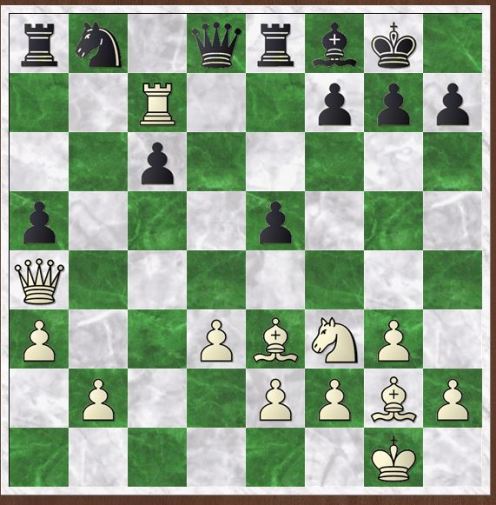
Botvinnik v Portisch, Monaco 1968
Solution
One I knew: or, perhaps I could say, one that is part of whatever chess education that I have.
1 Rf7!

Black, rather than accepting the rook, declined it, playing 1…h6. The final moves are quite pretty, especially the actual last one.

If instead Black had taken the rook, then 2 Qc4+ Kg6 3 Qg4+ (or 3 Qe4+) before bringing the N into the attack on g5; by contrast, 3 Nh4+?? is just equal after 3…Kf6.

White to play and win
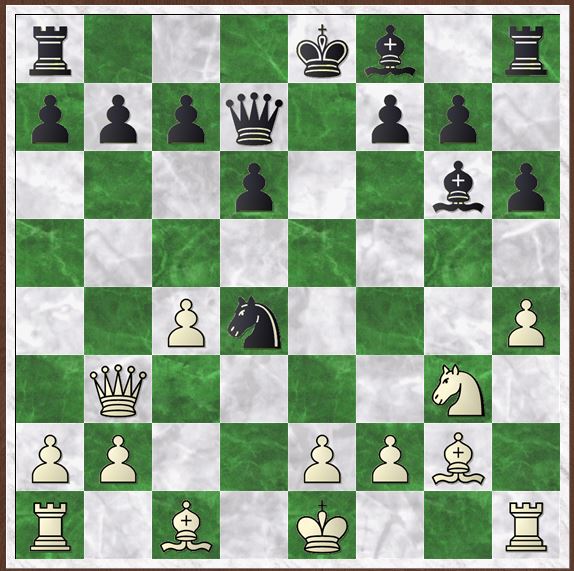
Schmid v Westerinen, Bamberg 1968
Solution
Not too hard today, but nor an especially convincing puzzle. One of the two natural moves, 1 Qb7, just leads to a mess (1…Rd8 2 e3? Nc2+ 3…Qc8 and the Queen is safe from Bc6, and Black is better; so 2 0-0 Qc8, unclear) so White has to play the other natural biff, 1 Qe3+ forcing 1…Ne6 when 2 f4 causes Black a lot of inconvenience.
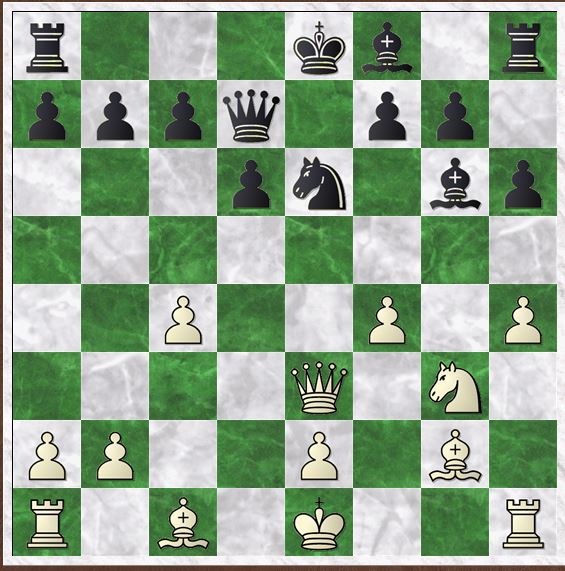
In the game, Black played the natural 2…f5, losing simply to 3 Bb7 and 4 Bc6:
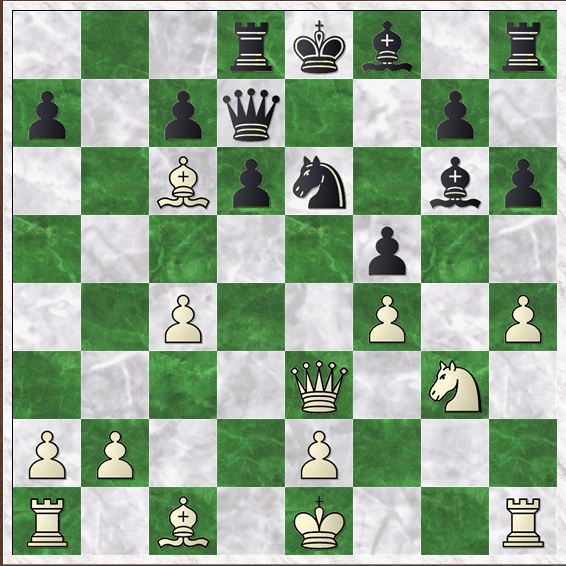
Slightly better is the tricky 2…Qa4, defending against f5 by the Qa5+ double attack motif. 3 b3 Qa6 retains the motif, and after 4 f5 Bf5 5 Nf5 Qa5+ 6 Bd2 Qf5 7 Bb7 the game goes on, but White is better.
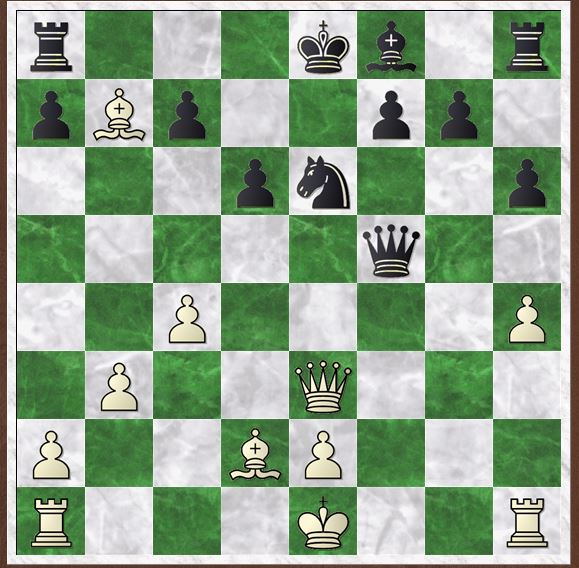
White to play and win
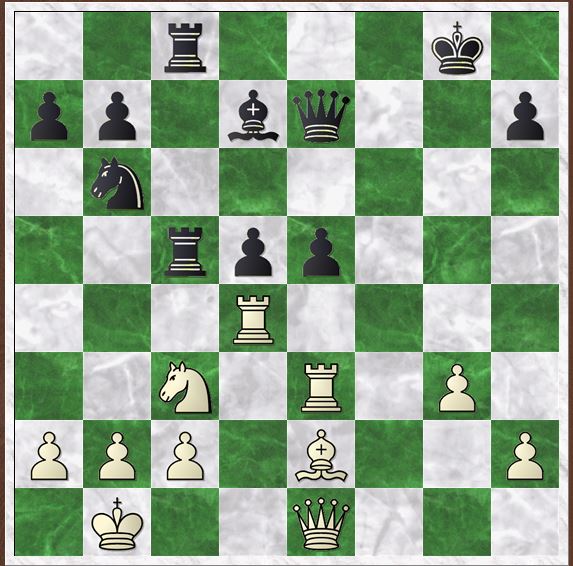
Unzicker v Szabo, Bamberg 1968
Solution
I failed on this one, the strongest move being beautiful: 1 Bb5!!
Instead I chose the “quite good” 1 Bg4 which with best play leads only to a smitheren of an advantage to white.
After 1 Bb5!!
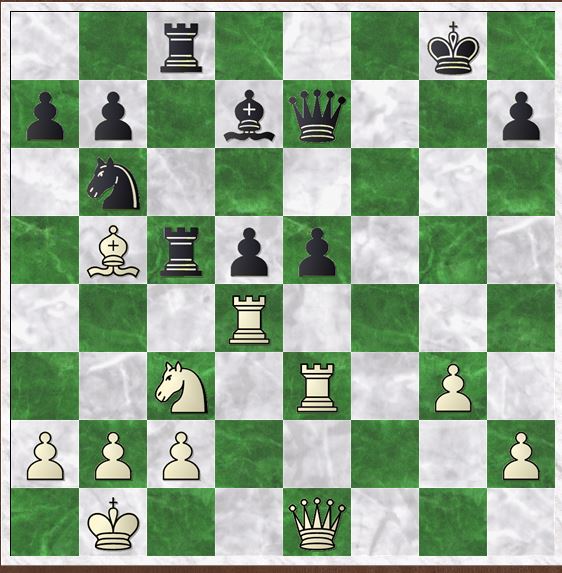
Rb5 2 Re5 Qf6 3 Nb5 Bb5
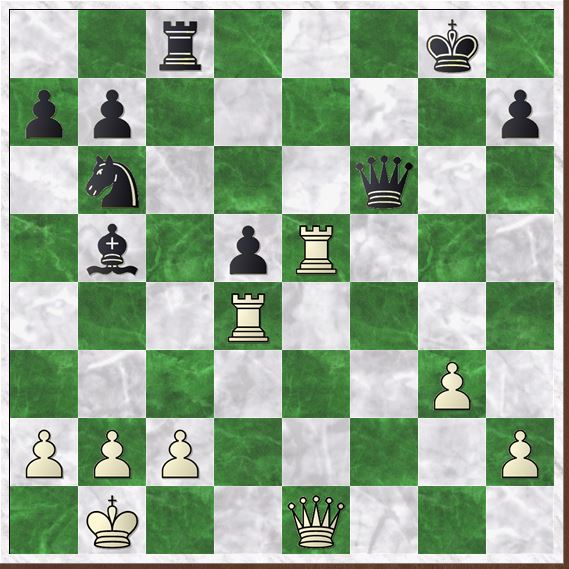
White has a surprisingly large advantage. Black can’t defend on the black squares; his king is unprotected, and his Nb6 has no stability after b3 and a4-a5: all these amount to a tangible advantage to White.
I have provided more annotations in the game file here.
Black to play: in the game, a draw was agreed here. Was it correct?
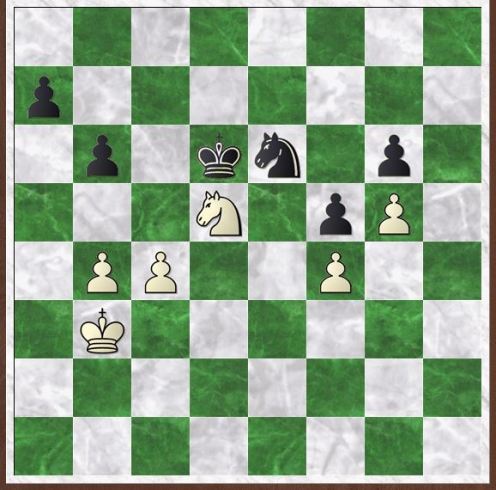
Tigran Petrosian v Lothar Schmid, Bamberg 1968
Solution
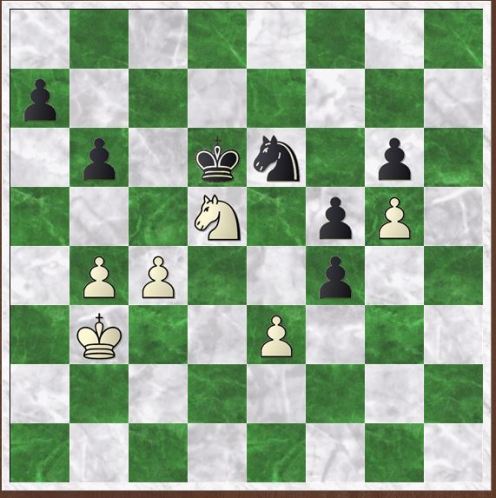
The answer, as always with puzzles, is no! 1…b5! and Black wins by zugzwang, 2 Kc3 bc 3 Kc4 a6 and White must retreat his Nd5, losing his f4 pawn.
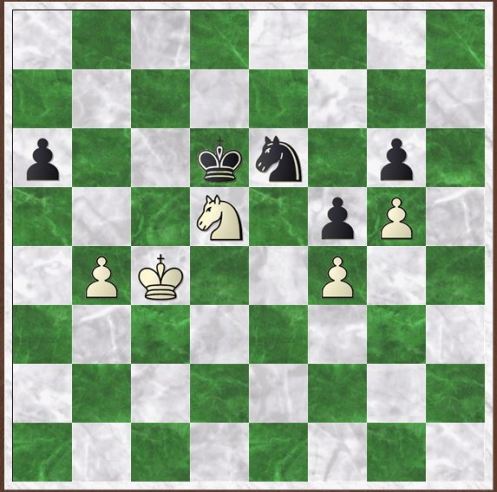
Looking at the game, it was virtually dead level throughout, and so maybe the players, even of their class, were playing the draw out. White should a move or two before have captured on f4 with his Nd5, then both g pawns get exchanged, result equality.
 allanbeardsworth