Today’s problem is from the C.H.O’D. Alexander’s 1973 book”The Penguin Book of Chess Positions”, a book I devoured (and loved) as a child.
I thought I would use it for more of my daily training.
As is my custom, I only say which side is to play: and not giving an idea if the move wins or otherwise, unless on occasion I think signposting would be helpful. Instead, the problems are posed with the instruction to decide what you would play, as in a game.
White to play

Rubnstein v Girschbein, Lodz 1967
Solution
1 Rd7! Bd7[] 2 Nf6+ Kf8

3 Nd5! with a winning double attack: on e7 and h8: 1-0.
FEN
r1b1r1k1/pp1nqp2/2p1p1pp/8/4N3/P1Q1P3/1P3PPP/1BRR2K1 w – – 0 1
Today’s problem is an old favourite, seen in a book I am reading at present. Played 24 years ago to this day.
As is my custom, I only say which side is to play: and not giving an idea if the move wins or otherwise, unless on occasion I think signposting would be helpful. Instead, the problems are posed with the instruction to decide what you would play, as in a game.
Black to play
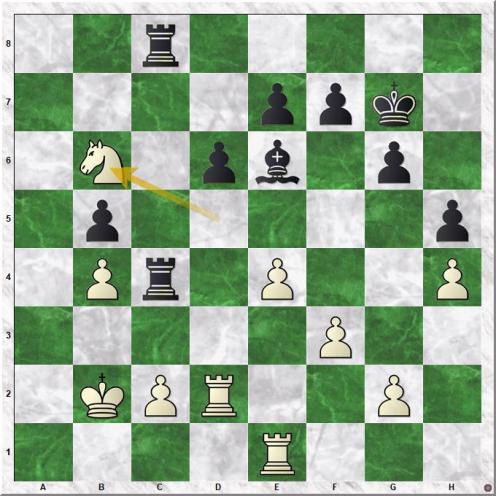
Anand v Kasparov, WC match, New York, 28/9/1995
Solution
Vishy had declined a draw a few moves previously, and had just played 1 Nd5-b6??. Garry played 1…Rb4+ 2 Ka3 Rc2! and White resigned.
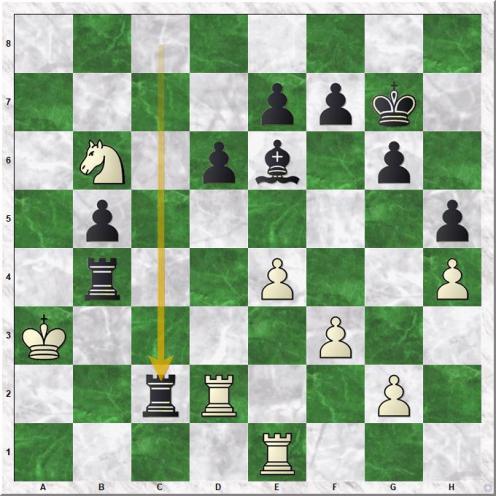
The LPDO Re1 falls to a discovered check after 3 Rc2[] Rb3+ 4 Ka2[] Re3+, and Black is two pawns up; the b pawn might fall, but so would the Ph4.

FEN
2r5/4ppk1/1N1pb1p1/1p5p/1Pr1P2P/5P2/1KPR2P1/4R3 b – – 0 30
Today’s problem is from the C.H.O’D. Alexander’s 1973 book”The Penguin Book of Chess Positions”, a book I devoured (and loved) as a child.
I thought I would use it for more of my daily training.
As is my custom, I only say which side is to play: and not giving an idea if the move wins or otherwise, unless on occasion I think signposting would be helpful. Instead, the problems are posed with the instruction to decide what you would play, as in a game.
White to play
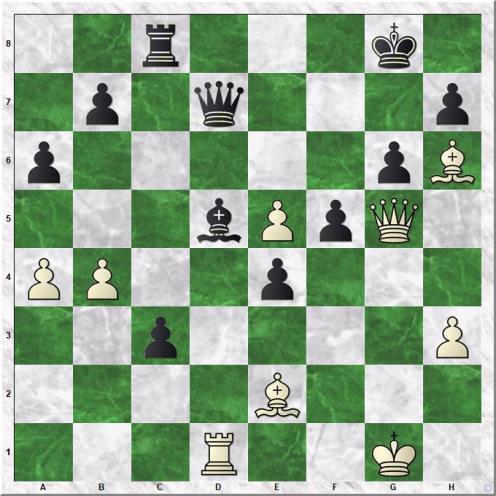
Samisch v Koch, Berlin 1930s
Solution
1 Rd5! Qd5[] 2 Qe7 Qf7[] 3 Bc4! deflecting the Rc8 3…Rc4[] 4 Qd8+ 1-0

FEN
2r3k1/1p1q3p/p5pB/3bPpQ1/PP2p3/2p4P/4B3/3R2K1 w – – 0 1
Today’s problem is from the C.H.O’D. Alexander’s 1973 book”The Penguin Book of Chess Positions”, a book I devoured (and loved) as a child.
I thought I would use it for more of my daily training.
As is my custom, I only say which side is to play: and not giving an idea if the move wins or otherwise, unless on occasion I think signposting would be helpful. Instead, the problems are posed with the instruction to decide what you would play, as in a game.
White to play
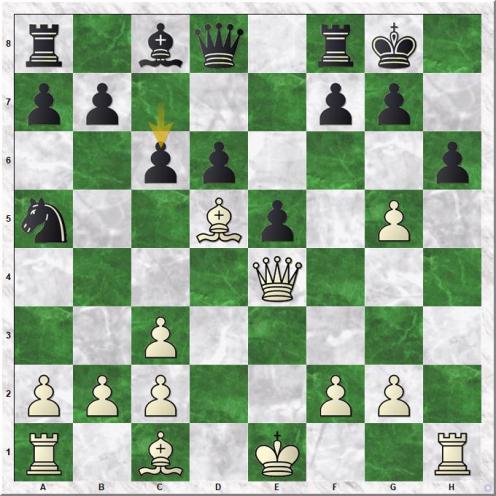
Nyholm v Post. Stockholm v Berlin 1927
Solution
1 Rh6 is a fairly obvious breakthrough. Then 1…gh 2 Qg6+ Kh8[] 3 Qh6+ and 4…g6.
If instead 1…Re8 2 Bf7+!

2…Kf7[] 3 Qg6+ Kg8 4 Rh7

and 5 Qh5 and maybe 6g6 depending on Black’s defence.
FEN
r1bq1rk1/pp3pp1/2pp3p/n2Bp1P1/4Q3/2P5/PPP2PP1/R1B1K2R w KQ – 0 13
Today’s problem is from the C.H.O’D. Alexander’s 1973 book”The Penguin Book of Chess Positions”, a book I devoured (and loved) as a child.
I thought I would use it for more of my daily training.
As is my custom, I only say which side is to play: and not giving an idea if the move wins or otherwise, unless on occasion I think signposting would be helpful. Instead, the problems are posed with the instruction to decide what you would play, as in a game.
White to play

Markland v Klundt, Madrid 1971
Solution
1 Rb3! bringing another piece to the party, before, after 1…Qa5[] 2 Bh7+ a standard Greek gift sacrifice.

2…Kh7[] 3 Ng5+
3…Kg8 4 Qh5 Qf5[] 5 Rh3;
or 3…Kg6 4 Rh3[]

and wins: Black has various defences, but all lose. For instance, 4…Kf6 5 Ne4+ Ke7 6 Nd6 Kd6 7 Ba3+ skewering the king and LPDO rook.
FEN
r1b2rk1/pp3ppp/2nbp3/8/3P4/2qB1N2/P4PPP/1RBQ1RK1 w – – 0 13
Today’s problem is from the C.H.O’D. Alexander’s 1973 book”The Penguin Book of Chess Positions”, a book I devoured (and loved) as a child.
I thought I would use it for more of my daily training.
As is my custom, I only say which side is to play: and not giving an idea if the move wins or otherwise, unless on occasion I think signposting would be helpful. Instead, the problems are posed with the instruction to decide what you would play, as in a game.
White to play
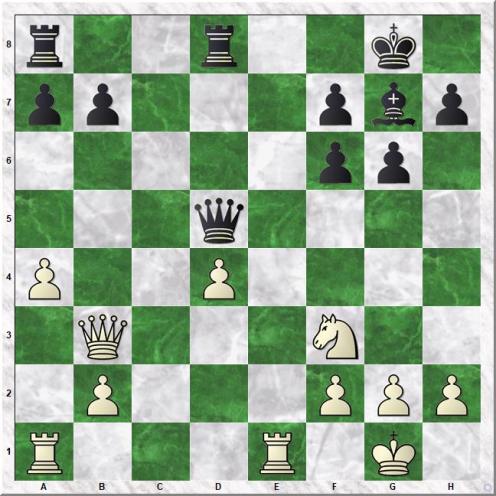
Minic v Bukic, Yugoslavia 1967
Solution
One of my favourite tactical tricks, which I envision as “taking the feet from under someone”.
1 Re8+ and the rook can’t be captured, else the Qd5 is LPDO, so 1…Bf8[] when 2 Qd5 Rd5[] 3 Ra8 wins a rook.

FEN
r2r2k1/pp3pbp/5pp1/3q4/P2P4/1Q3N2/1P3PPP/R3R1K1 w – – 0 1
Today’s problem is from the C.H.O’D. Alexander’s 1973 book”The Penguin Book of Chess Positions”, a book I devoured (and loved) as a child.
I thought I would use it for more of my daily training.
As is my custom, I only say which side is to play: and not giving an idea if the move wins or otherwise, unless on occasion I think signposting would be helpful. Instead, the problems are posed with the instruction to decide what you would play, as in a game.
White to play

Minic v Vukic, Vrnjacka Banja 1966
Solution
This position isn’t in CHOD’s book, but was seen in Megabase whilst trying to find the game played between these two players in 1967.
White played 1 Nf5 and drew.
But 1 Ne4! would have won: the same idea, of reaching d6, but with an additional threat of exchanging the Nd4 and Nf6: which gives the Queen access to d5.
For e
The double attack on the LPDO Ra8 and e8 (threat Re8+) is too great.
FEN
r1k2b1r/p2n1Np1/1p2Qn1p/2p5/qP3B1P/6N1/P1P2PP1/4R1K1 w – – 0 21
Today’s problem is from the C.H.O’D. Alexander’s 1973 book”The Penguin Book of Chess Positions”, a book I devoured (and loved) as a child.
I thought I would use it for more of my daily training.
As is my custom, I only say which side is to play: and not giving an idea if the move wins or otherwise, unless on occasion I think signposting would be helpful. Instead, the problems are posed with the instruction to decide what you would play, as in a game.
White to play

Abrahams v Winter, London 1946
Solution
1 Bf8! and Black only has spite checks (since 1…Qc1+ 2 Kh2 and now not 2…Qh6+ becaise of 3 Bf8.
If 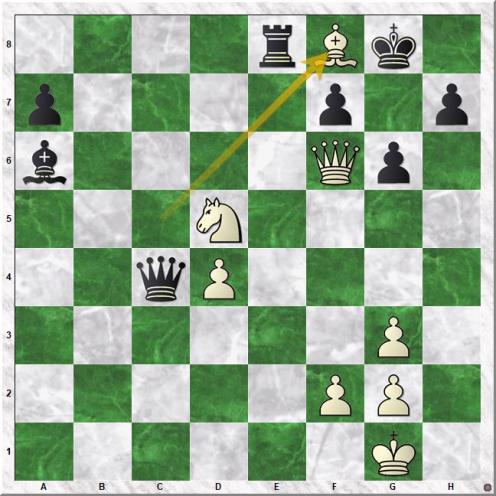
FEN
4r1k1/p4p1p/b4Qp1/2BN4/2qP4/6P1/5PP1/6K1 w – – 0 1
Today’s problem is from the C.H.O’D. Alexander’s 1973 book”The Penguin Book of Chess Positions”, a book I devoured (and loved) as a child.
I thought I would use it for more of my daily training.
As is my custom, I only say which side is to play: and not giving an idea if the move wins or otherwise, unless on occasion I think signposting would be helpful. Instead, the problems are posed with the instruction to decide what you would play, as in a game.
White to play
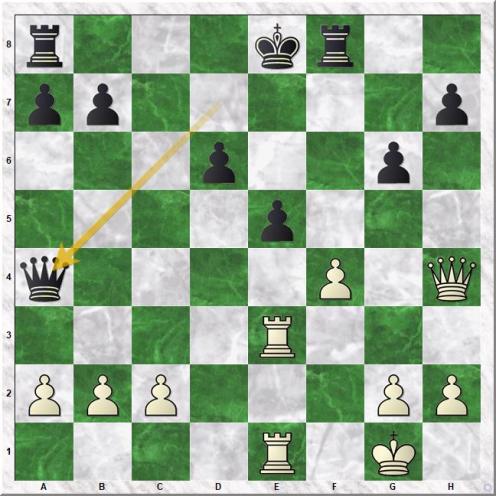
Abrahams v Winter, Ramsgate 29/7/1929
Solution
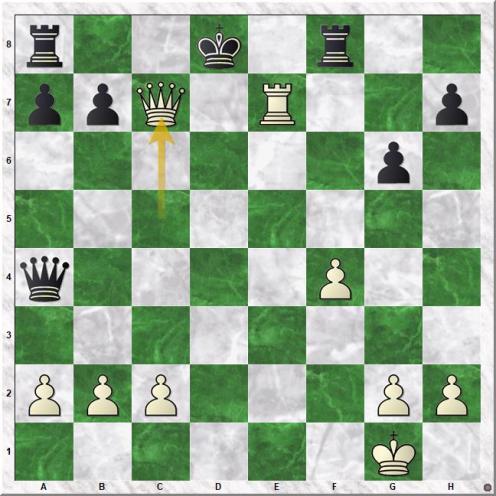
1 Re5+! de [] 2 Re5+ Kd7 (or 2…Kf7 and 3 Re7+ 4 Qh7 mate) 3 Qe5+ Kc6
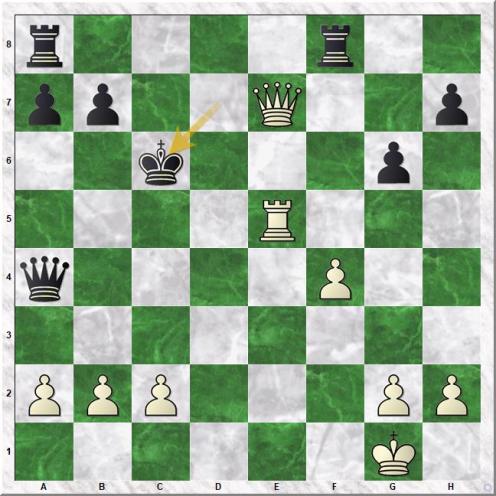
and mate in 3 by 4 Qc5+ Kd7[] 5 Re7+ amd 6 Qc7 mate.
FEN
r3kr2/pp5p/3p2p1/4p3/q4P1Q/4R3/PPP3PP/4R1K1 w – – 0 26
Today’s problem is from the C.H.O’D. Alexander’s 1973 book”The Penguin Book of Chess Positions”, a book I devoured (and loved) as a child.
I thought I would use it for more of my daily training.
As is my custom, I only say which side is to play: and not giving an idea if the move wins or otherwise, unless on occasion I think signposting would be helpful. Instead, the problems are posed with the instruction to decide what you would play, as in a game.
White to play played 1 Qa8 and 1..Ra2! would have drawn: what should Capablance have played?

Capablanca v Sir George Thomas, Hastings 14/8/1918
Solution
1 Qb5! wins; even 1 Re8! Qe8[] 2 Qa4! wins, overloading the Black Queen.
After 1 Qb5 Rb8 2 Qb8 Kg8 3 Qb3+ is a double attack, winning the LPDO Rc2.
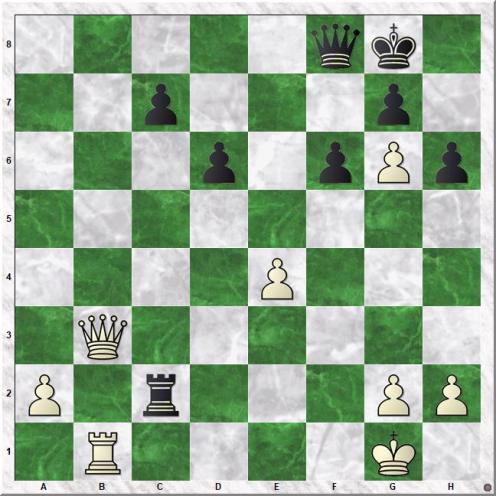
2..Rc1+ is just met by bringing the K up, to d1 or d3.
FEN
QR2rq1k/2p3p1/3p1pPp/8/4P3/8/P1r3PP/1R4K1 b – – 0 29
 allanbeardsworth