Today’s problem is from the C.H.O’D. Alexander’s 1973 book”The Penguin Book of Chess Positions”, a book I devoured (and loved) as a child.
I thought I would use it for more of my daily training.
As is my custom, I only say which side is to play: and not giving an idea if the move wins or otherwise, unless on occasion I think signposting would be helpful. Instead, the problems are posed with the instruction to decide what you would play, as in a game.
White to play: examine 1 Bf6
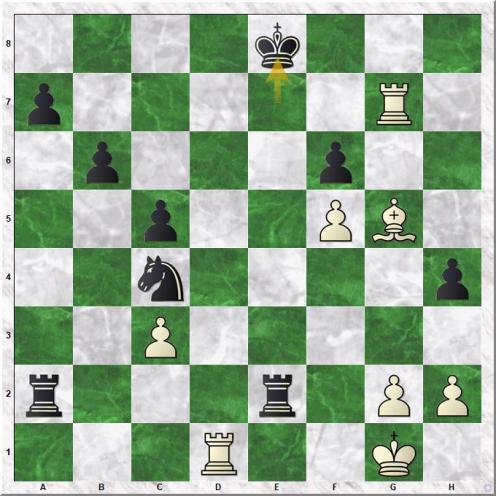
Taimanov v Huebner, Palma 13/11/1970
Solution
Taimanov didn’t play 1 Bf6, because of 1…Rg2+ 2 Rg2[] Rg2+ 3 Kg2 Ne3+
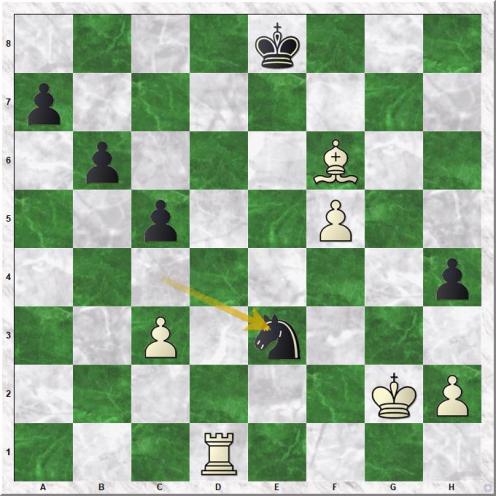
More tomorrow on this.
FEN
4k3/p5R1/1p3p2/2p2PB1/2n4p/2P5/r3r1PP/3R2K1 w – – 0 35
Today’s problem is from the C.H.O’D. Alexander’s 1973 book”The Penguin Book of Chess Positions”, a book I devoured (and loved) as a child.
I thought I would use it for more of my daily training.
As is my custom, I only say which side is to play: and not giving an idea if the move wins or otherwise, unless on occasion I think signposting would be helpful. Instead, the problems are posed with the instruction to decide what you would play, as in a game.
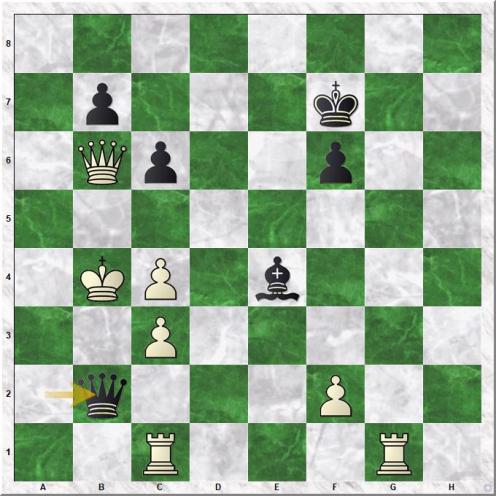
Black to play

Tartakower v Euwe, Venice 1948
Solution
1…Nc4+! exploiting the fork 2 bc[] Ra4+ decoying the K out from cover 3 Kb4[] Qb2+ skewering the K and LPDO Q.
The Megabase quick analysis graph shows that the game was fairly topsy-turvy:

FEN
r7/1p3k2/1Qpn1p2/8/P3b3/KPP5/3q1P2/2R3R1 b – – 0 39
Today’s problem is from the C.H.O’D. Alexander’s 1973 book”The Penguin Book of Chess Positions”, a book I devoured (and loved) as a child.
I thought I would use it for more of my daily training.
As is my custom, I only say which side is to play: and not giving an idea if the move wins or otherwise, unless on occasion I think signposting would be helpful. Instead, the problems are posed with the instruction to decide what you would play, as in a game.
White to play

Pachman v Gunnatsson, 4/2/1967 Vrnjacka Banja
Solution
1 Rdd7+! Rd7[] 2 Qb5! 1-0

There is an optical illusion here: 1 Rcd7 looks just as good, with the same idea, 1….Rd7[] 2Qb5 but, oops!, 2…Re7! and the same pin-based trick doesn’t work. White would have to rely on winning the rook ending after exchanging queens, checking and capturing the Pb7.
FEN
3rq3/ppRr2kp/3Rp1p1/4Pp2/2Q2P2/1P6/P5PP/6K1 w – – 0 26
Today’s problem is from the C.H.O’D. Alexander’s 1973 book”The Penguin Book of Chess Positions”, a book I devoured (and loved) as a child.
I thought I would use it for more of my daily training.
As is my custom, I only say which side is to play: and not giving an idea if the move wins or otherwise, unless on occasion I think signposting would be helpful. Instead, the problems are posed with the instruction to decide what you would play, as in a game.
White to play
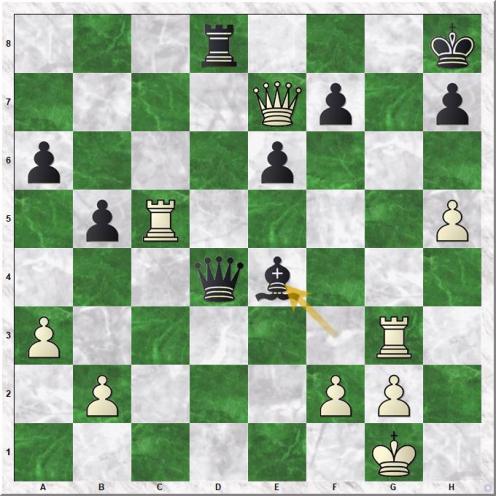
Eliskases v Hoelzl, Innsbruck 23/9/1929
Solution
1 Re5! a nice decoy/overload. 1-0.

Strangely, 1 Re5! is Komodo’s third best choice. It favours 1 Rd5! which is mate in 7; or 1 Qf7 which is mate in 9; to 1 Re5, which apparently is only mate in 10. I haven’t bothered/won’t check these “mates in”, though I was pleased to find both 1 Re5 and 1 Rd5, the latter being in my view prettier.
FEN
3r3k/4Qp1p/p3p3/1pR4P/3qb3/P5R1/1P3PP1/6K1 w – – 0 43
Today’s problem is from the C.H.O’D. Alexander’s 1973 book”The Penguin Book of Chess Positions”, a book I devoured (and loved) as a child.
I thought I would use it for more of my daily training.
As is my custom, I only say which side is to play: and not giving an idea if the move wins or otherwise, unless on occasion I think signposting would be helpful. Instead, the problems are posed with the instruction to decide what you would play, as in a game.
White to play
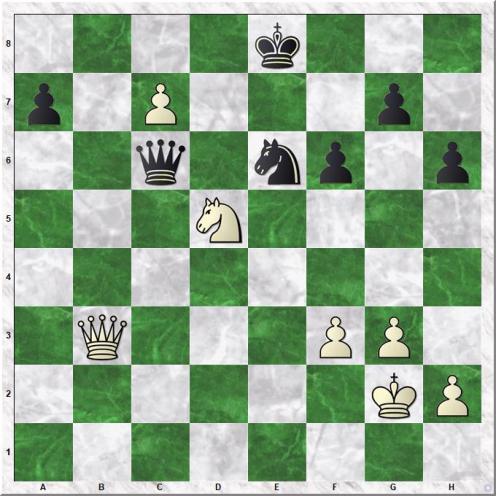
Zukertort v Englisch London 21/5/1883
Solution
1 Qb5! Qb5[] 2 c8(Q)+ Kf7[] 3 Qe6+!
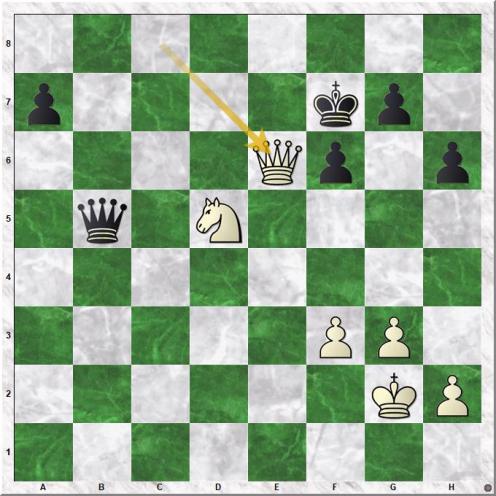
3…Ke6[] 4 Nc7+ Ke5 5 Nb5
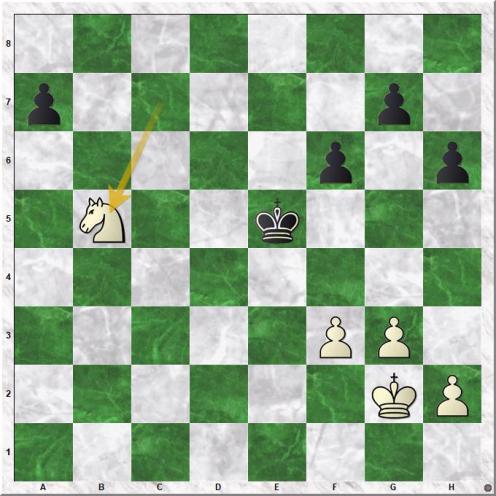
and White managed to win: see Megabase for the remainder of the game.
FEN
4k3/p1P3p1/2q1np1p/3N4/8/1Q3PP1/6KP/8 w – – 0 47
Today’s problem is from the C.H.O’D. Alexander’s 1973 book”The Penguin Book of Chess Positions”, a book I devoured (and loved) as a child.
I thought I would use it for more of my daily training.
As is my custom, I only say which side is to play: and not giving an idea if the move wins or otherwise, unless on occasion I think signposting would be helpful. Instead, the problems are posed with the instruction to decide what you would play, as in a game.
White to play

Sanner M v G St Bonnet, Pau 4th Sept 1969
Solution
1 Qf6! and wins: the Pe7 is pinned to the LPDO Re8, so Black is mated or loses his queen,

FEN
2R1r1k1/pp2pr1p/4QnpB/8/3q4/8/P4PPP/4R1K1 w – – 0 24
Today’s problem is from the C.H.O’D. Alexander’s 1973 book”The Penguin Book of Chess Positions”, a book I devoured (and loved) as a child.
I thought I would use it for more of my daily training.
As is my custom, I only say which side is to play: and not giving an idea if the move wins or otherwise, unless on occasion I think signposting would be helpful. Instead, the problems are posed with the instruction to decide what you would play, as in a game.
White to play

Taimanov v Petrosian, Candidates Zurich 6th October 1953
Solution
1 Rg6+! hg (1…Bg6 2 Qe6+ Bf7[] 3 Qf6 and Qg7 mate) 2 h7+! Kh7[] 3 Qf7+
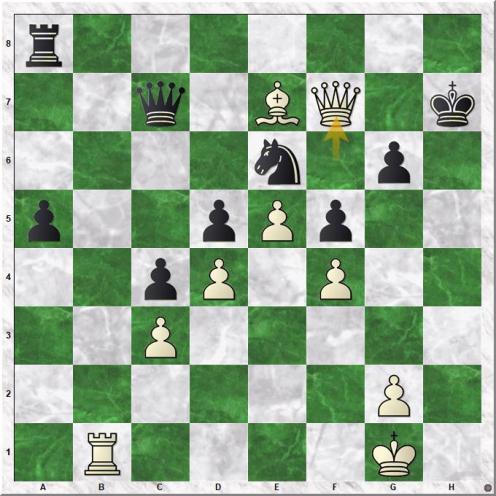
and next 4 Kf2 and the rook swings across to h1: 1-0.
FEN
r5k1/2q1Bb1p/4nQpP/p2pPp2/2pP1P2/2P3R1/6P1/1R4K1 w – – 0 37
Today’s problem is from the C.H.O’D. Alexander’s 1973 book”The Penguin Book of Chess Positions”, a book I devoured (and loved) as a child.
I thought I would use it for more of my daily training.
As is my custom, I only say which side is to play: and not giving an idea if the move wins or otherwise, unless on occasion I think signposting would be helpful. Instead, the problems are posed with the instruction to decide what you would play, as in a game.
White to play

Nyholm v Post, Berlin 1927
Solution
1 Rh6+ and if 1…gh then 2 Qg6+ exploits the pin, check on h6, g5-g6 and mates next move.
So 1…Re8 but 2 Bf7+ crashes through.

FEN
r1bq1rk1/pp3pp1/2pp3p/n2Bp1P1/4Q3/2P5/PPP2PP1/R1B1K2R w KQ – 0 13
Today’s problem is from the C.H.O’D. Alexander’s 1973 book”The Penguin Book of Chess Positions”, a book I devoured (and loved) as a child.
I thought I would use it for more of my daily training.
As is my custom, I only say which side is to play: and not giving an idea if the move wins or otherwise, unless on occasion I think signposting would be helpful. Instead, the problems are posed with the instruction to decide what you would play, as in a game.
Black to play: if Black played 1…Kf6, how would White proceed?

Peter Markland v Klaus Klundt, Madrid 16th March 1971
Solution
If 1…Kf6, then 2 Ne4+ Ke7[] 3 Nd6[] Kd6 4 Ba3+, attacking from all angles.

Either the LPDO Rf8 falls off because of the skewer, or the N self-pins 4…Nb4 and it and the rook are lost after 5 Qb3.
FEN
r1b2r2/pp3pp1/2nbp1k1/q5N1/3P4/7R/P4PPP/2BQ1RK1 b – – 0 16
Today’s problem is from the C.H.O’D. Alexander’s 1973 book”The Penguin Book of Chess Positions”, a book I devoured (and loved) as a child.
I thought I would use it for more of my daily training.
As is my custom, I only say which side is to play: and not giving an idea if the move wins or otherwise, unless on occasion I think signposting would be helpful. Instead, the problems are posed with the instruction to decide what you would play, as in a game.
White to play

Peter Markland v Klaus Klundt, Madrid 16th March 1971
Solution
1 Rh3[] threatening Qh5+ Bd7 2 Ne4! 1-0

A deadly final move, hitting the LPDO Bd6, stopping Kf6 and threatening Qg4+ mating.
FEN
r1b2r2/pp3pp1/2nbp1k1/q5N1/3P4/1R6/P4PPP/2BQ1RK1 w – – 0 16
 allanbeardsworth