Today’s problem is from the C.H.O’D. Alexander’s 1973 book”The Penguin Book of Chess Positions”, a book I devoured (and loved) as a child.
I thought I would use it for more of my daily training.
As is my custom, I only say which side is to play: and not giving an idea if the move wins or otherwise, unless on occasion I think signposting would be helpful. Instead, the problems are posed with the instruction to decide what you would play, as in a game.
White to play
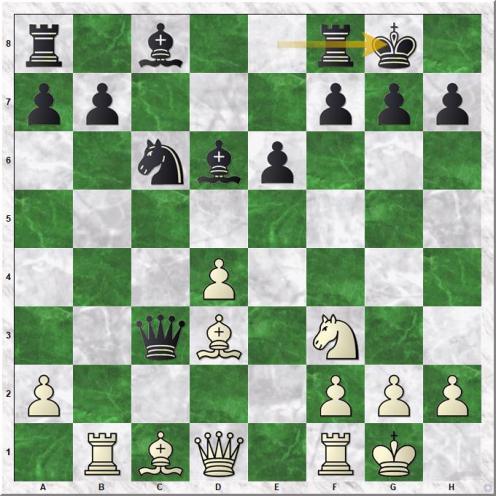
Peter Markland v Klaus Klundt, Madrid 16th March 1971
Solution
The first move is automatic, and the second move needs some calculation.
First, 1 Rb3 Qa5
2 Bh7+ Kh7[] 3 Ng5+ Kg6, the only testing move. If 3…Kg8 4 Qh5 Qf5 5 Rh3 wins.

I’ll give the remaining moves tomorrow, as a further puzzle.
FEN
r1b2rk1/pp3ppp/2nbp3/8/3P4/2qB1N2/P4PPP/1RBQ1RK1 w – – 0 13
Today’s problem is from the C.H.O’D. Alexander’s 1973 book”The Penguin Book of Chess Positions”, a book I devoured (and loved) as a child.
I thought I would use it for more of my daily training.
As is my custom, I only say which side is to play: and not giving an idea if the move wins or otherwise, unless on occasion I think signposting would be helpful. Instead, the problems are posed with the instruction to decide what you would play, as in a game.
White to play, after Black here played 1…g6

Frydman v Vidmar, Budapest May 1934
Solution
1 Ne7+ Qe7[] 2 Bc4 Rc4 3 Bg5 and Vidmar resigned, the pin is lethal.

If 3…Kg7 4 Qh6+ Kg8 5 Qh4 Kg7[] 6 Ng4: pins and wins.
FEN
2rq1rk1/3bbppp/p3pn2/1p1NN3/2nP1B2/P2BP2Q/1P3PPP/2R2RK1 b – – 0 15
Today’s problem is from the C.H.O’D. Alexander’s 1973 book”The Penguin Book of Chess Positions”, a book I devoured (and loved) as a child.I thought I would use it for more of my daily training.
As is my custom, I only say which side is to play: and not giving an idea if the move wins or otherwise, unless on occasion I think signposting would be helpful. Instead, the problems are posed with the instruction to decide what you would play, as in a game.
White to play
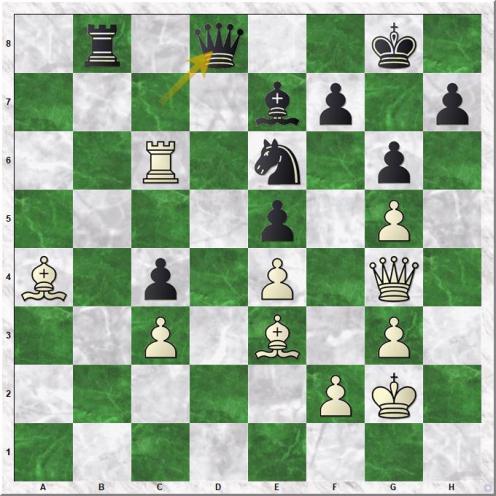
Fischer v Shocron, Mar del Platam 30/3/1959
Solution
1 Re6! because if the rook is captured, White checks on e6 and captures on e5, releasing his black squared bishop into the game.
So 1…Qc8 trying to exploit the pin, but 2 Bd7! breaks it: 2…Qd7 3 Rg6+ discovers on the LPDO Rd7.
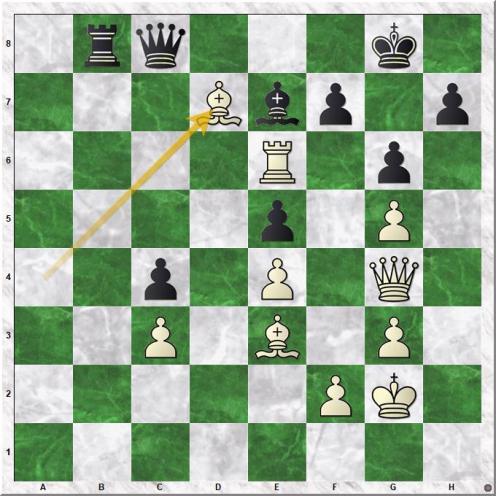
I have never heard of the player of the black pieces, but it seems he was close to a draw vs Bobby:

Megabase has an analysis of the game by Sergei Shipov, and the Chessbase map shows just one slip up let Bobby finish tactically.
FEN
1r1q2k1/4bp1p/2R1n1p1/4p1P1/B1p1P1Q1/2P1B1P1/5PK1/8 w – – 0 39
Today’s problem is from the C.H.O’D. Alexander’s 1973 book”The Penguin Book of Chess Positions”, a book I devoured (and loved) as a child.
I thought I would use it for more of my daily training.
As is my custom, I only say which side is to play: and not giving an idea if the move wins or otherwise, unless on occasion I think signposting would be helpful. Instead, the problems are posed with the instruction to decide what you would play, as in a game.
White to play
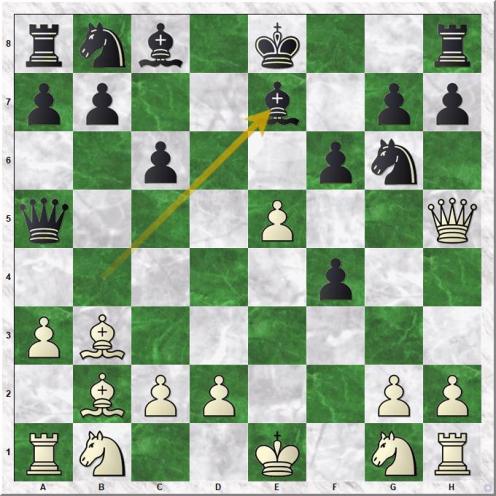
Katalymov v Ilivitski, Frunze 1959
Solution
1 Bf7+ 1-0: the king is decoyed to f7, when e6+ discovers on the LPDO Qa5, or if Black doesn’t capture the B, then 2 Bg6 wins the knight.
FEN
rnb1k2r/pp2b1pp/2p2pn1/q3P2Q/5p2/PB6/1BPP2PP/RN2K1NR w KQkq – 0 11
Today’s problem is from the C.H.O’D. Alexander’s 1973 book”The Penguin Book of Chess Positions”, a book I devoured (and loved) as a child.
I thought I would use it for more of my daily training.
As is my custom, I only say which side is to play: and not giving an idea if the move wins or otherwise, unless on occasion I think signposting would be helpful. Instead, the problems are posed with the instruction to decide what you would play, as in a game.
White to play
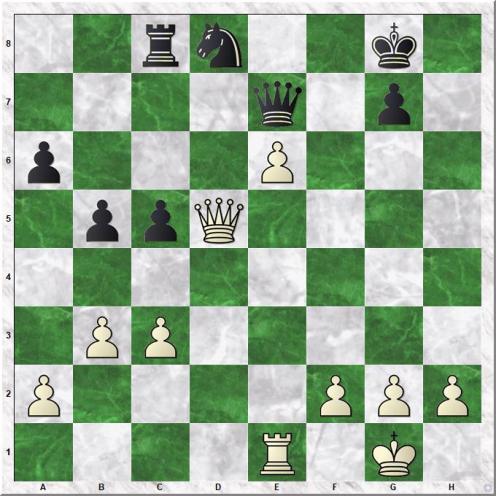
Lewis v Rubin, South Africa 1962
Solution
1 Qd7! double attacking the LPDO Qe7 and LPDO Rc8; 1…Rc7 2 Qc7!

2…Qc7[] 3 e7 is another double attack, 1-0.
Or 1…Qd7 2 ed Rb8 (2..Rc7 3 Re8+ Kf7 4 Rd8 Ke7 5 Rg8 wins) 3 Re8+ Kf7 and Black is in zugzwang. White will promote a pawn, slowly.
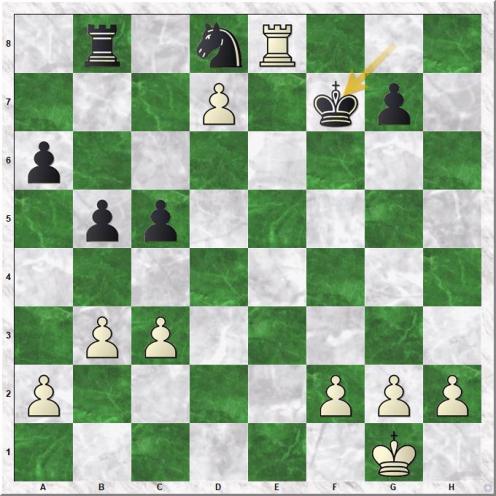
Black can never move his N, since if ..Nc6, then Rb8 Nb8[] d8(Q)
FEN
2rn2k1/4q1p1/p3P3/1ppQ4/8/1PP5/P4PPP/4R1K1 w – – 0 1
Today’s problem is from the C.H.O’D. Alexander’s 1973 book”The Penguin Book of Chess Positions”, a book I devoured (and loved) as a child.
I thought I would use it for more of my daily training.
As is my custom, I only say which side is to play: and not giving an idea if the move wins or otherwise, unless on occasion I think signposting would be helpful. Instead, the problems are posed with the instruction to decide what you would play, as in a game.
White to play
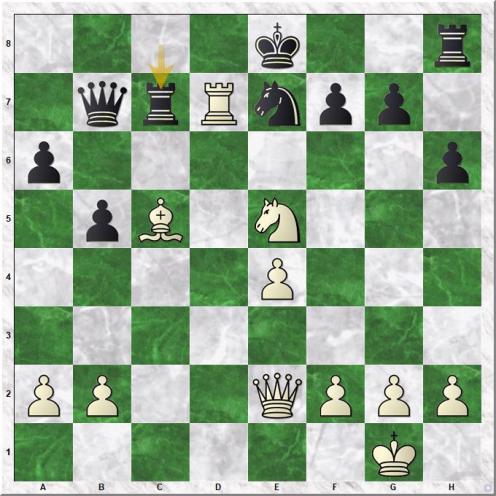
Boleslavsky v Dzindzichashvili, Sovient Union 1967
Solution
1 Rd8+! works because of various N forks.
1…Kd8[] 2 Nf7+ Kd7 (otherwise, 3 Nd6+ forking) 3 Qg4+
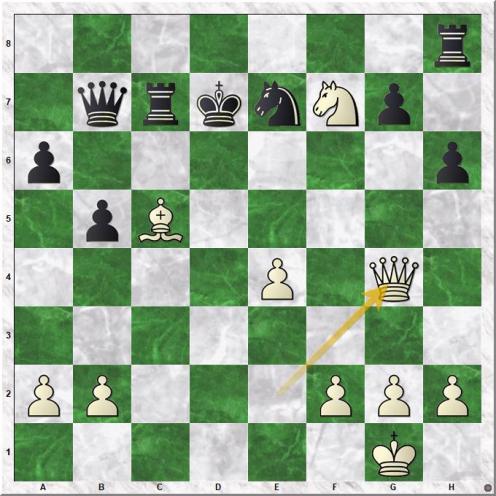
3…Kc6 (else, forks again) 4 Qe6+ 1-0.
If 4…Kc5[] 5 Qd6+ Kc4[] 6 Ne5 is mate.
FEN
4k2r/1qrRnpp1/p6p/1pB1N3/4P3/8/PP2QPPP/6K1 w k – 0 22
Today’s problem is from the August 1979 Chess magazine. I have hundreds (many hundreds) of magazines on my book shelves, and I thought I would dip into them; and thought I would start with going forty years back.
As has been my custom on this blog for a while, I adopt the style of only saying which side is to play: and not giving an idea if the move wins or otherwise, unless on occasion I think signposting would be helpful. Instead, the problems are posed with the instruction to decide what you would play, as in a game.
Black to play after White now plays 1 Qe3: how to finish off?
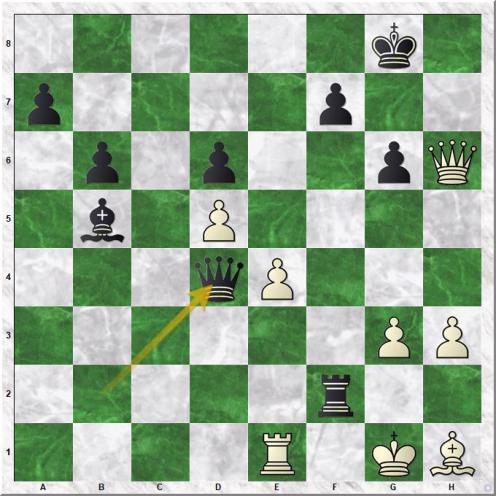
Britton v Shamkovich Lloyds Bank Open London 1978
Solution
[1 Qe3] 1…Rf1+! takes the feet off White’s Queen: the rook can’t be captured, else 2 …Qe4.
2 Kh2 (2…Kg2? Qb2+ wins the house) 2…Qb1+ 3 Bg2 and 3…Rf2 (or 3…a5) and White is trussed up, and the win is easy.
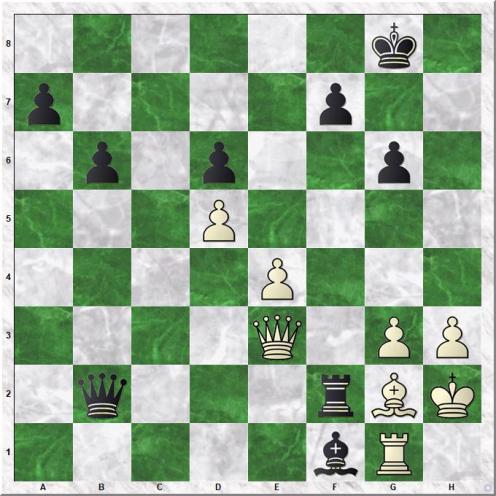
White resigned a few moves later.
FEN
6k1/p4p2/1p1p2pQ/1b1P4/3qP3/6PP/5r2/4R1KB w – – 0 34
Today’s problem is from the August 1979 Chess magazine. I have hundreds (many hundreds) of magazines on my book shelves, and I thought I would dip into them; and thought I would start with going forty years back.
As has been my custom on this blog for a while, I adopt the style of only saying which side is to play: and not giving an idea if the move wins or otherwise, unless on occasion I think signposting would be helpful. Instead, the problems are posed with the instruction to decide what you would play, as in a game.
Black to play
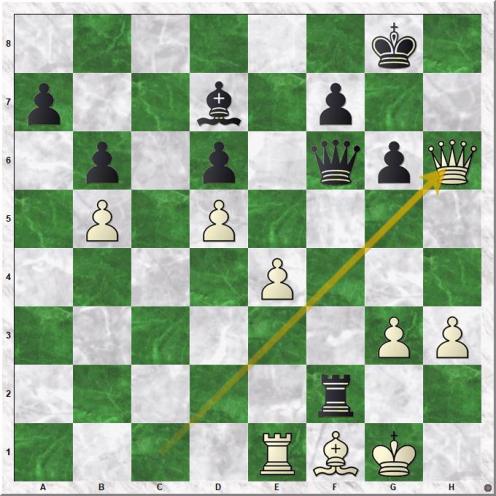
Britton v Shamkovich Lloyds Bank Open London 1978
Solution
1…Bb5! and the Bf1 is overloaded. If 2 Bb5 then 2…Qf3 hitting both g2 and g3.
In the game White played 2 Bg2 met with by 2…Qb2 3 Bh1 Qd4 -+
FEN
6k1/p2b1p2/1p1p1qpQ/1P1P4/4P3/6PP/5r2/4RBK1 b – – 0 31
Today’s problem is from the August 1979 Chess magazine. I have hundreds (many hundreds) of magazines on my book shelves, and I thought I would dip into them; and thought I would start with going forty years back.
As has been my custom on this blog for a while, I adopt the style of only saying which side is to play: and not giving an idea if the move wins or otherwise, unless on occasion I think signposting would be helpful. Instead, the problems are posed with the instruction to decide what you would play, as in a game.
White to play
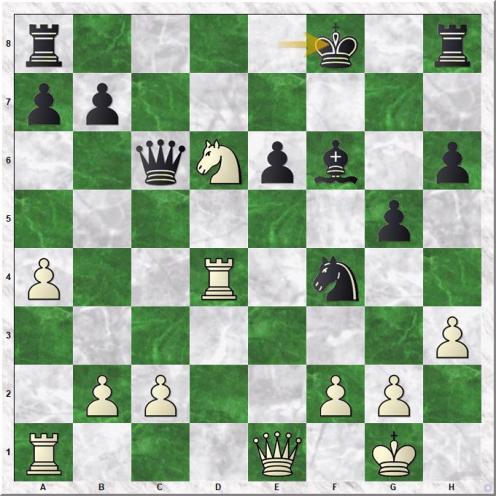
Casse v Martin Lloyds Bank Open London 1978
Solution
1 Rf4! gf 2 Qe6 and Black’s position collapses.
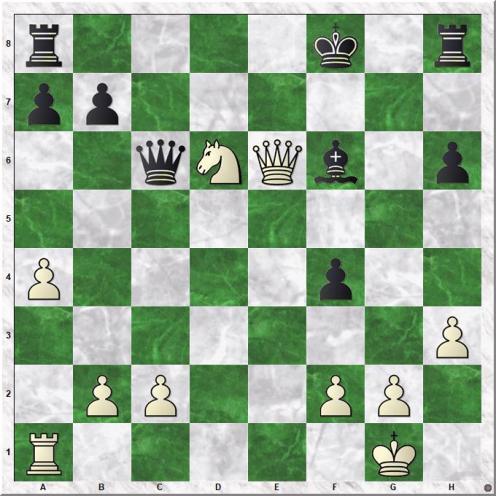
If 1…Ke7 then 2 Nf5+ and if 2…Kf7, then 3 Rc4! and neither of White’s pieces can be taken.
FEN
r4k1r/pp6/2qNpb1p/6p1/P2R1n2/7P/1PP2PP1/R3Q1K1 w – – 0 24
Today’s problem is from the August 1979 Chess magazine. I have hundreds (many hundreds) of magazines on my book shelves, and I thought I would dip into them; and thought I would start with going forty years back.
As has been my custom on this blog for a while, I adopt the style of only saying which side is to play: and not giving an idea if the move wins or otherwise, unless on occasion I think signposting would be helpful. Instead, the problems are posed with the instruction to decide what you would play, as in a game.
Black to play: what was better than 1…b3, as played in the game (and as posted yesterday)
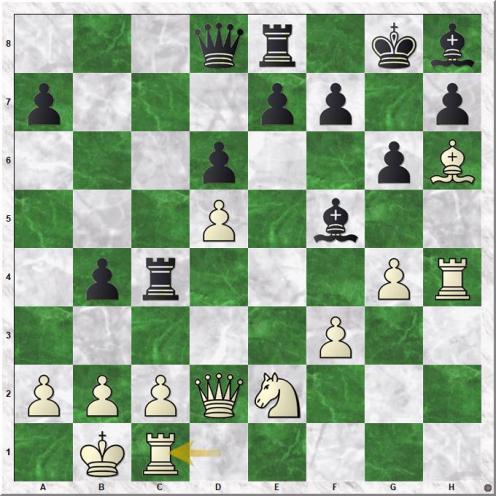
Grunefeld v Lind, Lloyds Bank Open London 1978
Solution
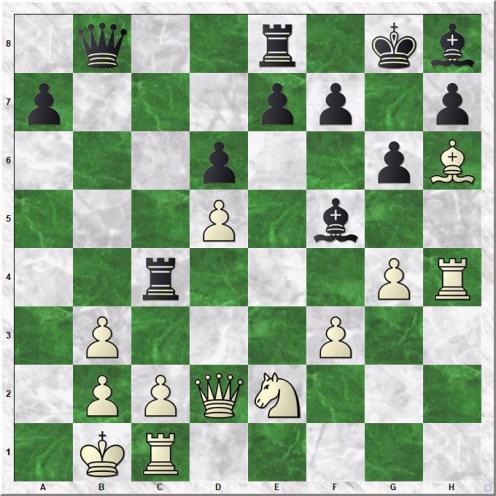
1..Qb8!, reversing the move order, is better: there is no need to first give up the Pb4. White has nothing better than 2 gf when Black again wins the exchange, but with an extra pawn.
FEN
3qr1kb/p3pp1p/3p2pB/3P1b2/1pr3PR/5P2/PPPQN3/1KR5 b – – 0 22
 allanbeardsworth