Today’s problem is from the July 1979 Chess magazine. I have hundreds (many hundreds) of magazines on my book shelves, and I thought I would dip into them; and thought I would start with going forty years back.
As has been my custom on this blog for a while, I adopt the style of only saying which side is to play: and not giving an idea if the move wins or otherwise, unless on occasion I think signposting would be helpful. Instead, the problems are posed with the instruction to decide what you would play, as in a game.
White to play
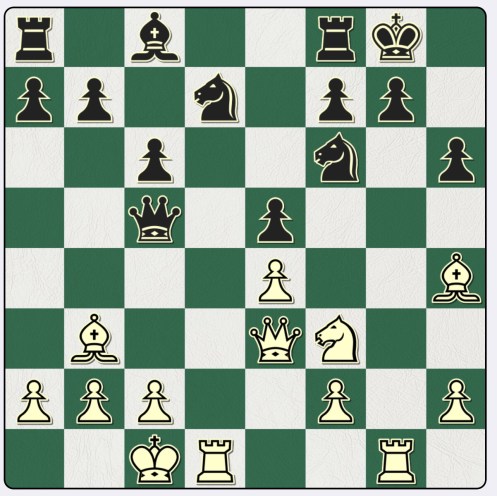
Kimelfeld v Luchinkin, Moscow 1979
Solution
1 Qh6! is simple enough.

1…Ne8 2 Rg7+! Ng7[] 3 Rg1 and mates.
Back In 1979, when I was just seventeen, I wrote in the margin of the magazine ‘busted’ because the game continuation is a much longer, 10 move, finale commencing 1 Rg7. And on the answers page, again forty years ago I wrote the simpler solution, in now the faintest of pencil.
FEN
r1b2rk1/pp1n1pp1/2p2n1p/2q1p3/4P2B/1B2QN2/PPP2P1P/2KR2R1 w – – 0 1
Today’s problem is from the July 1979 Chess magazine. I have hundreds (many hundreds) of magazines on my book shelves, and I thought I would dip into them; and thought I would start with going forty years back.
As has been my custom on this blog for a while, I adopt the style of only saying which side is to play: and not giving an idea if the move wins or otherwise, unless on occasion I think signposting would be helpful. Instead, the problems are posed with the instruction to decide what you would play, as in a game.
White to play

Nilsson v Sorensen, Aalborg 1979
Solution
The first few moves are obvious. 1 Qh5+ Kg8[] 2 Ng5 Re8[]

Now what?
Only 3 Rf3! wins. Other moves let Black’s king slip away from the mating zone, or enable Black to capture on e5 and hold things together, when he wins.

FEN
rqb2r2/pp3ppk/4p1n1/3pP1Q1/1Pn5/R4N2/1BP2P1P/4K2R w K – 0 1
Today’s problem is blogged live whilst watching the semi-finals of the Riga Grand Prix. Whilst written live, it is posted with a delay, since I write my posts sometime in advance.
As has been my custom on this blog for a while, I adopt the style of only saying which side is to play: and not giving an idea if the move wins or otherwise, unless on occasion I think signposting would be helpful. Instead, the problems are posed with the instruction to decide what you would play, as in a game.
White to play: can White win the b pawn?
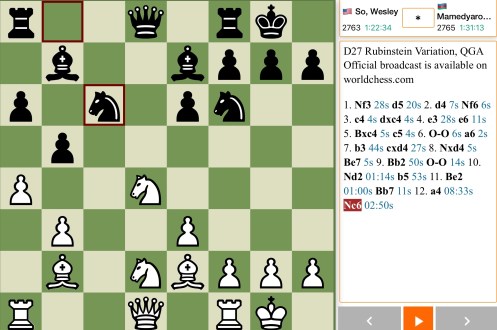
So v Mamedyarov, 19/7/19, Riga
Solution
No, he can’t. It took me a few moments to see why. After 13 ab Nd4 14 Bd4 ab 15 Bb5?? would be a losing blunder: 15…Qd5 would be a double attack on the LPDO Bb5 and the Pg2. The bishop would be lost.
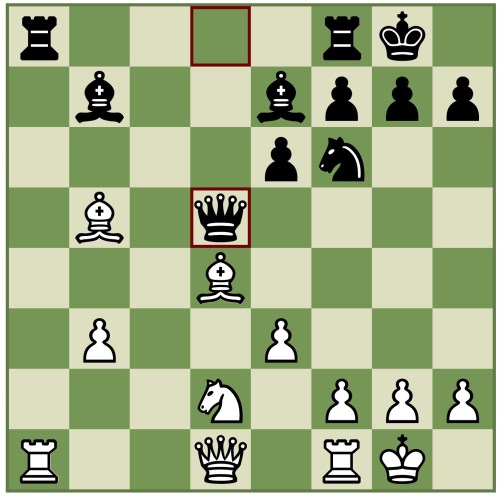
Today’s problem is from the July 1979 Chess magazine. I have hundreds (many hundreds) of magazines on my book shelves, and I thought I would dip into them; and thought I would start with going forty years back.
As has been my custom on this blog for a while, I adopt the style of only saying which side is to play: and not giving an idea if the move wins or otherwise, unless on occasion I think signposting would be helpful. Instead, the problems are posed with the instruction to decide what you would play, as in a game.
White to play

Petrosian v Ivkov, USSR v Yugoslavia 1979
Solution
1 Rd4! and after 1…cd, 2 Re5+ and Black is mated: 2…Kg4[] 3 h3 mate.

FEN
8/pr1r3p/6p1/2p1pk2/3b2N1/1P4P1/P2R1PKP/4R3 w – – 0 1
Today’s problem is from the July 1979 Chess magazine. I have hundreds (many hundreds) of magazines on my book shelves, and I thought I would dip into them; and thought I would start with going forty years back.
As has been my custom on this blog for a while, I adopt the style of only saying which side is to play: and not giving an idea if the move wins or otherwise, unless on occasion I think signposting would be helpful. Instead, the problems are posed with the instruction to decide what you would play, as in a game.
Black to play
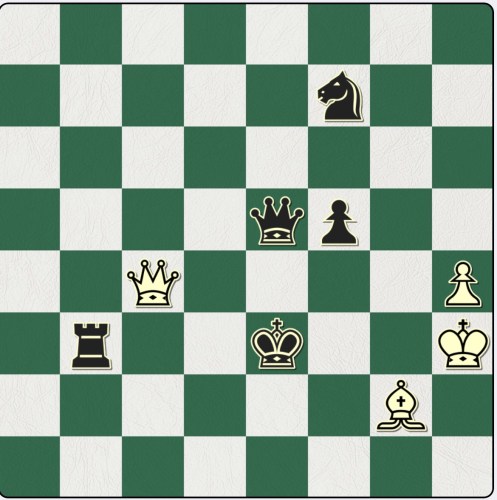
Dorfman v Tsehkovsky, Tiblisi 1978
Solution
1…Ng5+ 2 hg[] Kf2+ 3 Qb3 Qh8 mate.
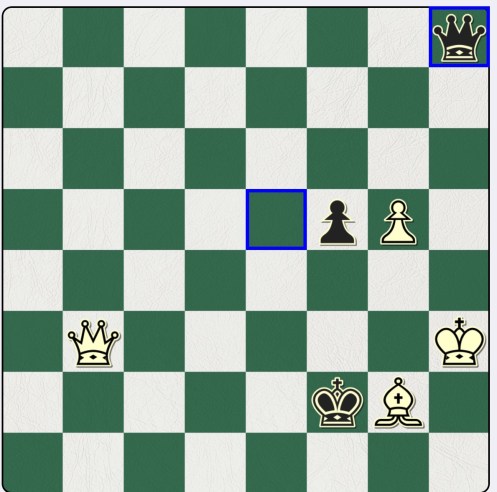
There are various alternatives, such as 1… Kf2+, each with the same idea.
FEN
8/5n2/8/4qp2/2Q4P/1r2k2K/6B1/8 b – – 0 1
Today’s problem is from the July 1979 Chess magazine. I have hundreds (many hundreds) of magazines on my book shelves, and I thought I would dip into them; and thought I would start with going forty years back.
As has been my custom on this blog for a while, I adopt the style of only saying which side is to play: and not giving an idea if the move wins or otherwise, unless on occasion I think signposting would be helpful. Instead, the problems are posed with the instruction to decide what you would play, as in a game.
White to play

van Baarle v Hodgson, Aaranson Masters, London 1979
Solution
1 Re7 is obvious, and is surprisingly strong. Black’s position collapses. If for instance 1…Ne7 then 2 de and either the pawn queens, or a rook is lost.

FEN
3r2k1/1bRrR2p/1p1P1pp1/pN1n4/P2N4/7P/1P3PP1/6K1 b – – 0 1
Today’s problem was seen in a recent newspaper or magazine (alas, I can’t remember where: I have misplaced the cutting). Since I enjoyed solving it I am sharing it on my blog.
Since the start of 2018, I have decided to adopt the style of only saying which side is to play: and not giving an idea if the move wins or otherwise, unless on occasion I think signposting would be helpful. Instead, the problems are posed with the instruction to decide what you would play, as in a game.
White to play
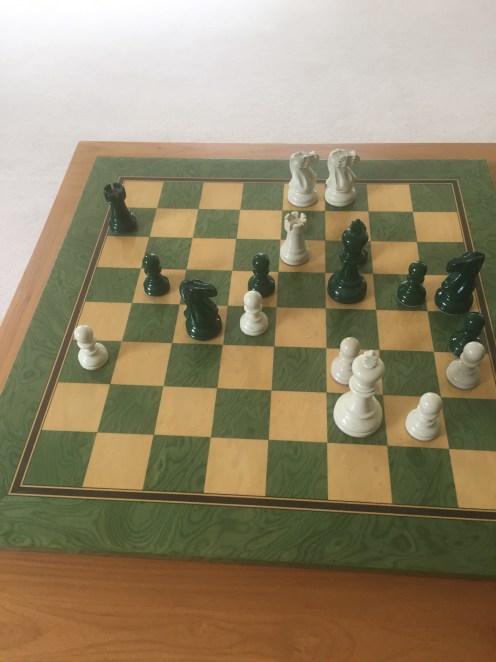
Unknown players ( I couldn’t find the position in Megabase or TWIC)
Solution
1 Rd6! is the nice, little, venomous move. The reason I set the position up on my board was that I couldn’t solve the clipping when I first looked at, trying everything but 1 Rd6. But examine all biffs and the problem was solved.
Today’s problem was seen in a recent weekend Financial Times column by Leonard Barden. Since I enjoyed solving it I am sharing it on my blog.
Since the start of 2018, I have decided to adopt the style of only saying which side is to play: and not giving an idea if the move wins or otherwise, unless on occasion I think signposting would be helpful. Instead, the problems are posed with the instruction to decide what you would play, as in a game.
White to play
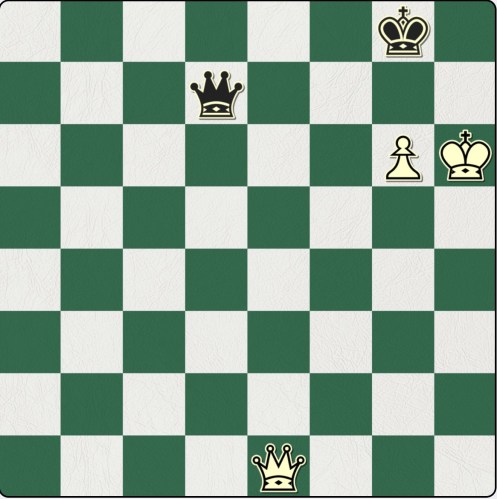
Unknown, Poland. Leonard doesn’t give the players’ names, and I am writing this without access to Megabase or TWIC (away on holiday without my laptop)
Solution
White must prevent Qg7+ and also Qh3+ so 1 Qc3, on the intersection of the long diagonal and the third rank.
1…Qb7.
If 1…Qe7, White checks on c8, swaps queens, and the pawn promotes.
Now White must prevent both Qh1+ and Qg7+, so again we find the intersecting move: 2 Qa1!
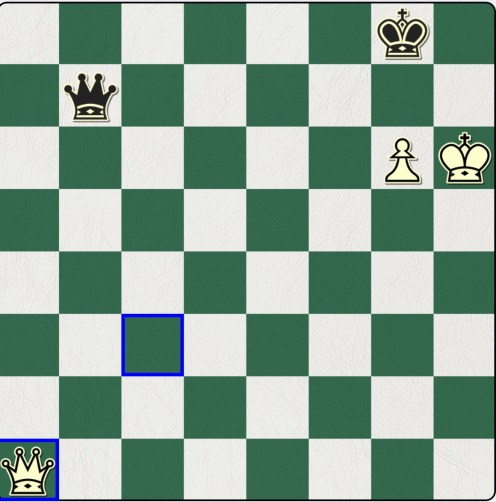
Now Black is in zugzwang. 2…Kf8 loses to 3 Qh8+ and then the skewering 4 Qg7+, so 2…Qe7
3 Qa8+ Qf8+[] 4 Qf8+ Kf8[] 5 Kh7 and the pawn promotes.
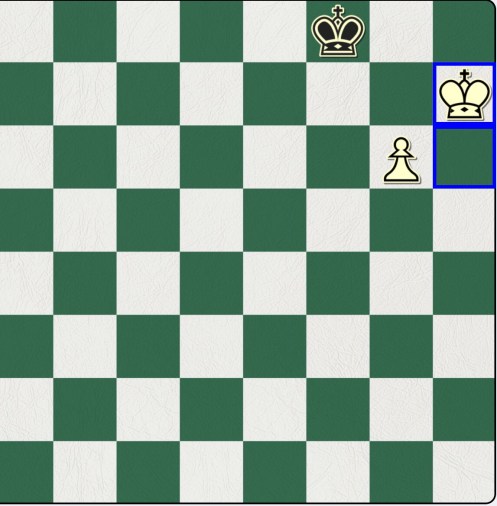
Pretty. Nice geometry.
FEN
5k2/7K/6P1/8/8/8/8/8 b – – 0 1
Today’s problem is from the April 1979 Chess magazine. I have hundreds (many hundreds) of magazines on my book shelves, and I thought I would dip into them; and thought I would start with going forty years back.
As is my custom, I only say which side is to play: and not giving an idea if the move wins or otherwise, unless on occasion I think signposting would be helpful. Instead, the problems are posed with the instruction to decide what you would play, as in a game.
White to play, played 1 Ne7, met with by 1…Be4. What was Black’s better defence?

Trow v Carr, Southend Easter Congress 1979
Solution
1 Ne7 should have been met by 1…Qb4! when 2 b3? loses to 2…Ke7, so White must play 2 c3 Bc3 3 Re2 Ke7, or 2 e5!? Ke7! 3 a3 Qb6[] 4 ed+ Kf8 both being “three zeros” according to my engine after 5 Ne5.
In fact, after 1…Qb4, both lines are, in human terms, unclear.
FEN
2r1k2r/pp2ppb1/2bp3p/3N1p2/q3P3/3Q1N2/PPP2PPP/1K1RR3 w k – 0 1
Today’s problem is from the April 1979 Chess magazine. I have hundreds (many hundreds) of magazines on my book shelves, and I thought I would dip into them; and thought I would start with going forty years back.
As is my custom, I only say which side is to play: and not giving an idea if the move wins or otherwise, unless on occasion I think signposting would be helpful. Instead, the problems are posed with the instruction to decide what you would play, as in a game.
White to play
Trow v Carr, Southend Easter Congress 1979
Solution
1 Ne7 is the obvious solution to the position, being a puzzle.
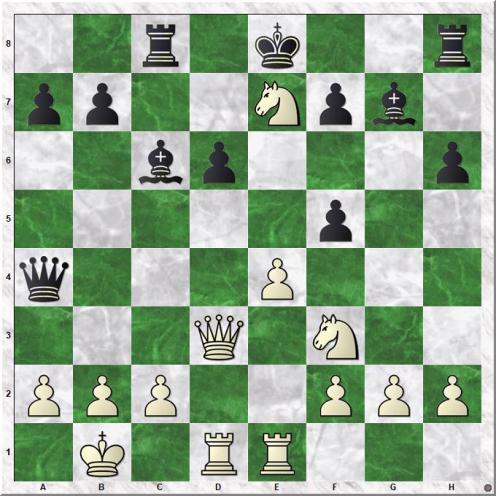
Black played 1…Be4, after which White replied 2 Nf5, and Black resigned.

If instead 1…Ke7, then 2 Qd6_+ Ke8[] 3 ef+ and wins.
But this isn’t everything about the position: see tomorrow.
FEN
2r1k2r/pp2ppb1/2bp3p/3N1p2/q3P3/3Q1N2/PPP2PPP/1K1RR3 w k – 0 1
 allanbeardsworth