Today’s problem is from the January 1979 Chess magazine. I have hundreds (many hundreds) of magazines on my book shelves, and I thought I would dip into them; and thought I would start with going forty years back.
As is my custom, I only say which side is to play: and not giving an idea if the move wins or otherwise, unless on occasion I think signposting would be helpful. Instead, the problems are posed with the instruction to decide what you would play, as in a game.
White to play

Dolmadjan v Angelov, Sofia 1977
Solution
1 Re7! examine all biffs Re7[] 2 Nd6+ Qd6 3 Re7!
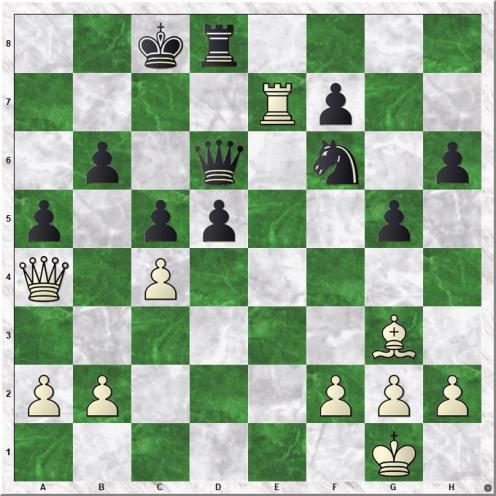
If 3….Qe7, 4 Qc6+ is curtains.
If 2…Kb8 3 Re& and it is over.
FEN
2krr3/3qbp2/1p3n1p/pNppR1p1/Q1P5/6B1/PP3PPP/4R1K1 w – – 0 1
Today’s problem is from the January 1979 Chess magazine. I have hundreds (many hundreds) of magazines on my book shelves, and I thought I would dip into them; and thought I would start with going forty years back.
As is my custom, I only say which side is to play: and not giving an idea if the move wins or otherwise, unless on occasion I think signposting would be helpful. Instead, the problems are posed with the instruction to decide what you would play, as in a game.
White to play

Dennison v Pos, Manchester 1978
Solution
1 Nh6+
1…Kf8?? 2 Qe7 mate;
1…Kh8 2 Nf7+ Kg8+ 3 Nh6+ Kh8[] 4 fg+

4…Kg7[] 5 Qe7+ Kh6 6 Qf6+ Kh5 7 g4+! etc

1…gh 2 Qg4+ Kf8 3 Re1
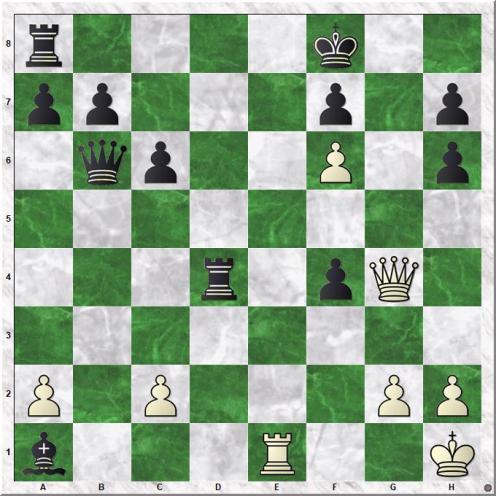
3…Re4 4 Qg7+ Ke8[] 5 Re4+ etc
FEN
r5k1/pp3ppp/1qp2P2/5N2/3r1p2/8/P1P1Q1PP/b4R1K w – – 0 1
Today’s problem is from one of my games: a move I found when analysing the game recently, when preparing for another match against the same opponent.
As is my custom, I only say which side is to play: and not giving an idea if the move wins or otherwise, unless on occasion I think signposting would be helpful. Instead, the problems are posed with the instruction to decide what you would play, as in a game.
White to play: what moves would you consider? Look for candidate moves

Allan Beardsworth v Robert Shaw, Stockport 10/4/17
Solution
I only looked at 1 h3 and the move I played, 1 Kb4; both are good, and I managed to win the game, but my engine’s first choice is a move I didn’t even consider.
1 c4!!

Should I have seen it? I think I should, but had blinkered thinking, and regarded the Queen side pawn structure as blocked.
But if I have done as Purdy said, and examined all biffs maybe I would have considered it;
Or if I had considered all pawn breaks, maybe also?;
or if I had talked to my pieces, I would have seen that the Bd2 is not very happy and that on b4, it would skewer the king and rook;
if if I had done another thing Purdy said, look for pins, I might have found it : the alignment on the a3-f8 diagonal of K and R.
Purdy on nets, pins and ties, Fine Art, vol 2, pg 205Some things are hooey,and most others lies;But forks you mustn’t miss,nor pins, nets, ties.
Or if I had followed Jacob Aagaard’s advice and addressed his three questions, I might have found it.
Aagaard’s three questions1. What are the weaknesses? (potential targets)2. What is the worst piece? (improve position)3. What is my opponent intending? (prophylaxis)
Or if I had followed another of Jacob’s words of wisdom, and brought all pieces to the party, I would have found it.
But despite knowing all these mantras, I didn’t even look at it, it was beyond my vision.
I wonder how many readers spotted it, or have “systems” in place to not overlookl such hidden moves?
(By the way, 1 c4 is best, but relies on some tactical lines to work; had I seen it, I still might not have played it. To be honest, I think I should have played 1 h3 which is a mean, prophylactic, move. The fact that 1 Kb4 is very strong doesn’t absolve me from finding a good move, and then looking for a stronger one.
FEN
5r2/1p2k3/4pb2/1p1p2pr/3P4/PKP2R2/1P1B1R1P/8 w – – 0 38
Today’s problem is from the January 1979 Chess magazine. I have hundreds (many hundreds) of magazines on my book shelves, and I thought I would dip into them; and thought I would start with going forty years back.
As is my custom, I only say which side is to play: and not giving an idea if the move wins or otherwise, unless on occasion I think signposting would be helpful. Instead, the problems are posed with the instruction to decide what you would play, as in a game.
White to play
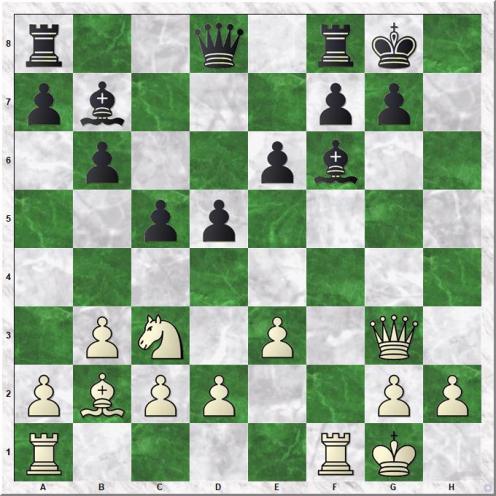
Mildenhall v Ardin, Coventry 1978
Solution
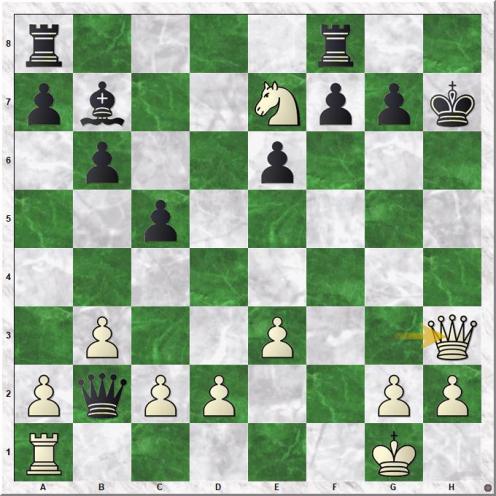
1 Rf6! Qf6[] 2 Nd5! and if 2…Qb2, a standard mate results: 3 Ne7+ and 4 Qh3 mate.
FEN
r2q1rk1/pb3pp1/1p2pb2/2pp4/8/1PN1P1Q1/PBPP2PP/R4RK1 w – – 0 1
Today’s problem is from the January 1979 Chess magazine. I have hundreds (many hundreds) of magazines on my book shelves, and I thought I would dip into them; and thought I would start with going forty years back.
As is my custom, I only say which side is to play: and not giving an idea if the move wins or otherwise, unless on occasion I think signposting would be helpful. Instead, the problems are posed with the instruction to decide what you would play, as in a game.
White to play

Faibisovich v Kaminski, Leningrad 1978
Solution
1 Qg5! and Black resigned: 1…fg[] 3 Rh7 g6 and 4 Bf7+ is curtains.

FEN
4r1k1/4qrpp/2pp1p2/p3p1nR/Pp2P1Q1/1B1PP2R/1PP3PP/6K1 w – – 0 26
Today’s problem was seen very recently in Leonard Barden’s Saturday Financial Times column. It took me a while- half a dog walk- to solve in my head- so I thought it might interest my readers. Hopefully they will do better than me.
As is my custom, I only say which side is to play: and not giving an idea if the move wins or otherwise, unless on occasion I think signposting would be helpful. Instead, the problems are posed with the instruction to decide what you would play, as in a game.
White to play
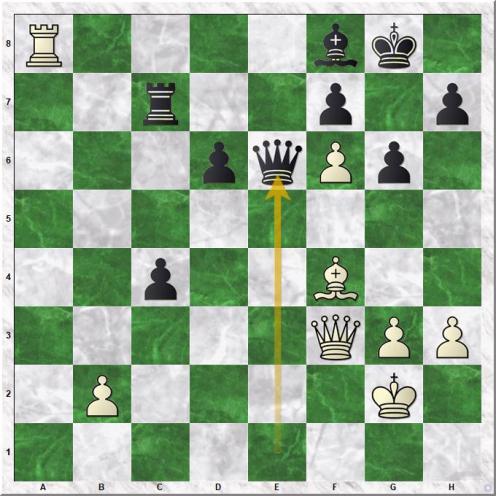
Kociscak v Tazbir, Czech Republic 1 December 2018
Solution
1 Rf8+! Kf8[] is obvious, but for a while I couldn’t see the next move, the key one; so oscillated between 1 Rf8+, 1 Bh6, and other attemps.
2 Bd6+! is the key.
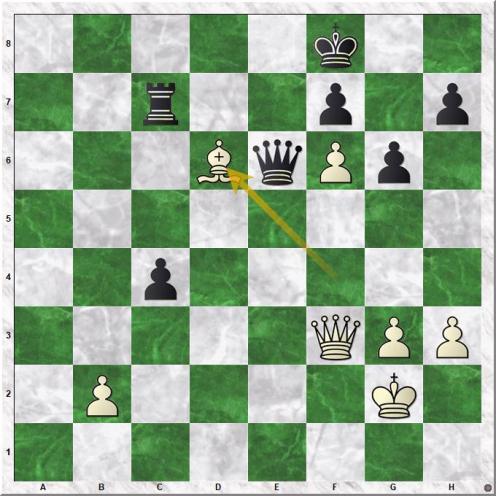
Black resigned.
The key is that the Qe6 is tied to e8 (so as to defend against Qa8+) so the B can’t be captured, and the LPDO Rc7 drops off.
FEN
R4bk1/2r2p1p/3pqPp1/8/2p2B2/5QPP/1P4K1/8 w – – 0 35
Today’s problem is from the January 1979 Chess magazine. I have hundreds (many hundreds) of magazines on my book shelves, and I thought I would dip into them; and thought I would start with going forty years back.
As is my custom, I only say which side is to play: and not giving an idea if the move wins or otherwise, unless on occasion I think signposting would be helpful. Instead, the problems are posed with the instruction to decide what you would play, as in a game.
White to play
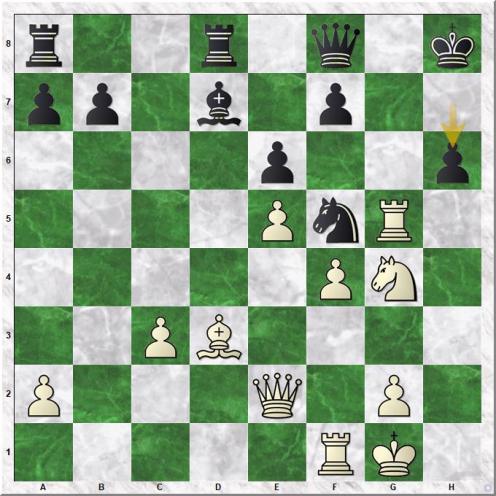
Regan v Shamkovich, Pasadena 1978
Solution
1 Nh6! examine all biffs 1…Nh6 (1…Qh6 2 Rh5 +-) 2 Qe4!
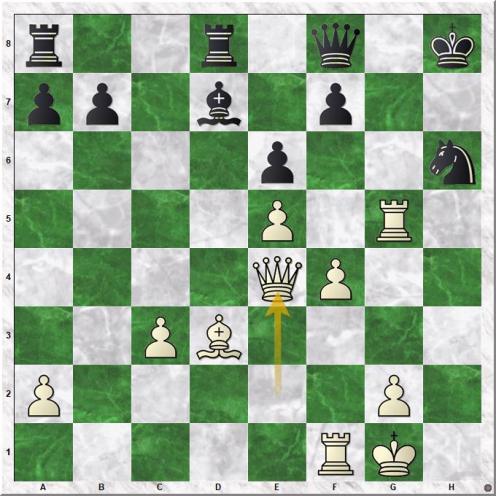
2…Nf5[] 3 Rf3 bringing more pieces to the party, and Black must sacrifice his queen, for the game to go on, but he is losing.
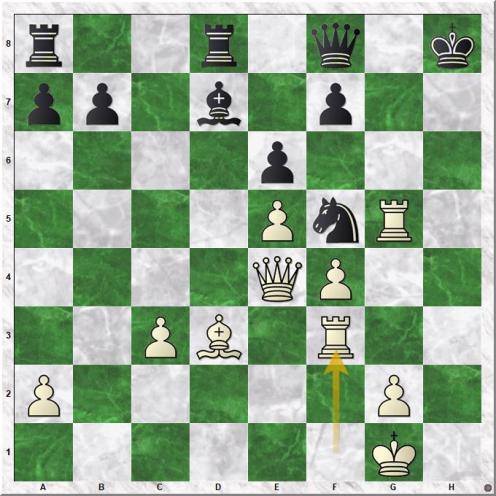
Black played 3…Qg7 but resigned a few moves later.
FEN
r2r1q1k/pp1b1p2/4p2p/4PnR1/5PN1/2PB4/P3Q1P1/5RK1 w – – 0 27
Today’s problem is from the January 1979 Chess magazine. I have hundreds (many hundreds) of magazines on my book shelves, and I thought I would dip into them; and thought I would start with going forty years back.
As is my custom, I only say which side is to play: and not giving an idea if the move wins or otherwise, unless on occasion I think signposting would be helpful. Instead, the problems are posed with the instruction to decide what you would play, as in a game.
Black to play

Janosevic v Petrosian, Lone Pine 5th April 1978
Solution
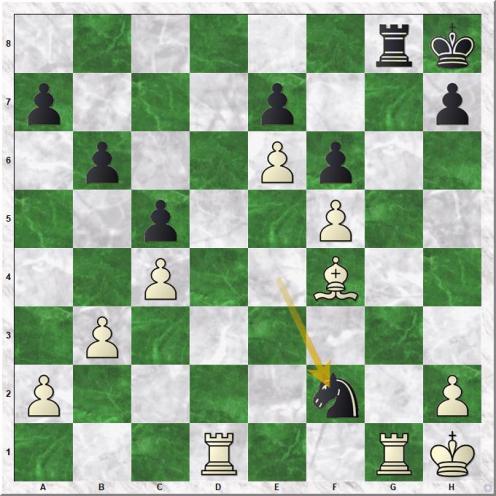
This game was played 41 years ago today.
1…Rg1+! and White resigned: the Rf1 is tied to defending f2 so that 2…Nf2 is mate.
FEN
6rk/p3p2p/1p2Pp2/2p2P2/2P1nBr1/1P6/P6P/3R1R1K b – – 0 33
Today’s problem is from the European Individual Championships.
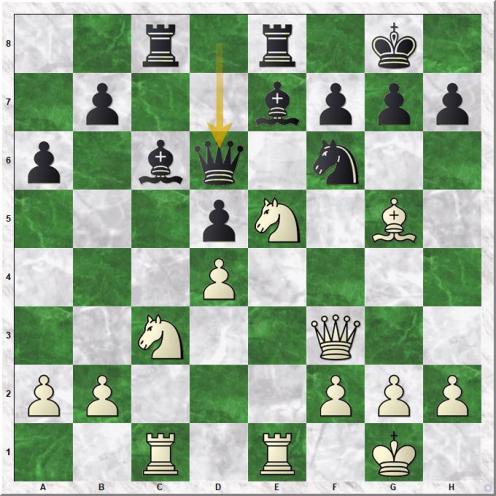
Dipping into the tournament live on the Follow Chess app (dipping in because I was working that day) I was struck by the pressure Artemiev had in this position, and wondered if was going to convert it. Later, I logged on to see he had, and in style.
As is my custom, I only say which side is to play: and not giving an idea if the move wins or otherwise, unless on occasion I think signposting would be helpful. Instead, the problems are posed with the instruction to decide what you would play, as in a game.
White to play
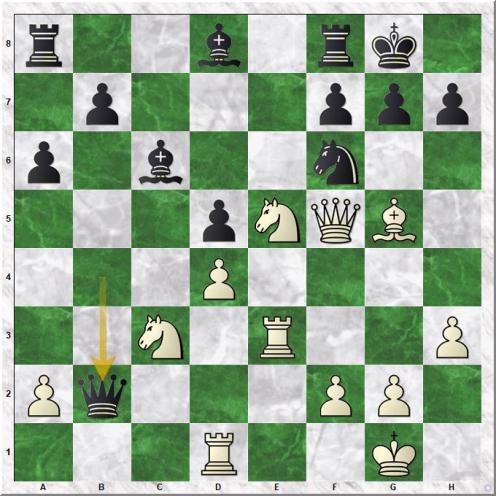
Artemiev v Hracek, EIXX 2019 Skopye, 26/3/19
(variation after 20….Qb2)
Solution
I had wondered what would have happened if Black had captured on b2.
White would win by 1 Rb1! forcing 1…Qa3, when a discovered attack wins: 2 Ne4! (and not 2 Nd5- no need to improve Black’s Bc6)
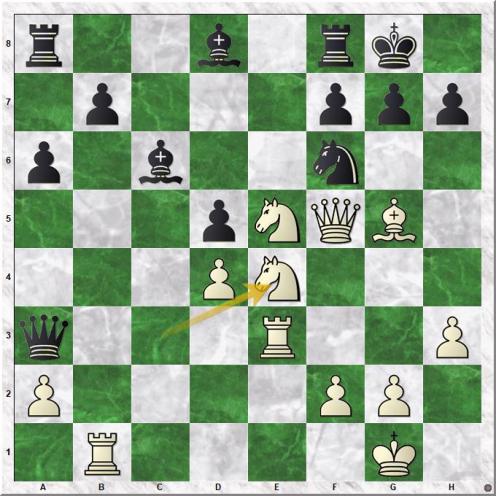
If 2…Qe7 3 Nf6+ gf[] 4 Nc6! hits the Q whilst winning a piece.
Tomorrow, my puzzle will be the game finale itself.
FEN
r2b1rk1/1p3ppp/p1b2n2/3pNQB1/3P4/2N1R2P/Pq3PP1/3R2K1 w – – 0 21
 allanbeardsworth