Today’s problem is from the 1972 book “Chess Combination as a Fine Art”, a book based on articles published in the 1950s-1960s by Kurt Richter.
Since the start of 2018, I have decided to adopt the style of only saying which side is to play: and not giving an idea if the move wins or otherwise, unless on occasion I think signposting would be helpful. Instead, the problems are posed with the instruction to decide what you would play, as in a game.
White to play: yesterday, the solution was given as 1 Ne6 fe 2 Rc7+, exchange on h8, and promote or win the exchange. What was wrong with that solution?
Szabo v Dozsa, Budapest 28/5/1962
Solution
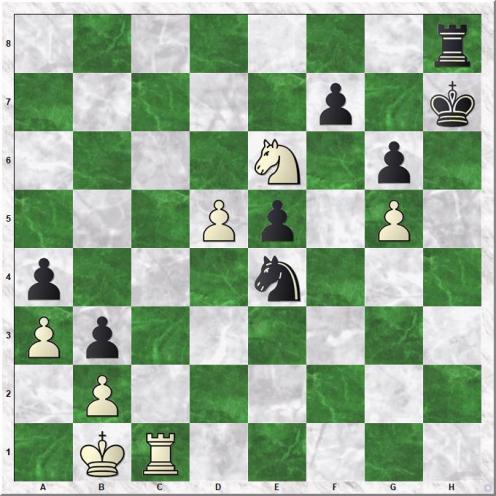
1..Ne4! and the game is equal: 2 Rc7 Kg8 and White can’t progress.
The book doesn’t mention this cook, so I wonder if the players, or Richter, knew?
FEN
7r/5p1k/4N1p1/3Pp1P1/p3P3/Pp4n1/1P6/1KR5 b – – 0 38
Today’s problem is from the 1972 book “Chess Combination as a Fine Art”, a book based on articles published in the 1950s-1960s by Kurt Richter.
Since the start of 2018, I have decided to adopt the style of only saying which side is to play: and not giving an idea if the move wins or otherwise, unless on occasion I think signposting would be helpful. Instead, the problems are posed with the instruction to decide what you would play, as in a game.
White to play
Szabo v Dozsa, Budapest 28/5/1962
Solution
1 Ne6! fe 2 Rc7+, 3 Rc8+, 4 Rh8 and either the d-pawn queens, or White is an exchange up, with a winning advantage.

If 1…Re8 (which is better than 1…fe) then 2 Nc5 or 2 Rc7, and White is better.
I will return to this problem tomorrow.
FEN
7r/5p1k/6p1/3Pp1P1/p3PN2/Pp4n1/1P6/1KR5 w – – 0 38
Today’s problem is from the 1972 book “Chess Combination as a Fine Art”, a book based on articles published in the 1950s-1960s by Kurt Richter.
Since the start of 2018, I have decided to adopt the style of only saying which side is to play: and not giving an idea if the move wins or otherwise, unless on occasion I think signposting would be helpful. Instead, the problems are posed with the instruction to decide what you would play, as in a game.
Black to play

Balogh v Pogats, Budapest 1957
Solution
1…Qg3! and White’s position collapses.
2 hg Rf1+ 3 Kh2[] Ne1 and the game is over.

If 4 Qb4 (say) Black has a mate by 4…Rh1+ 5 Kg4 h5 mate.
FEN
5rk1/pp5p/4p1p1/4P3/2pP2q1/3nPrN1/PP1Q2RP/5RK1 b – – 0 1
Today’s problem is from the 1972 book “Chess Combination as a Fine Art”, a book based on articles published in the 1950s-1960s by Kurt Richter.
Since the start of 2018, I have decided to adopt the style of only saying which side is to play: and not giving an idea if the move wins or otherwise, unless on occasion I think signposting would be helpful. Instead, the problems are posed with the instruction to decide what you would play, as in a game.
White to play

Taimanov v AN Other, simul USSR 1964
Solution
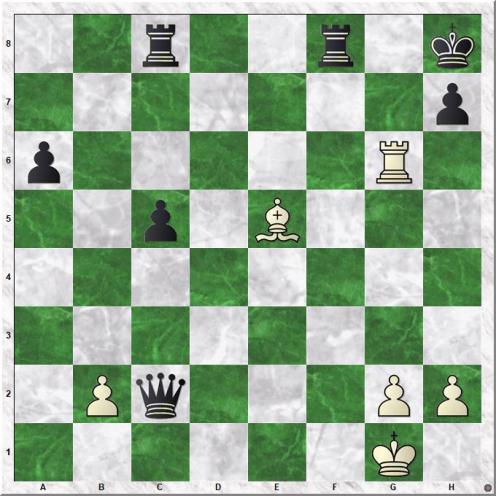
The finale of yesterday’s puzzle: 1 Rf8+!! Rf8[] 2 Rg6+ and mate next move.
FEN
2r1r2k/6Rp/p5p1/2p1B3/8/8/1Pq3PP/5RK1 w – – 0 4
Today’s problem is from the 1972 book “Chess Combination as a Fine Art”, a book based on articles published in the 1950s-1960s by Kurt Richter.
Since the start of 2018, I have decided to adopt the style of only saying which side is to play: and not giving an idea if the move wins or otherwise, unless on occasion I think signposting would be helpful. Instead, the problems are posed with the instruction to decide what you would play, as in a game.
White to play

Taimanov v AN Other, simul USSR 1964
Solution
1 Bc4! Qc4[]
2 Rg7+! Kh8 (if 2…Kg7, 3 Be5+ wins the queen)

3 Be5! flashy, and wins, though the engines say Rb7 or Ra7 is ‘better’ (in the sense 12>6) Qc2 (3…Qf1+ also loses, prosaically).
and the finale will be tomrrow’s puzzle.
FEN
2r1r1k1/1R4bp/p5p1/2pqn3/8/2B5/1PQ1B1PP/5RK1 w – – 0 1
Today’s problem is from the 1972 book “Chess Combination as a Fine Art”, a book based on articles published in the 1950s-1960s by Kurt Richter.
A very nice, pretty, problem, to celebrate my wife’s birthday. Not that she understands how to play chess, that is.
Since the start of 2018, I have decided to adopt the style of only saying which side is to play: and not giving an idea if the move wins or otherwise, unless on occasion I think signposting would be helpful. Instead, the problems are posed with the instruction to decide what you would play, as in a game.
White to play:
and which of White’s pieces wins the game? Name that piece.
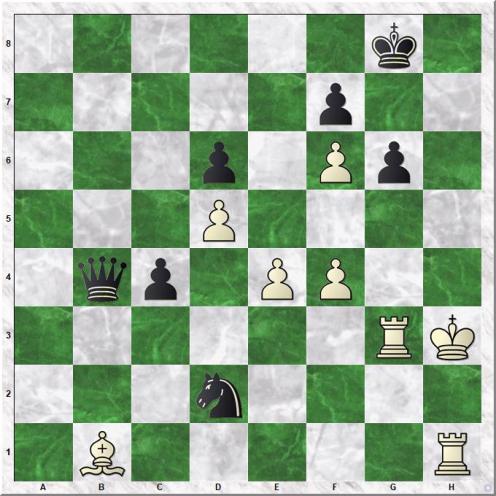
Stulik v Kozma, Czechoslovakia 1957
Solution
1 Kg4! Qb2 – hitting f6, in time to prevent Rgh3 and Rh8 mate.
2 Rgh3! anyway Qf6[]
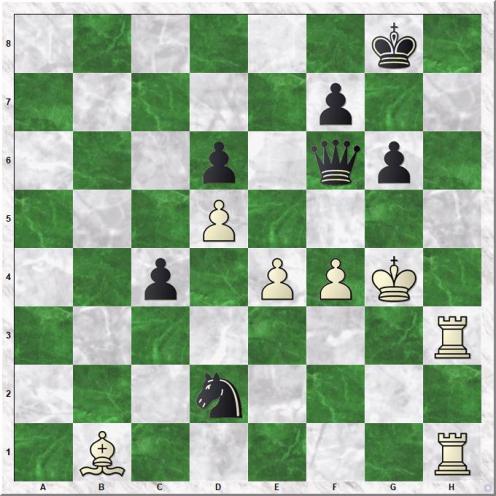
3 e5!! and Black doesn’t have a check, since the Bb1 covers f5, and the Pd5 covers e6.
3…de[] 4 Rh8+! Qh8[] (else 5 R1h7 mate) 5 Rh8 Kh8[] 6 d6 and promotes, since the Bb1 prevents the N coming back to e4 and then f6 with check.

Almost a study. I bet Mr Stulik went home happy that evening, and Mr Kozma was consoled by losing to such a fine combination.
FEN
6k1/5p2/3p1Pp1/3P4/1qp1PP2/6RK/3n4/1B5R w – – 0 1
Today’s problem is from the 1972 book “Chess Combination as a Fine Art”, a book based on articles published in the 1950s-1960s by Kurt Richter.
Since the start of 2018, I have decided to adopt the style of only saying which side is to play: and not giving an idea if the move wins or otherwise, unless on occasion I think signposting would be helpful. Instead, the problems are posed with the instruction to decide what you would play, as in a game.
White to play

Pesch v Koehlei, Sinzig 1959
Solution
1 Ne5! Bb4 2 Qh5+ Ke7 3 Rg7+ Kd6
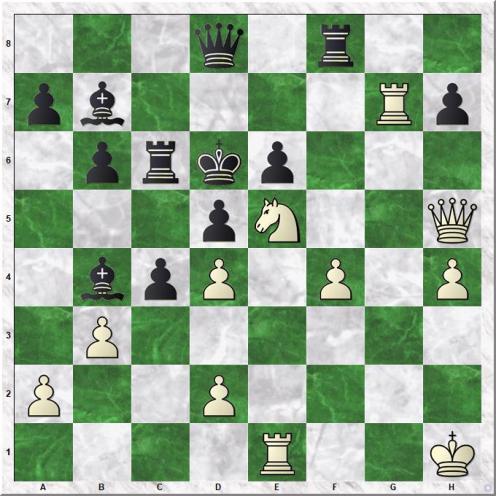
4 Nc4+!! Rc4
5 Re6+!!
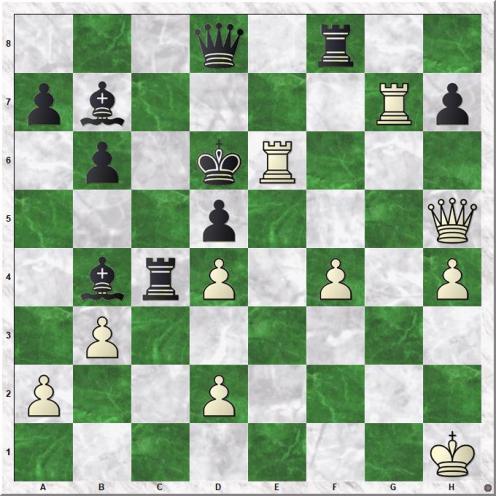
5…Ke6[[ 6 Qe5 mate.

Very pretty.
FEN
3qkr2/pb2b2p/1pr1p3/3p4/1BpP1P1P/1P3N2/P2PQ1R1/4R2K w – – 0 1
Today’s problem is from the 1972 book “Chess Combination as a Fine Art”, a book based on articles published in the 1950s-1960s by Kurt Richter.
Since the start of 2018, I have decided to adopt the style of only saying which side is to play: and not giving an idea if the move wins or otherwise, unless on occasion I think signposting would be helpful. Instead, the problems are posed with the instruction to decide what you would play, as in a game.
White to play: evaluate 1 Rd2, as played in the game
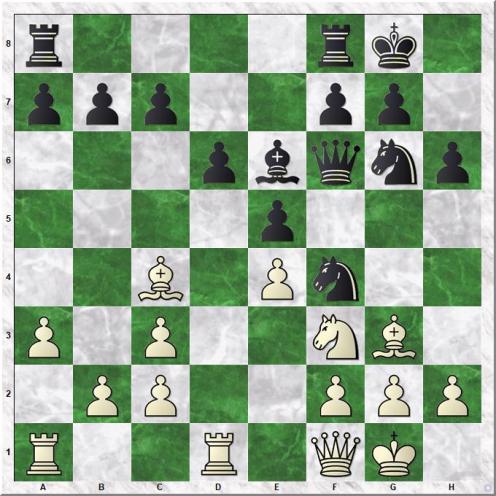
Hulsmann v Engert, Dusseldorf 1965
Solution
1…Ng2!
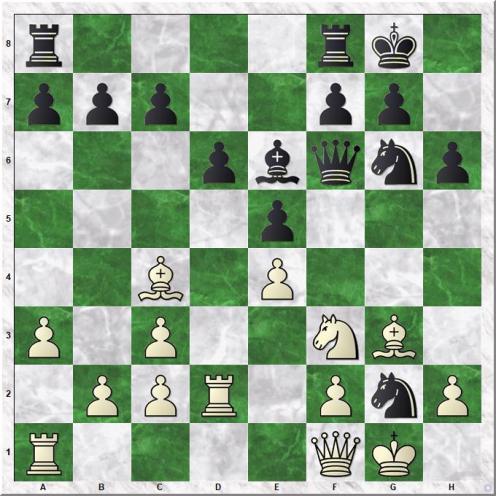
Now White should accept the much worse game by 2 Be6 fe 3 Qg2 Qf3, but in the game played 2 Kg2 (2 Qg2 would also have been better, down a pawn and with the worse game) met by 2…Bh3+!! 3 Kh3[] Qf3.
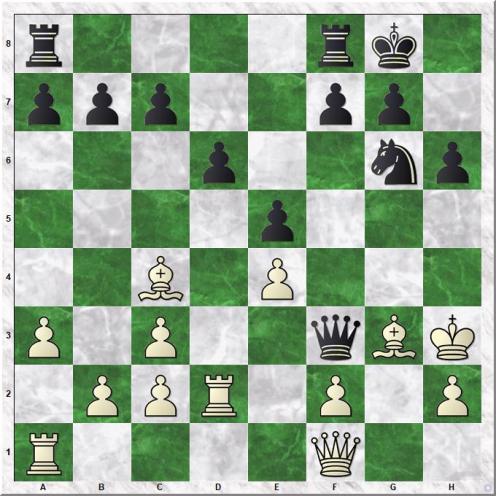
It is mate after Nf4+ and Qh5.
FEN
r4rk1/ppp2pp1/3pbqnp/4p3/2B1Pn2/P1P2NB1/1PP2PPP/R2R1QK1 w – – 0 1
Today’s problem is from the 1972 book “Chess Combination as a Fine Art”, a book based on articles published in the 1950s-1960s by Kurt Richter.
Since the start of 2018, I have decided to adopt the style of only saying which side is to play: and not giving an idea if the move wins or otherwise, unless on occasion I think signposting would be helpful. Instead, the problems are posed with the instruction to decide what you would play, as in a game.
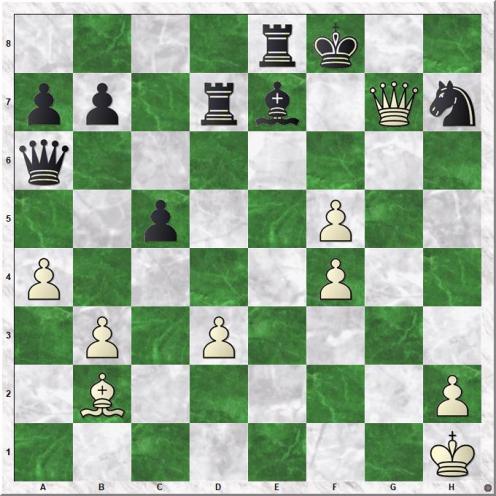
White to play

Bulat v Smederevac, Kranj 1958
Solution
1 Rg7+! Kg7 (otherwise it is a disaster for Black) 2 Qg2+ Kf8 (2…Kh8 3 Nf7 mate) 3 Eh7!

3…Nh7 4 Nd7+! Rd7 (4…Kf7 5 Qg6 mate) 5 Qg7 mate.
A nice fairly forced line.
FEN
4r1k1/pp2b1pp/q4n2/2prNP2/P4P2/1P1P3R/1BQ4P/6RK w – – 0 1
Today’s problem is from the 1972 book “Chess Combination as a Fine Art”, a book based on articles published in the 1950s-1960s by Kurt Richter.
Since the start of 2018, I have decided to adopt the style of only saying which side is to play: and not giving an idea if the move wins or otherwise, unless on occasion I think signposting would be helpful. Instead, the problems are posed with the instruction to decide what you would play, as in a game.
White to play

Ansorge v Hubner, Cologne 1960

Solution
1 h6?? loses: 1 Kf4 probably draws (I think draws- note h1 is a White square)
1..Be5! 2 Kg5 Ke5 3 Kh5[] Kf6 4 g5+[] Kf5 5 g6[] hg mate.
FEN
8/6bp/4k3/6KP/6P1/8/8/8 w – – 0 1
 allanbeardsworth