Today’s problem is from the 1972 book “Chess Combination as a Fine Art”, a book based on articles published in the 1950s-1960s by Kurt Richter.
Since the start of 2018, I have decided to adopt the style of only saying which side is to play: and not giving an idea if the move wins or otherwise, unless on occasion I think signposting would be helpful. Instead, the problems are posed with the instruction to decide what you would play, as in a game.
White to play: evaluate 1 d7+ Bd7 2 Bb8, as played in the game

Taimanov v Bronstein, Leningrad 1960
Solution
2…c5+!! and the players agreed a draw. Very pretty.

FEN
1nk5/8/2pP2p1/5bP1/BP1K1B2/8/8/8 w – – 0 70
Today’s problem is from the 1972 book “Chess Combination as a Fine Art”, a book based on articles published in the 1950s-1960s by Kurt Richter.
Since the start of 2018, I have decided to adopt the style of only saying which side is to play: and not giving an idea if the move wins or otherwise, unless on occasion I think signposting would be helpful. Instead, the problems are posed with the instruction to decide what you would play, as in a game.
White to play
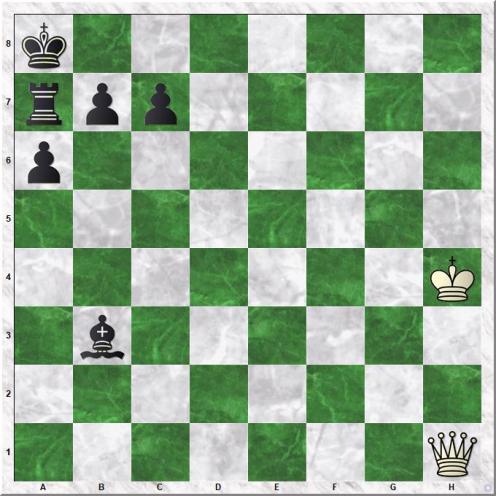
Study, unattributed
Solution
1 Kg5! to threaten mate with Qh8+, whilst keeping the b pawn pinned, so as to prevent Black from freeing himself.
1…Bg8! seeking to play 2…b5 after 2 Qh8
2 Qf3! Bf7!
3 Qh3! double attack on c8 and h8: 1-0

FEN
k7/rpp5/p7/8/7K/1b6/8/7Q w – – 0 1
Today’s problem is from the 1972 book “Chess Combination as a Fine Art”, a book based on articles published in the 1950s-1960s by Kurt Richter.
Since the start of 2018, I have decided to adopt the style of only saying which side is to play: and not giving an idea if the move wins or otherwise, unless on occasion I think signposting would be helpful. Instead, the problems are posed with the instruction to decide what you would play, as in a game.
White to play

Trojanenscu v Soos, Rumanian championship 1957
Solution
1 Re1+! Kf4
2 Bd1 or 2 Kc1! or 2 Bg6! and the pawn queens, or the N is captured: Re8 Nb7 Rb8 traps the N.
2 Bg6! seems most efficient, but they are fairly equivalent. The advantage of 2 Bg6 is that White can later play Be4 hitting the Nb7, rather than using the R to capture it.
FEN
8/3P4/p3n3/1p2k1p1/2p3r1/8/PPB5/1K1R4 w – – 0 1
Today’s problem is from the 1972 book “Chess Combination as a Fine Art”, a book based on articles published in the 1950s-1960s by Kurt Richter.
Since the start of 2018, I have decided to adopt the style of only saying which side is to play: and not giving an idea if the move wins or otherwise, unless on occasion I think signposting would be helpful. Instead, the problems are posed with the instruction to decide what you would play, as in a game.
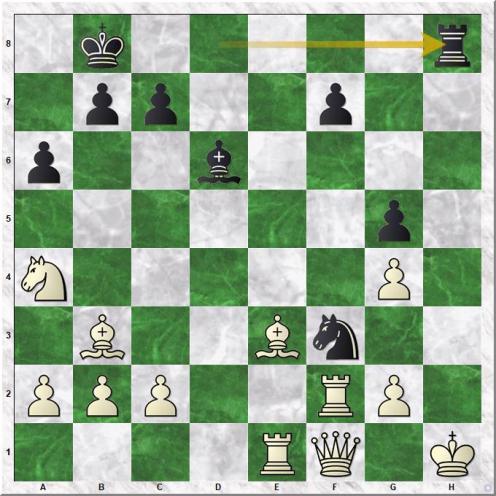
Black to play

Suni v Alivirta, Helsinki 1957
Solution
A well known motif; I wonder if I learnt it from this game itself?
1.. Rh1+!
2…Qh7+!
3…Qh2+!!

4…Nf3++
5…Rh8 mate
FEN
1k1r3r/1pp2p2/p2b4/4n1p1/N3q1P1/1B2B3/PPP2RP1/4RQK1 b – – 0 1
Today’s problem is from the 1972 book “Chess Combination as a Fine Art”, a book based on articles published in the 1950s-1960s by Kurt Richter.
Since the start of 2018, I have decided to adopt the style of only saying which side is to play: and not giving an idea if the move wins or otherwise, unless on occasion I think signposting would be helpful. Instead, the problems are posed with the instruction to decide what you would play, as in a game.
White to play

Kajaste v Nilsson, Finland 1957
Solution
1 Nf7+ Kh7 2 Qh6+!
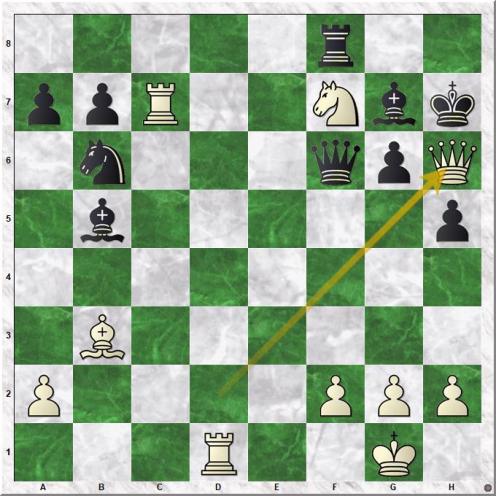
2..Bh6 3 Ng5++ Kh8[] 4 Rh7 mate.

FEN
Today’s problem is from the 1972 book “Chess Combination as a Fine Art”, a book based on articles published in the 1950s-1960s by Kurt Richter.
Since the start of 2018, I have decided to adopt the style of only saying which side is to play: and not giving an idea if the move wins or otherwise, unless on occasion I think signposting would be helpful. Instead, the problems are posed with the instruction to decide what you would play, as in a game.
White to play: evaluate 1 Qb7, as played in the game (but don’t take too much time on this problem, for reasons discussed)

Furman v Viatcheslav Osnos, Leningrad 1964
Solution
1 Qb7 a6 2 Rac1 Nd5 3 Nc3 Nf3+! and the double attack wins: Bh2+ or Qh4 win.
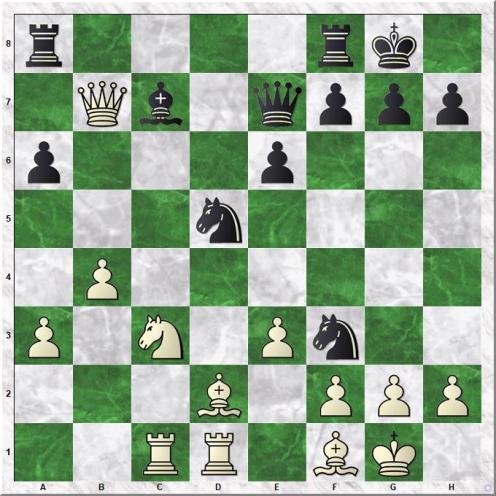
Alas, the position is cooked 2 g3 and White is fine; and 3 g3 or 3 Rc7, and again the game goes on.
FEN
r4rk1/ppb1qppp/4pn2/4n3/NP6/P3PQ2/3B1PPP/R2R1BK1 w – – 0 1
Today’s problem is from the 1972 book “Chess Combination as a Fine Art”, a book based on articles published in the 1950s-1960s by Kurt Richter.
Since the start of 2018, I have decided to adopt the style of only saying which side is to play: and not giving an idea if the move wins or otherwise, unless on occasion I think signposting would be helpful. Instead, the problems are posed with the instruction to decide what you would play, as in a game.
Black to play (not a problem to spend much time on today, for reasons in the solution)
Zamora v G Garcia, place/date unknown

Solution
I quickly found 1…Bd4, and ‘knew’ it was the solution. And Komodo gives it as -4. But it gives -9 to 1…Ba6 and if 2 Ra6 Bc3, running amok on the Black squares.
So cooked.

Having said the above, in the further time taken to write up the post, Komodo has given both moves as -7. Who knows what AlphaZero would assess the position as? -100%, I presume.
FEN
2b3k1/5pbp/Bn4p1/2q5/2p2P2/R1P1r3/5QPP/R5K1 b – – 0 1
Today’s problem is from the 1972 book “Chess Combination as a Fine Art”, a book based on articles published in the 1950s-1960s by Kurt Richter.
Since the start of 2018, I have decided to adopt the style of only saying which side is to play: and not giving an idea if the move wins or otherwise, unless on occasion I think signposting would be helpful. Instead, the problems are posed with the instruction to decide what you would play, as in a game.
White to play: evaluate 1 Qd6, as played in the game
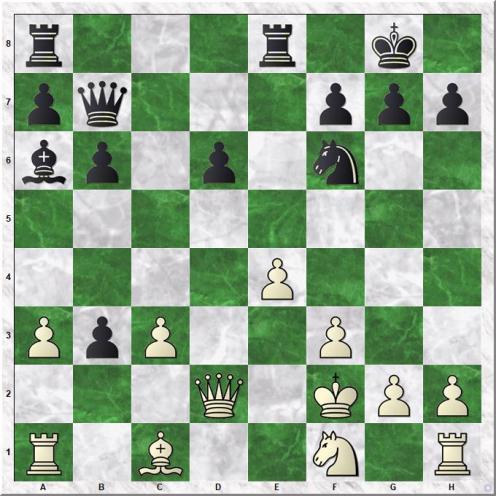
Z Valdes v H Sta Cruz, place/date unknown
Solution
1 Qd6? was a mistake, met by 1…Qe4! with a knight fork if 2 fe. But 2 Ne3 is then met by a potassium cyanide fork 2…b2! and the game is over.
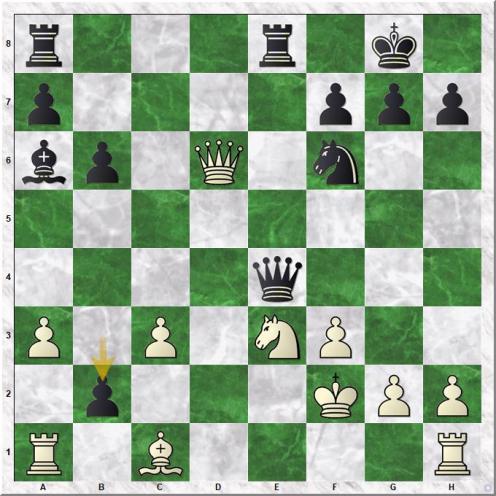
FEN
r3r1k1/pq3ppp/bp1p1n2/8/4P3/PpP2P2/3Q1KPP/R1B2N1R w – – 0 1
Today’s problem is from some of my own analysis of AlphaZero v Stockfish, as I read through Matthew Sadler’s and Natasha Regan’s gold mine of a book, Game Changer.
Since the start of 2018, I have decided to adopt the style of only saying which side is to play: and not giving an idea if the move wins or otherwise, unless on occasion I think signposting would be helpful. Instead, the problems are posed with the instruction to decide what you would play, as in a game.
Black to play: examine 1…fe 2 Rc7 Rd8 3 Rg7+ Kf8[]

variation from AlphaZero v Stockfish, London 2018
Solution

Here, White has an only move: not the obvious 4 Qc7, due to 4….Qd1+ and 5….Qg4+ with perpetual; but 4 Qg3!!; and not 4…Qg4, say.
Why? Because from g3 the Q eyes g6, but also- and what I didn’t see- I chose 4 Qg4- it also eyes Qa3, switching the sides of the attack.

Instead, 1…Qd7 and the game goes on.
FEN
r5kr/p2q1p2/1p2pPp1/3p4/P2P1Q1P/8/1P3P2/2R1R1K1 b – – 0 29
Today’s problem is from the 1972 book “Chess Combination as a Fine Art”, a book based on articles published in the 1950s-1960s by Kurt Richter.
Since the start of 2018, I have decided to adopt the style of only saying which side is to play: and not giving an idea if the move wins or otherwise, unless on occasion I think signposting would be helpful. Instead, the problems are posed with the instruction to decide what you would play, as in a game.
Black to play: examine 1…Bc3 2 Qd3, as played in the game
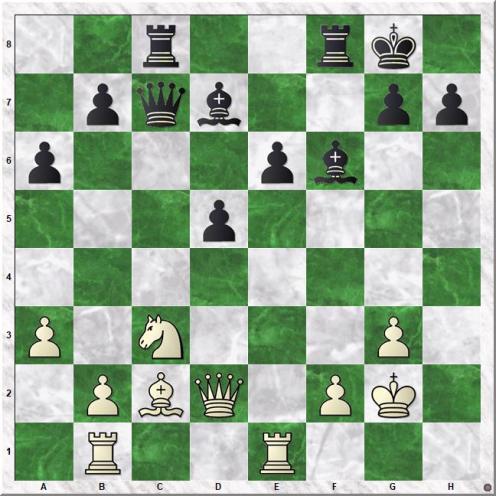
Castellanos v Planas Cuba 1965
Solution
2 Qd3? is a mistake, albeit in a lost position: 2…Rf2+! and if 3 Kf2 Be1+ and 4…Qc2
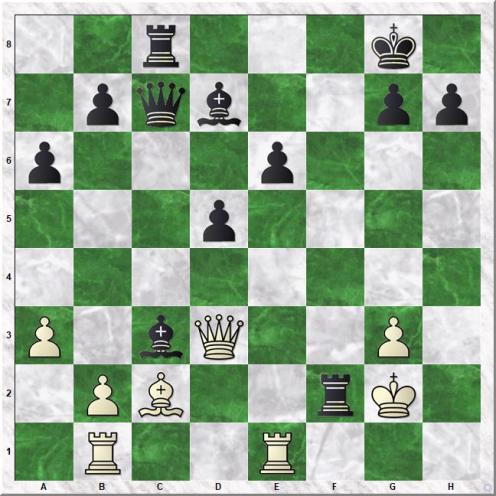
Having said the above, Komodo thinks 1…Be1 is just as good, the Black king finding safe harbour on d8.
FEN
2r2rk1/1pqb2pp/p3pb2/3p4/8/P1N3P1/1PBQ1PK1/1R2R3 b – – 0 1
 allanbeardsworth