Today’s problem is from the 1972 book “Chess Combination as a Fine Art”, a book based on articles published in the 1950s-1960s by Kurt Richter.
Since the start of 2018, I have decided to adopt the style of only saying which side is to play: and not giving an idea if the move wins or otherwise, unless on occasion I think signposting would be helpful. Instead, the problems are posed with the instruction to decide what you would play, as in a game.
White to play

Orega v Valdes, date unknown
Solution
1 Nf7! Kf7[] 2 Be3! double attack, hitting the Qc5 and Ph7, and White mops up,

FEN
r1br2k1/p3bp1p/4p1pB/1pqnN3/8/P2B3Q/1PP2PPP/3RR1K1 w – – 0 1
Today’s problem is from the 1972 book “Chess Combination as a Fine Art”, a book based on articles published in the 1950s-1960s by Kurt Richter.
Since the start of 2018, I have decided to adopt the style of only saying which side is to play: and not giving an idea if the move wins or otherwise, unless on occasion I think signposting would be helpful. Instead, the problems are posed with the instruction to decide what you would play, as in a game.
White to play
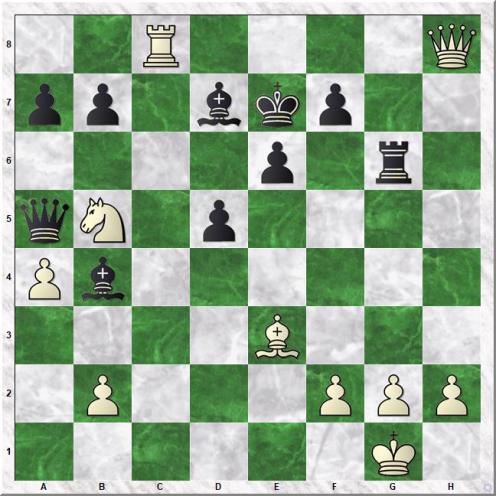
Tal v a.n. other, USSR 1964
Solution
I missed Tal’s beautiful solution, but found a more prosaic one which Komodo says is just as good: 1 Qf8+ Kf6[] 2 Bd4+ and check, check, check and 1-0.
But 1 Bb6!!
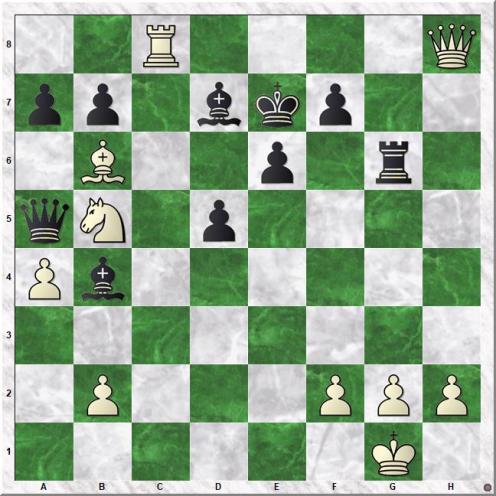
1…ab 2 Qd8 mate;
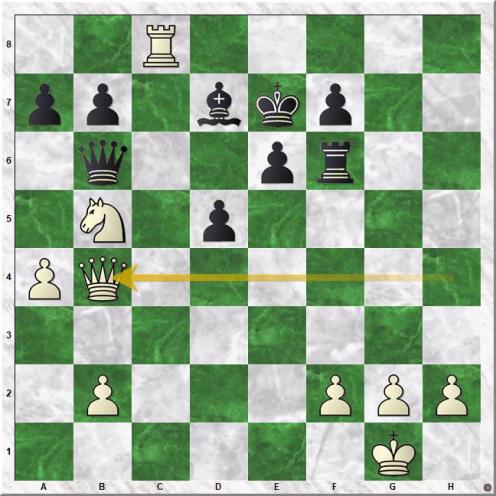
1…Qb6 2 Qh4+ Rf6 (2…f6 3 Qh7+ ) 3 Qb4+! and mates: 1…Qb6 removes the Black Queen’s protection of the Bb4.
FEN
2R4Q/pp1bkp2/4p1r1/qN1p4/Pb6/4B3/1P3PPP/6K1 w – – 0 1
Today’s problem is from the 1972 book “Chess Combination as a Fine Art”, a book based on articles published in the 1950s-1960s by Kurt Richter.
Since the start of 2018, I have decided to adopt the style of only saying which side is to play: and not giving an idea if the move wins or otherwise, unless on occasion I think signposting would be helpful. Instead, the problems are posed with the instruction to decide what you would play, as in a game.
White to play : examine 1 Rb5 fg, as played

Hanninen v a.n.other, simul Helsinki 1957
Solution
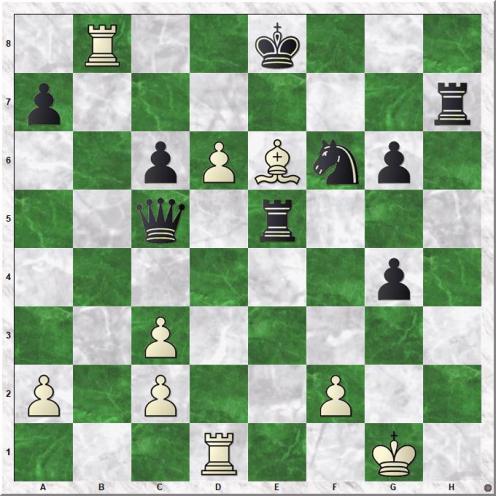
1 Rb5! fg 2 Qf6+!!
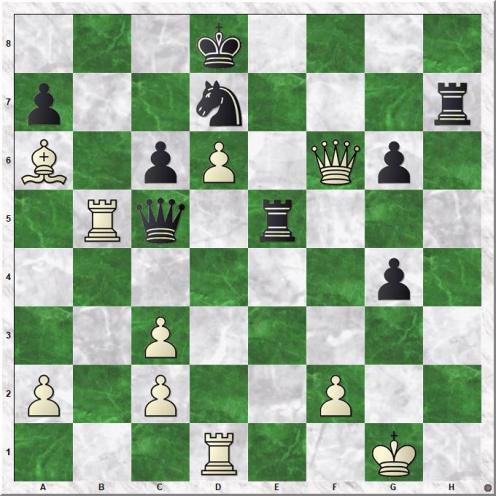
and if 2…Nf6 then 3 Rb8+ Kd7 4 Bc8+ and 5 Be6 mate.
FEN
3k4/p2n3r/B1pP2p1/2q1rp2/6P1/2P2Q2/P1P2P2/1R1R2K1 w – – 0 1

Wei Yi v Bruzon Batista, Danzhou 3/7/2015
Today’s problem is from the 1972 book “Chess Combination as a Fine Art”, a book based on articles published in the 1950s-1960s by Kurt Richter.
Since the start of 2018, I have decided to adopt the style of only saying which side is to play: and not giving an idea if the move wins or otherwise, unless on occasion I think signposting would be helpful. Instead, the problems are posed with the instruction to decide what you would play, as in a game.
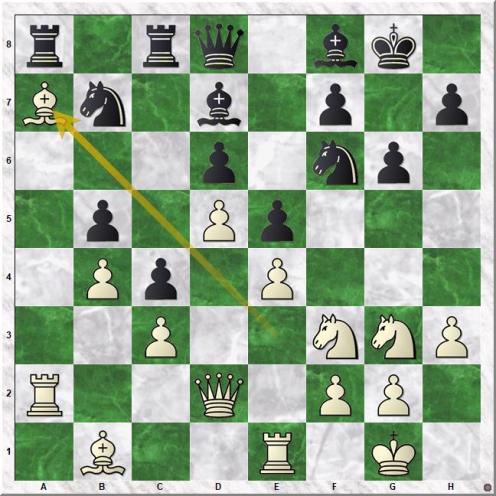
White to play: examine 1 Rd6 Rf6 2 Rd8+ Rf8 1/2-1/2, as played in the game

Ivanov v Dimitrov Sofia 1957
Solution
Alas, White missed 1 Qh8+! (or 3 Qh8+, or even 2 Qh8+) mating.

FEN
3R1rk1/p5p1/1p4q1/n4pN1/7Q/2p4P/2P2P2/6K1 w – – 0 1
Today’s problem is from the 1972 book “Chess Combination as a Fine Art”, a book based on articles published in the 1950s-1960s by Kurt Richter.
Since the start of 2018, I have decided to adopt the style of only saying which side is to play: and not giving an idea if the move wins or otherwise, unless on occasion I think signposting would be helpful. Instead, the problems are posed with the instruction to decide what you would play, as in a game.
White to play

Portisch v Bergerm Amsterdam 19.6.1964
Solution
1 Nh7! Kh7[] 2 Rh5+ Kg7[] (2…Kg8 3 Qg6 mate) 3 Be5+ f6 4 Rg5! 1-0

FEN
r1bn1rk1/pp3p1p/6p1/2bR2N1/2B2B2/q1P1P3/2Q2PPP/4K2R w K – 0 16
Today’s problem is from the 1972 book “Chess Combination as a Fine Art”, a book based on articles published in the 1950s-1960s by Kurt Richter.
Since the start of 2018, I have decided to adopt the style of only saying which side is to play: and not giving an idea if the move wins or otherwise, unless on occasion I think signposting would be helpful. Instead, the problems are posed with the instruction to decide what you would play, as in a game.
White to play

Sisigin v Camzirajem, Kizila 1960
Solution
1 Nd5 Bd5 (1…Bf6 2 Qh2 Qh8[] 3 Nf6 and 4 Qh6+) 2 f6+!

A key zwischenschach: White prevents the closing of the diagonal b1-h7.
2…Bf6[] 3 ed[] Qd7 4 Rh6!
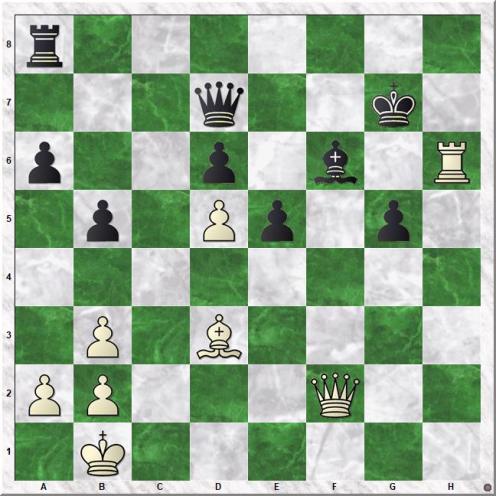
and if the Rh6 is captured, 5 Qh2+ 6 Qh7+ picks up the queen.
However, all this shows is that 3…Qd7?? is a blunder: 3…Qe7! and the game goes on. 4 Qf5 e4! 5 Be4 Re8 6 Qg6+ Kf8 7 Qh6+ Qg7 8 Bf3 say, and Black is for choice. So the problem is cooked.
FEN
r2q4/1b2b1k1/p2p3p/1p2pPp1/4P3/1PNB4/PP3Q2/1K5R w – – 0 1
 allanbeardsworth