Today’s problem is from the 1972 book “Chess Combination as a Fine Art”, a book based on articles published in the 1950s-1960s by Kurt Richter.
Since the start of 2018, I have decided to adopt the style of only saying which side is to play: and not giving an idea if the move wins or otherwise, unless on occasion I think signposting would be helpful. Instead, the problems are posed with the instruction to decide what you would play, as in a game.
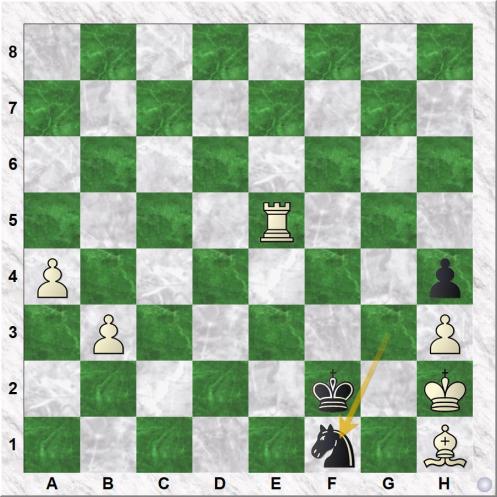
White to play: examine 1 Re5+, as played in the game

Batuyev v Simagin, Riga 1954
Solution
1 Re5+?? loses ( 1 Ra8 instead) after 2…Kf2 and White’s king is in a mating net.
If say 2 a4 then 2…Rh1+! 3 Bh1[] Nf1 mate.
FEN
8/8/8/R7/7p/1P2k1nP/P5BK/3r4 w – – 0 1
Today’s problem is from the 1972 book “Chess Combination as a Fine Art”, a book based on articles published in the 1950s-1960s by Kurt Richter.
Since the start of 2018, I have decided to adopt the style of only saying which side is to play: and not giving an idea if the move wins or otherwise, unless on occasion I think signposting would be helpful. Instead, the problems are posed with the instruction to decide what you would play, as in a game.
White to play
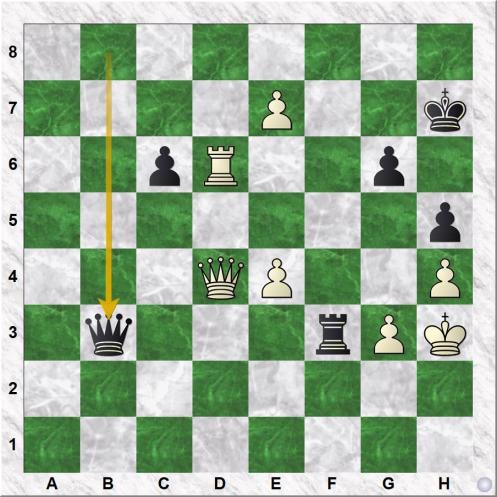
Simagin v Furman. Sochi 1961
Solution
Simagin played 1 Qh8+ and won a long game. Instead,
1 Rg6! would have concluded the game immediately: it protects g3, and if 1…Kg6, 2 e8(Q)+ queens with check.
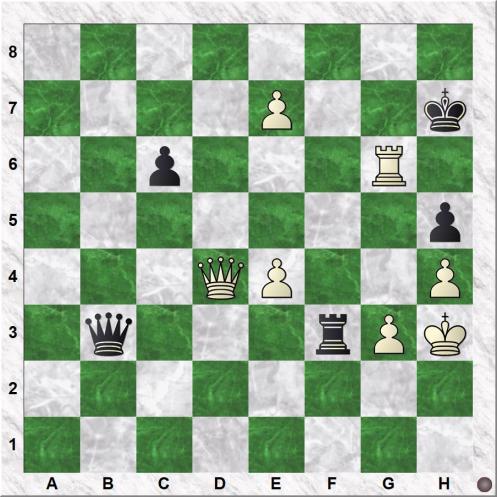
1 Qe5 is also a prosaic way to win. If then 1…Qc4 (eyeing f1) then 1 Rd1; and if 1…Qb1 (eyeing f1 and h1) then now 2 Qh8+! wins.
FEN
6k1/2p5/1p1p4/3P2Pb/r1P5/P1RKP1R1/1Q6/5r1q b – – 0 1
Today’s problem is from the 1972 book “Chess Combination as a Fine Art”, a book based on articles published in the 1950s-1960s by Kurt Richter.
Since the start of 2018, I have decided to adopt the style of only saying which side is to play: and not giving an idea if the move wins or otherwise, unless on occasion I think signposting would be helpful. Instead, the problems are posed with the instruction to decide what you would play, as in a game.
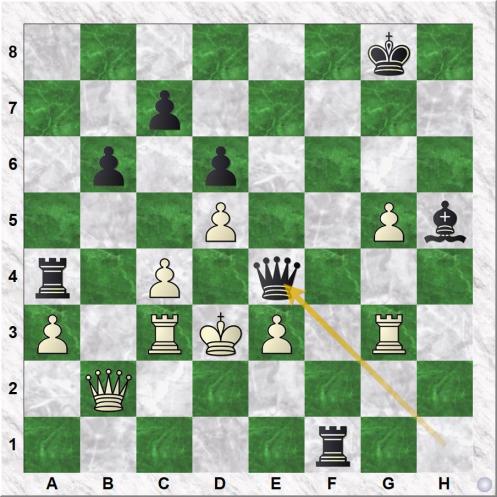
Black to play

Bagdasarov v Bronstein, USSR 1961
Solution
1…Qe4+!! is the pretty way Bronstein concluded the game. White’s king is drawn into a mating net.
FEN
6k1/2p5/1p1p4/3P2Pb/r1P5/P1RKP1R1/1Q6/5r1q b – – 0 1
; Today’s problem is from the current Gibraltar tournament. The posting, written 29/1/19, was mid-play, before the game was finished
Since the start of 2018, I have decided to adopt the style of only saying which side is to play: and not giving an idea if the move wins or otherwise, unless on occasion I think signposting would be helpful. Instead, the problems are posed with the instruction to decide what you would play, as in a game.
White to play: examine 1 Re6, as played in the game
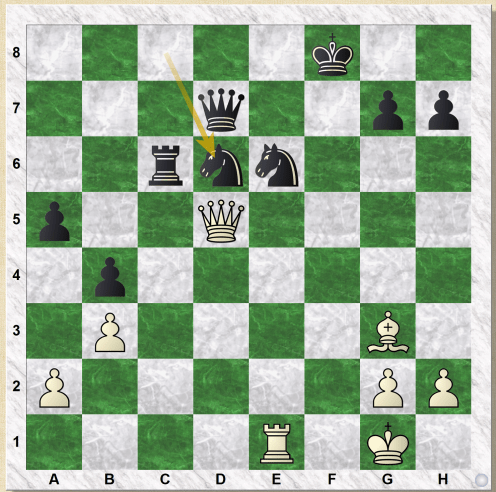
Tari v Sadzikowski, Gibraltar 29/1/19
Solution
1 Re6?? was a mistake (1 h3, for instance) but Black missed 1…Ne4! and the game is over. Black wins the exchange.
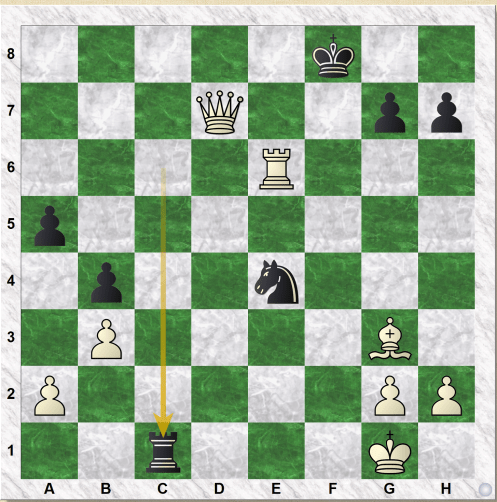
Instead, the game went on; at the time of writing this blog, some days before publication, the game hadn’t finished.
Today’s problem is from the 1972 book “Chess Combination as a Fine Art”, a book based on articles published in the 1950s-1960s by Kurt Richter.
Since the start of 2018, I have decided to adopt the style of only saying which side is to play: and not giving an idea if the move wins or otherwise, unless on occasion I think signposting would be helpful. Instead, the problems are posed with the instruction to decide what you would play, as in a game.
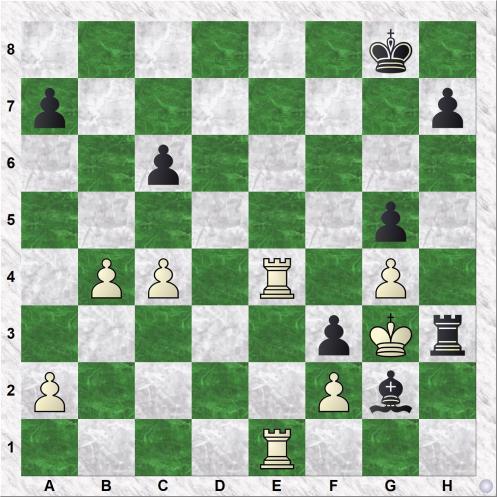
Black to play: in the game, 1…Rc5?? was played: what should he have played instead?

Ott v Bozdoghina, 1962
Solution
1…R (either) e6 forces mate on h3 or h1.
FEN
4r1k1/p6p/2p5/2N1r1p1/1PP1p1P1/4Rp2/P4PbK/4R3 b – – 0 1
Today’s problem is from the 1972 book “Chess Combination as a Fine Art”, a book based on articles published in the 1950s-1960s by Kurt Richter.
Since the start of 2018, I have decided to adopt the style of only saying which side is to play: and not giving an idea if the move wins or otherwise, unless on occasion I think signposting would be helpful. Instead, the problems are posed with the instruction to decide what you would play, as in a game.
Black to play: examine 1..Rc5, as played in the game
Ott v Bozdoghina, 1962
Solution
1…Rc5?? loses: 2 Re4 and after rooks are exchanged, the Rc5 is trapped.

FEN
4r1k1/p6p/2p5/2N1r1p1/1PP1p1P1/4Rp2/P4PbK/4R3 b – – 0 1
Another position from ‘Chess Combination as a Fine Art’ by Keres. Today’s blog is affected by my PC having failed and needing repair or replacement, so is in different format to normal. How long it will be before it returns to normal format will be dependent on if the PC can be returned to good health.
White to move and win
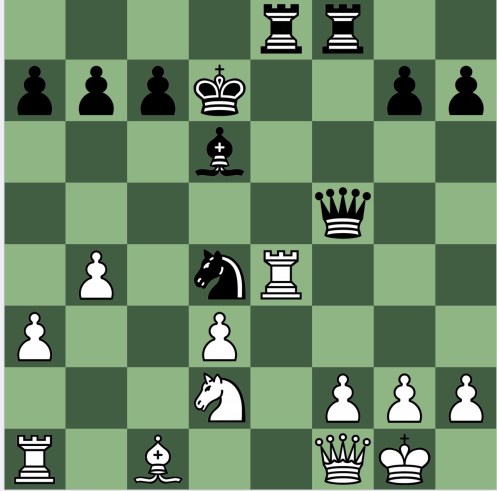
Matz v Schumann, Ottawa 1962
Solution
1…Bh2+ and after 2 Kh2, 2…Qh5+ and 3…Re4. After White recaptures, 4…Ne2+ wins the house.

FEN
No FEN whilst this problem persists. Sorry.
Another position from ‘Chess Combination as a Fine Art’ by Keres. Today’s blog is affected by my PC having failed and needing repair or replacement, so is in different format to normal. How long it will be before it returns to normal format will be dependent on if the PC can be returned to good health.
Examine 1…Kh7, as played in the game.
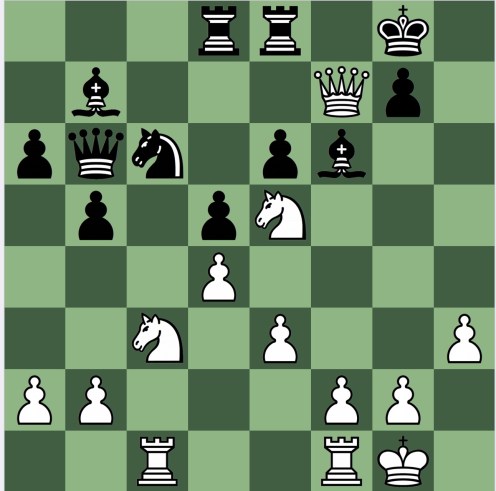
Akimov v Zelenka, Ukraine 1964
Solution
1…Kh7? was a mistake, met by 2 Nd7! and the fork on the Qb6 and Bf6 is decisive, the Pg7 being pinned by the Q to the K, so the Bf6 is LPDO.
If 2…Rd7 then 3 Qe8+! first: 3…Kh7 and then 4 Qd7.
FEN
No FEN whilst this problem persists. Sorry.
Another position from ‘Chess Combination as a Fine Art’ by Keres. Today’s blog is affected by my PC having failed and needing repair or replacement, so is in different format to normal. How long it will be before it returns to normal format will be dependent on if the PC can be returned to good health.
White to move and win

Drescher v Hauser, Frankfurt-on-Main, 1923
Solution
In the game, White played 1 Bd6, which Keres thought was best, the point being that if 1..Qd6 then 2 Qh5+! Kg8[] 3 Qe8 mate (and not merely 2 Qe8+ which just wins, but not mate so quickly).
But 1… Nf5 and Black is lost after 2 Qh5+ Nh6 3 Nd7+ winning the Queen.
Instead, 1 Qh5+! Kg8 and only now 2 Bd6! mates.

Position after 2 Bd6
FEN
No FEN whilst this problem persists. Sorry.
Another position from ‘Chess Combination as a Fine Art’ by Keres. Today’s blog is affected by my PC having failed and needing repair or replacement, so is in different format to normal. How long it will be before it returns to normal format will be dependent on if the PC can be returned to good health.
Examine 1…Rfe8, as played in the game

Asimov v Zelenka, Ukraine 1964
Solution
1…Rfe8? was a mistake (1…g6 was necessary) permitting the Greek Bishop sacrifice. It hardly needs calculating, it being easy to see that White has at least a draw: a platform where one can rest one’s mind and either decide to delve in before playing 1 Bf6, or wait until the position arises: 1…Bf6 2 Bh7+ Kh7 3 Qh5+ Kg8[] 4 Qf7+

I will conclude the analysis tomorrow.
FEN
No FEN whilst this problem persists. Sorry.
 allanbeardsworth