Today’s problem is from the 1972 book “Chess Combination as a Fine Art”, a book based on articles published in the 1950s-1960s by Kurt Richter.
Since the start of 2018, I have decided to adopt the style of only saying which side is to play: and not giving an idea if the move wins or otherwise, unless on occasion I think signposting would be helpful. Instead, the problems are posed with the instruction to decide what you would play, as in a game.
White to play: examine 1 Rb8 Ra2. as played in the game

Wehnert v Liess, Savnitz 1962
Solution
1 Rb8 Ra2??

2 Re1!! shades of Torre-Adams
2…Rd8 3 Qb5!! further shades of Torre-Adams

Black resigned, but 3…c6 4 Qb7!! completes the Torre-Adams mirror.

Note that Rg2+ desperadoes are always met by Kh1 and if then Rh2+ Kh2, and Black doesn’t have a perpetual.
FEN
4r1k1/2pq1ppp/3p4/1R1P4/1Q3P2/8/P3r1PP/5RK1 w – – 0 1
Today’s problem features my move of the year, or, rather, my concept of the year.
Since the start of 2018, I have decided to adopt the style of only saying which side is to play: and not giving an idea if the move wins or otherwise, unless on occasion I think signposting would be helpful. Instead, the problems are posed with the instruction to decide what you would play, as in a game.
White to play: devise a plan
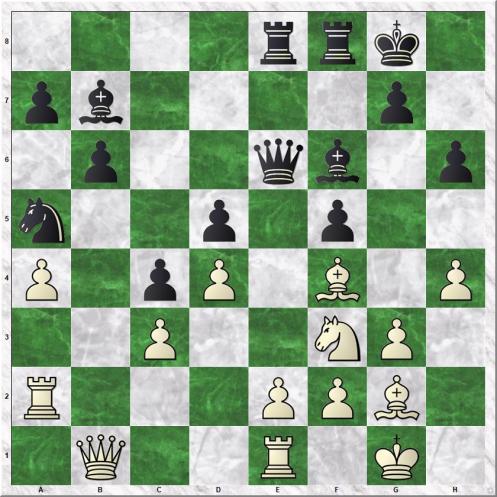
AlphaZero v Stockfish, 2018
Solution
Firstly, let’s go back a few moves:
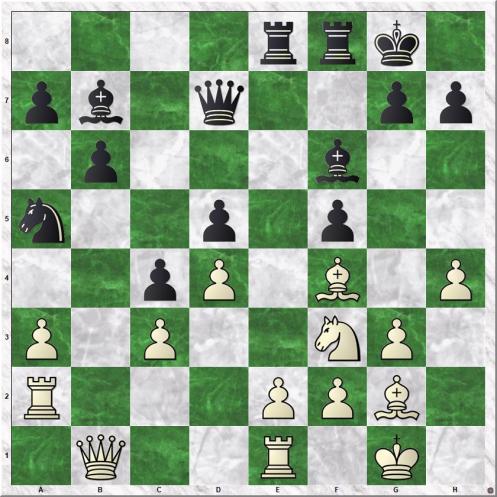
After White’s last move, 1 Ra2, Black played 1..h6 2 a4 Qe6 reaching the puzzle’s opening position.
White played the truly remarkable 3 Kh2!! Bc8 4 Rh1!! Nc6 5 h5! Kh8 6 Ng1!!
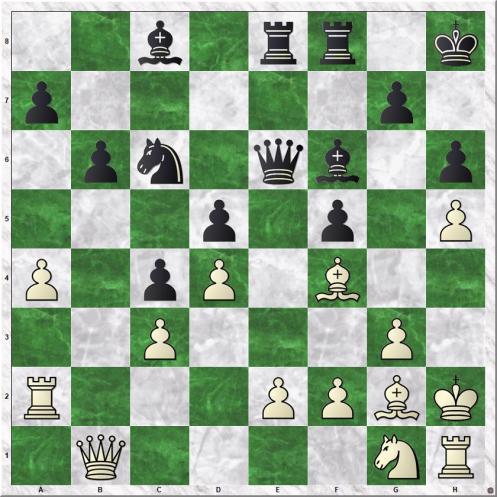
A joy to behold!
White’s moves all seem to have a purpose: Kh2 to vacate g1 for the N, Rh1 to protect the h5 pawn (Ra2 probably also has the idea of defending the Pe2, as well as being prophylactic against Nb3).
And the aim? To land a N on g6, a hole created by h6. Ng1-h3-f4-g6 beckons.
The whole game is remarkable .
The N actually lands on g6 and then moves off-on to the square three more times, all with a purpose.
A gif of the game is here, too; my first attempt at using the new feature in ChessBase 15.
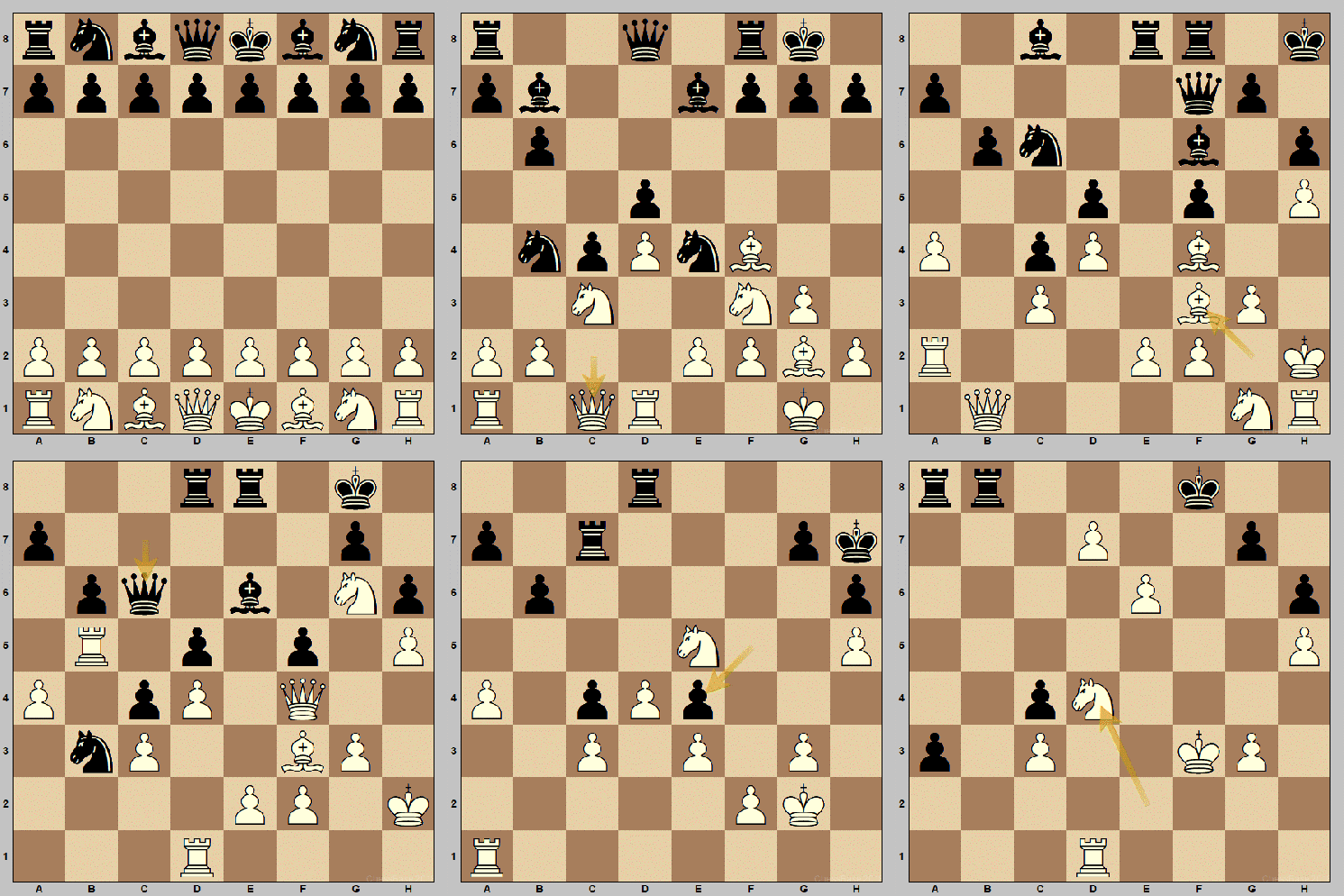
FEN
4rrk1/pb4p1/1p2qb1p/n2p1p2/P1pP1B1P/2P2NP1/R3PPB1/1Q2R1K1 w – – 0 24
Today’s problem is from the 1972 book “Chess Combination as a Fine Art”, a book based on articles published in the 1950s-1960s by Kurt Richter.
Since the start of 2018, I have decided to adopt the style of only saying which side is to play: and not giving an idea if the move wins or otherwise, unless on occasion I think signposting would be helpful. Instead, the problems are posed with the instruction to decide what you would play, as in a game.
White to play

Olsson v Puig, Varna Olympiad Preliminaries, 25/9/1962
Solution
Back a few days: I looked at 1 Re6! which Richter gave !!; but in fact deserves no exclam. White’s advantage reduces, and 1 g3! would have preserved more, though why is beyond me. 1…Qb6 2 Qb6 Rb6 3 f4 seems to be the main line.
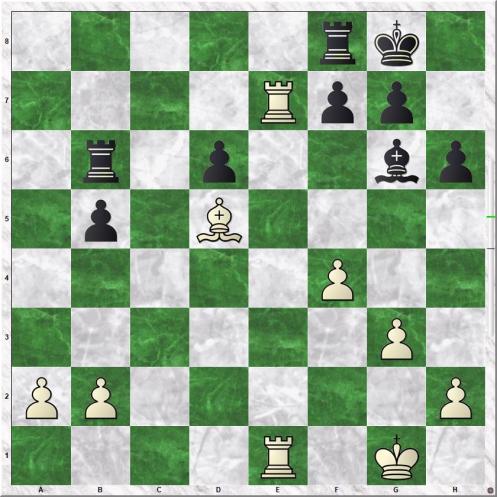
In fact, the whole position (covered in the last few days) is ripe for more explanation: and e.g. when h3 is best, and when g3 is best. Worth exploring.
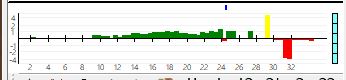
Here is the ChessBase15 graph of the game.
FEN
1r1q1rk1/Q3Rpp1/3p2bp/1p1B4/8/8/PP3PPP/4R1K1 w – – 0 25
Today’s problem is from the 1972 book “Chess Combination as a Fine Art”, a book based on articles published in the 1950s-1960s by Kurt Richter.
Since the start of 2018, I have decided to adopt the style of only saying which side is to play: and not giving an idea if the move wins or otherwise, unless on occasion I think signposting would be helpful. Instead, the problems are posed with the instruction to decide what you would play, as in a game.
White to play: compare 1 Re6 fe and 1 Re6 Rc8 2 h3 fe
Olsson v Puig, Varna Olympiad Preliminaries, 25/9/1962
Solution
(a) 1 Re6 fe?? loses to 2 Rg7+ Kh8[] 3 Rg6
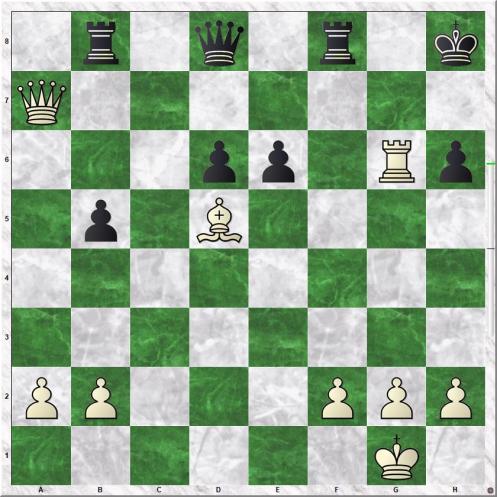
Black’s best is to lose his Q by playing 3…Qf6, since both 4 Qg7 mate and 4 Rh6+/5Qh7 mate were threatened.
(b) 1 …Rc8 2 h3 fe draws. 3 Rg7+ Kh8[] 5 Rg6 and now Black has 5…Qc7! spoiling White’s plans.
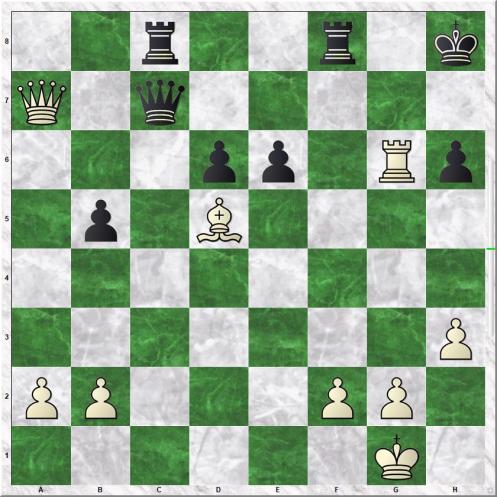
White’s best is perpetual check with Rh6+/Rg6+; or he could try Re6; if 6 Qd4+ e5 7 Qh4 then 7…Qc1+ and 8….Qf4+ and the Qs come off: the ending after a few pawns come off looks equal/unclear:

FEN
1r1q1rk1/Q3Rpp1/3p2bp/1p1B4/8/8/PP3PPP/4R1K1 w – – 0 25
Today’s problem is from the 1972 book “Chess Combination as a Fine Art”, a book based on articles published in the 1950s-1960s by Kurt Richter.
Since the start of 2018, I have decided to adopt the style of only saying which side is to play: and not giving an idea if the move wins or otherwise, unless on occasion I think signposting would be helpful. Instead, the problems are posed with the instruction to decide what you would play, as in a game.
White to play
Olsson v Puig, Varna Olympiad Preliminaries, 25/9/1962
Solution
1 R1e6! though the engine only gives the slightest advantage to White after the move played in the game, 1…Rc8.
Then 2 h3 (my engine drops to 0.0 here) Rc5 2 Bb3 Kh8??

3 Rg6! and 1-0/
FEN
1r1q1rk1/Q3Rpp1/3p2bp/1p1B4/8/8/PP3PPP/4R1K1 w – – 0 25
Today’s problem is from the 1972 book “Chess Combination as a Fine Art”, a book based on articles published in the 1950s-1960s by Kurt Richter.
Since the start of 2018, I have decided to adopt the style of only saying which side is to play: and not giving an idea if the move wins or otherwise, unless on occasion I think signposting would be helpful. Instead, the problems are posed with the instruction to decide what you would play, as in a game.
Black to play
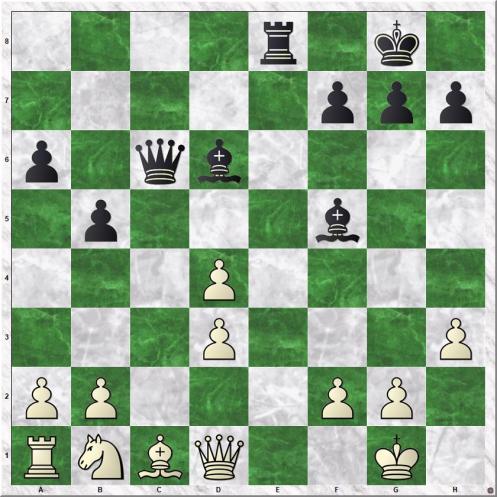
Safvat v Zwaig, Varna Olympiad 5/10/1962
Solution
1… Qc2! 2 Qd2 Re2!! and wins a piece and the game.
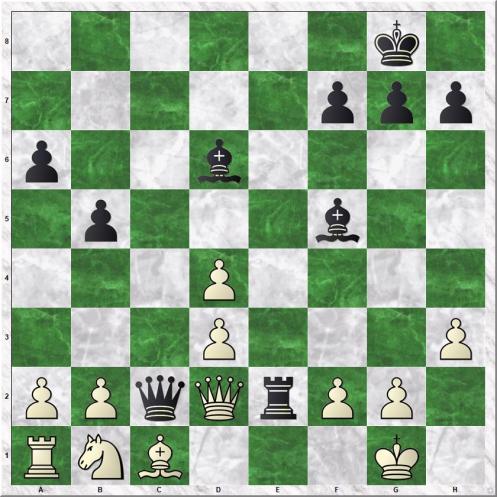
FEN
4r1k1/5ppp/p1qb4/1p3b2/3P4/3P3P/PP3PP1/RNBQ2K1 b – – 0 21
Today’s problem is from the 1972 book “Chess Combination as a Fine Art”, a book based on articles published in the 1950s-1960s by Kurt Richter.
Since the start of 2018, I have decided to adopt the style of only saying which side is to play: and not giving an idea if the move wins or otherwise, unless on occasion I think signposting would be helpful. Instead, the problems are posed with the instruction to decide what you would play, as in a game.
White to play, after 1…Qh6, yesterday’s puzzle
Examine why 2 Re8+ is equal (or at least, lets the game go on)
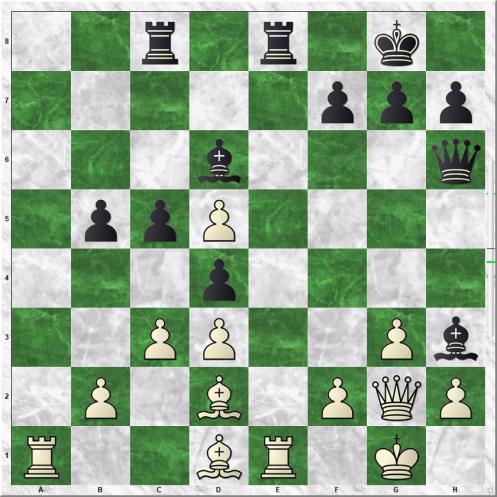
Montell v Serrano, Spain 1962
Solution
2 Re8+ Re8 3 cd Qd2 4 Qh3 Re1+ 5 Kg2[] and I saw that after 5..Rd1 6 Qc8+ Black had Bd6-f8 and no back rank mate.
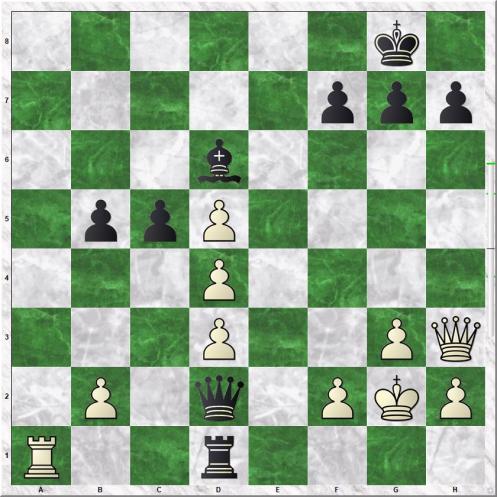
However, examine one move further: the Black Q and R aren’t coordinated, there are no good checks, so 6 Qc8+ Bf8 7 Ra8! changes the picture.
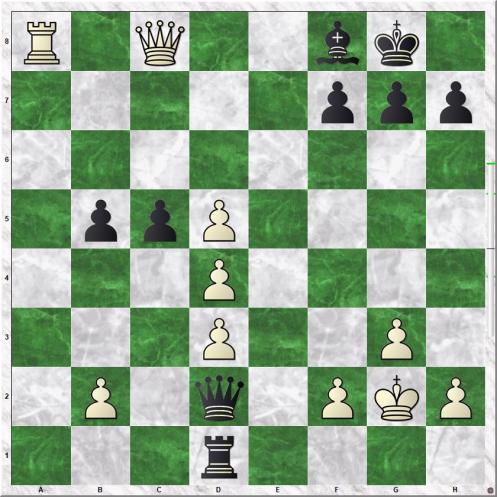
White wins.
So 5…Rd1?? would have been a blunder, hence it is level
FEN
2r1r1k1/5ppp/3b3q/1ppP4/3p4/2PP2Pb/1P1B1PQP/R2BR1K1 w – – 0 2
Today’s problem is from the 1972 book “Chess Combination as a Fine Art”, a book based on articles published in the 1950s-1960s by Kurt Richter.
Since the start of 2018, I have decided to adopt the style of only saying which side is to play: and not giving an idea if the move wins or otherwise, unless on occasion I think signposting would be helpful. Instead, the problems are posed with the instruction to decide what you would play, as in a game.
Black to play
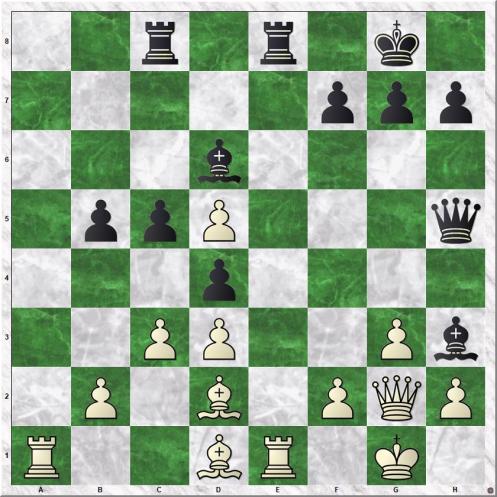
Montell v Serrano, Spain 1962
Solution
1… Qh6! wins at least a piece: the Bd2 is LPDO: or so I thought, and so did Kurt Richter.
But 2 Re8+! Re8 3 cd is equal, as is 2 Re2!!, the latter because the Rc8 is LPDO after 2..Re2 3 Be2 Qd2 4 Qh3, so White escapes.
FEN
2r1r1k1/5ppp/3b4/1ppP3q/3p4/2PP2Pb/1P1B1PQP/R2BR1K1 b – – 0 1
Today’s problem is from the 1972 book “Chess Combination as a Fine Art”, a book based on articles published in the 1950s-1960s by Kurt Richter.
Since the start of 2018, I have decided to adopt the style of only saying which side is to play: and not giving an idea if the move wins or otherwise, unless on occasion I think signposting would be helpful. Instead, the problems are posed with the instruction to decide what you would play, as in a game.
Today’s puzzle from Kurt Richter’s book was played in South Africa, so I correctly recalled I had seen it before, when working through one of my books on South African chess. So please look at:
https://allanbeardsworth.com/2015/06/27/its-your-move-daily-chess-puzzle-32/

Today’s problem is from the 1972 book “Chess Combination as a Fine Art”, a book based on articles published in the 1950s-1960s by Kurt Richter.
Since the start of 2018, I have decided to adopt the style of only saying which side is to play: and not giving an idea if the move wins or otherwise, unless on occasion I think signposting would be helpful. Instead, the problems are posed with the instruction to decide what you would play, as in a game.
White to play, after 1 R7e5 Qe5 2 Qa7! Qd6 from the last two days

Denes v Faur, Arpad 1966
Solution
1 Qa1!! is the only move that wins, but does so, convincingly.

1…Qc5 2 Kg2 and there is no good way to stop 3 Qc1 mating.


The Queen march: Alphazero would be proud
FEN
7r/Q7/1r1q2p1/1p1p4/2p2kPP/2P2P2/1P3K2/4R3 w – – 0 3
 allanbeardsworth