Today’s problem is from the 1972 book “Chess Combination as a Fine Art”, a book based on articles published in the 1950s-1960s by Kurt Richter.
Since the start of 2018, I have decided to adopt the style of only saying which side is to play: and not giving an idea if the move wins or otherwise, unless on occasion I think signposting would be helpful. Instead, the problems are posed with the instruction to decide what you would play, as in a game.
White to play: after 1 R7e5 Qe5 from yesterday’s problem

Denes v Faur, Arpad 1966
Solution
1 Qa7!! Qf6 2 g5! and either the Rb6 drops, or Qf7+ and mates/wins.

Tomorrow I will look at the move played in the game, 1…Qd6
FEN
7r/p6Q/1r4p1/1p1pq3/2p2kPP/2P2P2/1P3K2/4R3 w – – 0 2
Today’s problem is from the 1972 book “Chess Combination as a Fine Art”, a book based on articles published in the 1950s-1960s by Kurt Richter.
Since the start of 2018, I have decided to adopt the style of only saying which side is to play: and not giving an idea if the move wins or otherwise, unless on occasion I think signposting would be helpful. Instead, the problems are posed with the instruction to decide what you would play, as in a game.
White to play

Denes v Faur, Arpad 1966
Solution
1 R7e5!
so that if 1…Rh7?? 2 Re4+ de[] 3 Re4 mate.

Tomorrow we will look at what happened after 1…Qe5, as played in the game.
FEN
7r/p3R2Q/1r3qp1/1p1pp3/2p2kPP/2P2P2/1P3K2/4R3 w – – 0 1
Today’s problem is from the 1972 book “Chess Combination as a Fine Art”, a book based on articles published in the 1950s-1960s by Kurt Richter.
Since the start of 2018, I have decided to adopt the style of only saying which side is to play: and not giving an idea if the move wins or otherwise, unless on occasion I think signposting would be helpful. Instead, the problems are posed with the instruction to decide what you would play, as in a game.
White to play

Perez Perez v Ivkov, Havana 20/5/1962
Solution
Megabase says 0-1 in this position, due to the threatened R8g2 mate.
My book says White played 1 Be4! fe 2 Rd6+ Ke7 3 Re6+! and a draw was agreed, since Black can’t avoid the stalemates.
My engine says 1 Be4 Ke7! with ever so slight advantage to Black.
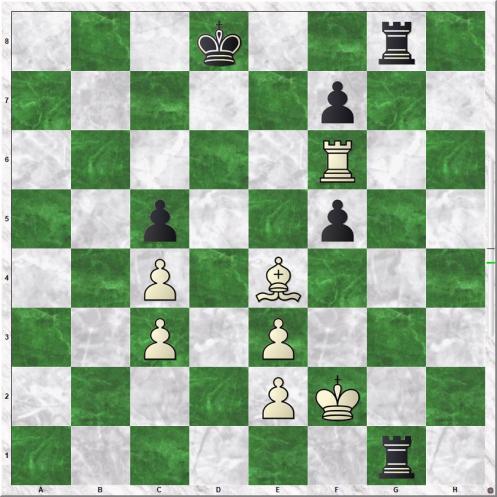
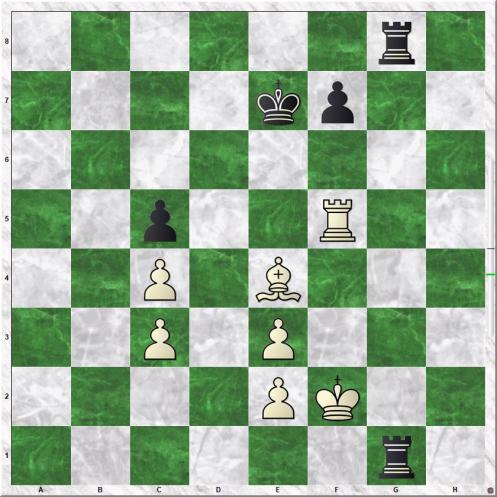
Deep Fritz gives this as -1; I wouldn’t be confident in my ability to exploit this advantage if I were Black.
I wonder which of Megabase and the book is correct? From the source below, it looks like Megabase is correct.

FEN
3k2r1/5p2/5R2/2pB1p2/2P1p3/2P1P3/4PK2/6r1 w – – 0 37
Today’s problem was posted on Twitter by Mikhail Golubev.
Since the start of 2018, I have decided to adopt the style of only saying which side is to play: and not giving an idea if the move wins or otherwise, unless on occasion I think signposting would be helpful. Instead, the problems are posed with the instruction to decide what you would play, as in a game.
“an easy chess puzzle”
“mate in three – from my internet blitz game”
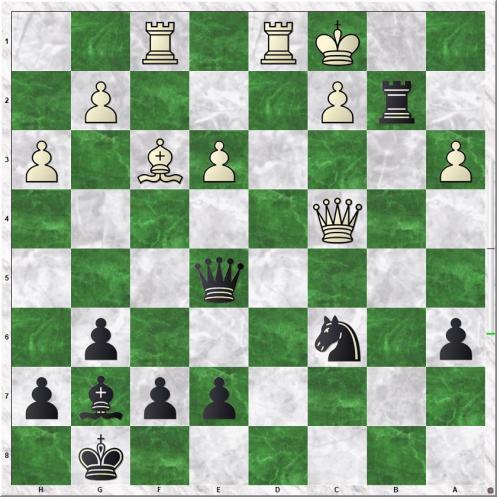
posted on Twitter, diagram as above, November 29th 2018
Solution
After failing to make 1…Rb1+; 1…Qe3+; and many other tries work, in what was obviously a Sicilian Dragon by Golubev; and even knowing that it had to be check, check, mate because White can check and avoid a mate in three; I paused for a moment to look at White’s threats:
1 Qf7+! Kf7 (1…Kh8 2 Qe8+ and 3 Qf8 mate) 2 Bd5++ Ke8 3 Bc8 mate.
It is mate in three, but for White.
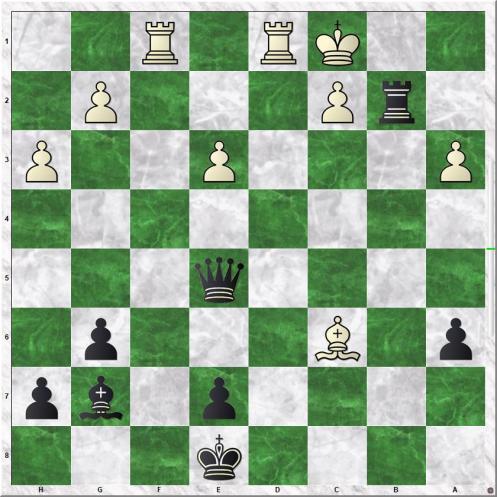
A trick by Mikhail Golubev; one where the smile exceeded the annoyance.
FEN
6k1/4ppbp/p1n3p1/4q3/2Q5/P3PB1P/1rP3P1/2KR1R2 b – – 0 1
Today’s problem is from the 1972 book “Chess Combination as a Fine Art”, a book based on articles published in the 1950s-1960s by Kurt Richter.
Since the start of 2018, I have decided to adopt the style of only saying which side is to play: and not giving an idea if the move wins or otherwise, unless on occasion I think signposting would be helpful. Instead, the problems are posed with the instruction to decide what you would play, as in a game.
White to play
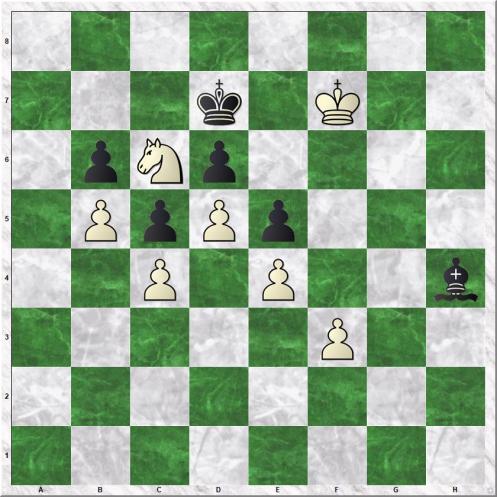
Ekburg v Martius, Copenhagen 1962
Solution
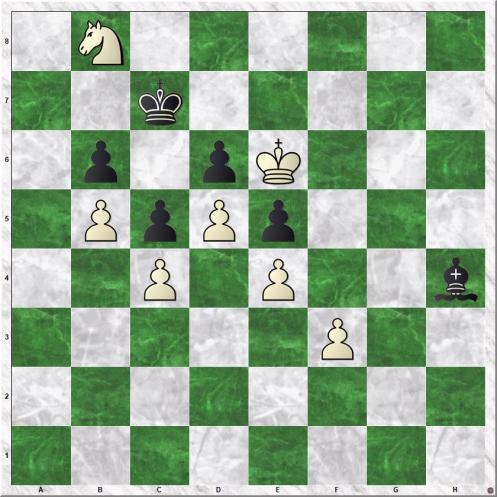
1 Nb8+ Kc7 2 Ke6! and White mops up two pawns for the N, following which he has three connected passed pawns: 1-0.
FEN
8/3k1K2/1pNp4/1PpPp3/2P1P2b/5P2/8/8 w – – 0 1
Today’s problem is from the 1972 book “Chess Combination as a Fine Art”, a book based on articles published in the 1950s-1960s by Kurt Richter.
Since the start of 2018, I have decided to adopt the style of only saying which side is to play: and not giving an idea if the move wins or otherwise, unless on occasion I think signposting would be helpful. Instead, the problems are posed with the instruction to decide what you would play, as in a game.
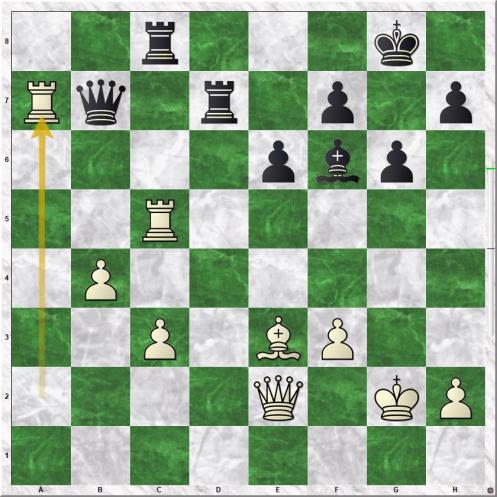
Black to play: analyse 1…Rc8, as played in the game

Solution
1..Rc8?? was a mistake: 2 Ra7! wins at least the Rd7, if not more. Alas, White missed the opportunity, and eventually lost the game.
FEN
1r4k1/1q1r1p1p/4pbp1/2R5/1P6/2P1BP2/R3Q1KP/8 b – – 0 32
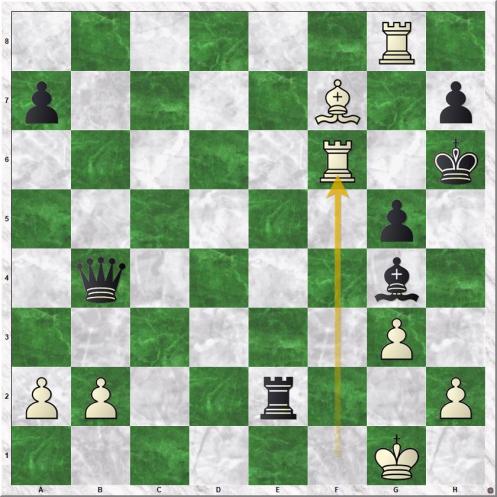
Today’s problem is from the 1972 book “Chess Combination as a Fine Art”, a book based on articles published in the 1950s-1960s by Kurt Richter.
Since the start of 2018, I have decided to adopt the style of only saying which side is to play: and not giving an idea if the move wins or otherwise, unless on occasion I think signposting would be helpful. Instead, the problems are posed with the instruction to decide what you would play, as in a game.
White to play
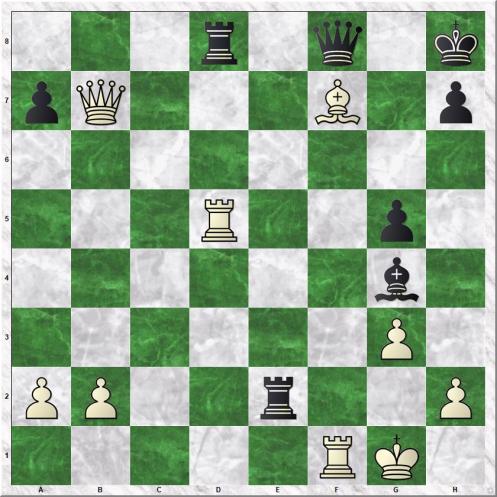
Bloussenko v Pugachov, corres 1966-68
Solution
1Qb4!! exploits the fact that the Qf8 and Rd8 are tied to each other; that the Bg4 is LPDO; and the threat of Qc3+. The result: 1-0.
If 1…Qb4, then 2 Rd8+ Kg7 3 Rg8+ Kh6[] 4 Rf6 mate.
FEN
3r1q1k/pQ3B1p/8/3R2p1/6b1/6P1/PP2r2P/5RK1 w – – 0 0
Today’s problem is from the 1972 book “Chess Combination as a Fine Art”, a book based on articles published in the 1950s-1960s by Kurt Richter.
Since the start of 2018, I have decided to adopt the style of only saying which side is to play: and not giving an idea if the move wins or otherwise, unless on occasion I think signposting would be helpful. Instead, the problems are posed with the instruction to decide what you would play, as in a game.
Black to play
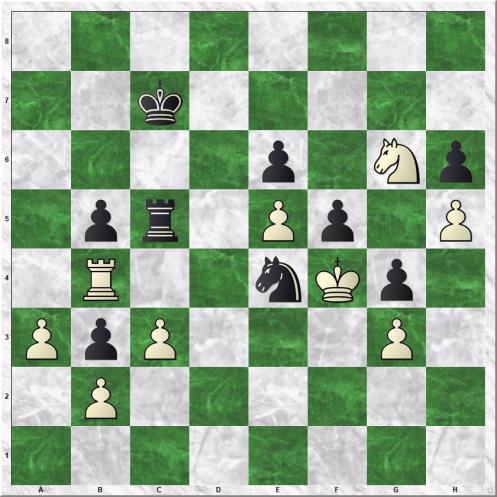
Ventura v Neu, corres 1968-69
Solution
1… Nc3!! and the threat of 2 …Nd5 mate wins the exchange.

FEN
8/2k5/4p1Np/1pr1Pp1P/1R2nKp1/PpP3P1/1P6/8 w – – 0 0
Today’s problem is from the 1972 book “Chess Combination as a Fine Art”, a book based on articles published in the 1950s-1960s by Kurt Richter.
Since the start of 2018, I have decided to adopt the style of only saying which side is to play: and not giving an idea if the move wins or otherwise, unless on occasion I think signposting would be helpful. Instead, the problems are posed with the instruction to decide what you would play, as in a game.
White to play

Jukcenko v Michalek, Czechoslovakia 1969
Solution
1 Rd8! and 1-0; Black collapses.

FEN
4r1k1/pbq2rp1/4QnN1/1pb3Np/5B1P/2P5/PP3P2/2KR3R w – – 0 1
Today’s problem is another game between Bent Larsen and Heinz Lehmann, two players who featured in a recent puzzle taken from the 1972 book “Chess Combination as a Fine Art”, a book based on articles published in the 1950s-1960s by Kurt Richter. One of the pleasures of writing this blog, and using Megabase to find the games, is to learn more about different players, or see new games.
Today, having not long ago upgraded to Chessbase 15 (first impressions: some nice changes), and with its superb Instant Analysis graph, it is easy to see if games might be “interesting” or what their key moments are.
Today’s puzzle is having seen the red dip at move 33.

Since the start of 2018, I have decided to adopt the style of only saying which side is to play: and not giving an idea if the move wins or otherwise, unless on occasion I think signposting would be helpful. Instead, the problems are posed with the instruction to decide what you would play, as in a game.
Quite nicely, this game took place 50 years ago today
White to play: played 1 Kf3: what should Black have done?

Larsen v Lehmann, Palma de Mallorca 7 December 1968
Solution
1 Kf3? was a mistake; Black played 1…Kf6, and the game was eventually drawn, but 1…Ra6! rounds up the Pf2.
2 Kf4?? loses to 2…Rf2+ and 3….Rf5 mate, so all White can do is retreat, 2 Kg2 Rf6 3 Ra4

3…Rff2+ 4 Kg1 Rg2+ 5 Kh1 Rh2+ 6 Kg1[] Rbg2+ 7 Kf1

and Black is winning.
FEN
8/2R2pk1/6p1/r2p3p/p2P3P/R3P1P1/1r3PK1/8 w – – 0 34
 allanbeardsworth